GRATIS KUNSTADVIES

x

1855 - 1907

Kerngegevens

  • Works on APS: 37
  • Museums on APS:
    • Inter-American Development Bank
    • Inter-American Development Bank
    • Inter-American Development Bank
    • Inter-American Development Bank
    • Inter-American Development Bank
  • Top-ranked work: Casita al Mar
  • Lifespan: 52 years
  • Nationality: Spain
  • Top 3 works:
    • Casita al Mar
    • Spanish Landscape
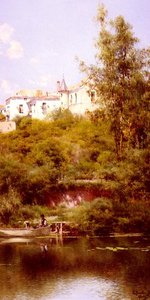
    • On The River Bank
  • Meer…
  • Copyright status: Public domain
  • Born: 1855, Seville, Spain
  • Creative periods: mature period
  • Died: 1907
  • Art period: 19th Century

Kunstquiz

Er is slechts één correct antwoord op elke vraag.

Vraag 1:
In which Spanish city was Emilio Sánchez Perrier born?
Vraag 2:
Which artist significantly influenced Sánchez Perrier's style, particularly his use of vibrant colors and detail?
Vraag 3:
Besides Spain, which city became a frequent subject in Sánchez Perrier's paintings?
Vraag 4:
Sánchez Perrier studied at the studios of several artists in Paris. Which of these was NOT one of them?
Vraag 5:
What artistic movement is Sánchez Perrier's work often associated with, alongside the Barbizon School?

A Life Painted in Light: The World of Emilio Sánchez Perrier

Emilio Sánchez Perrier, born in the vibrant heart of Seville in 1855, was an artist destined to capture the ephemeral beauty of light and atmosphere. His journey began not with a brush in hand, but amidst the precise workings of his father’s clockmaking shop. Yet, even within the meticulous world of gears and springs, a creative spirit stirred, leading him toward formal training at the School of Fine Arts in Seville and later, Madrid. These formative years laid a solid foundation, instilling in him a dedication to technique that would become a hallmark of his style. However, it was a pivotal encounter with Mariano Fortuny in Granada in 1871 that truly ignited his artistic vision. Fortuny’s influence – a vibrant palette and an acute attention to detail – became deeply embedded within Perrier's evolving aesthetic. This early mentorship proved crucial, shaping the direction of his career as he embraced landscape painting and watercolor with increasing passion.

Parisian Horizons and Artistic Refinement

The allure of Paris beckoned in 1879, offering Sánchez Perrier a gateway to new artistic horizons. He immersed himself in the studios of Auguste Bolard, Jean-Léon Gérôme, and Félix Ziem, each master contributing uniquely to his development. Studying under these diverse influences broadened his perspective, solidifying his commitment to landscape painting while exposing him to varied approaches to composition and technique. The Barbizon school’s emphasis on direct observation of nature resonated deeply, as did the luminous quality found in Ziem's work. These Parisian experiences weren’t merely about acquiring skills; they were about absorbing a spirit – a dedication to capturing the fleeting moments of light and atmosphere that define a place. He painted *en plein air* around Fontainebleau and Barbizon, honing his ability to translate the natural world onto canvas with remarkable fidelity.

Venice, Andalusia, and the Essence of Place

Sánchez Perrier’s artistic voice truly blossomed as he began to focus on specific locales – Venice and Andalusia. He became particularly celebrated for his evocative depictions of Venice, capturing not just its architectural grandeur but also its unique charm and romantic ambiance. His paintings transport viewers to the canals and palazzi, bathed in a soft, ethereal light. Simultaneously, he remained deeply connected to his Andalusian roots, portraying the landscapes and everyday life of southern Spain with equal skill and sensitivity. Works like *Triana* (1889) offer captivating glimpses into Seville’s neighborhoods, while *Bank of the Guadaira with boat* (c. 1890) exemplifies the serene beauty of the Andalusian countryside. His style is a compelling blend of realism and impressionistic sensibility; he doesn't merely record what he sees but evokes a feeling, an atmosphere that lingers in the mind long after viewing his work. He masterfully balanced detailed observation with a poetic interpretation of light and color.

Legacy and Lasting Influence

Emilio Sánchez Perrier’s contributions to Spanish landscape painting are significant, though perhaps not as widely recognized as some of his contemporaries. His work reflects the artistic currents of the late 19th century – the influence of the Barbizon School, a touch of Orientalism gleaned from his Parisian studies, and a uniquely Spanish sensibility rooted in his Andalusian heritage. He successfully captured the essence of both Andalusian life and the allure of Venice, creating a body of work that continues to resonate with audiences today. His paintings offer a glimpse into a bygone era, demonstrating a remarkable talent for capturing not only physical beauty but also the spirit of a place. Even now, his works – like *Winter in Andalusia (poplars and sheep at Alcalá de Guadaira)* housed in the Museo Carmen Thyssen, Málaga – stand as testaments to his skill and vision. Sánchez Perrier passed away in 1907, leaving behind a legacy of evocative landscapes that continue to inspire and captivate art lovers worldwide. His paintings are not simply representations of places; they are invitations to experience them anew, through the eyes of an artist who understood the power of light, color, and atmosphere.