Desmond Turner: Bridging Tradition and Vision
Desmond Turner (1923–2011) was a British watercolorist whose artistic spirit resided in the breathtaking landscapes of Ireland, particularly coastal vistas and tranquil rural cottages. His creative journey commenced at Derrylane Lough, Connemara—a scene unmistakably imbued with the dramatic grandeur characteristic of J.M.W. Turner’s oeuvre. This initial undertaking solidified an aesthetic foundation rooted in meticulous observation and atmospheric rendering, mirroring Turner's masterful manipulation of light and color to convey emotion and sublime beauty.
Early Life & Artistic Training
Born in Dublin in 1923, Turner embarked upon formal artistic education at Slade School of Fine Art in London—a formative experience that honed his watercolor technique under the guidance of esteemed instructors. This grounding in classical art principles would prove instrumental in shaping his subsequent artistic endeavors. His fascination with landscape painting blossomed early on, fueled by a deep appreciation for the Romantic movement and its championing of imagination and emotional expression.
Turner’s Influences: The Legacy of J.M.W. Turner
Turner's artistic sensibilities were profoundly molded by the towering figure of Joseph Mallard William Turner—whose pioneering exploration of sublime landscapes served as an unwavering beacon for Turner’s own compositional pursuits. Turner recognized in Turner’s work a profound understanding of how to capture the essence of nature—translating its grandeur into visual form with unparalleled sensitivity and artistic prowess. The artist's preoccupation with atmospheric perspective and tonal harmony reflected Turner’s unwavering commitment to conveying emotion through color and light—a stylistic hallmark that distinguished him from his contemporaries.
Turner’s Oeuvre: Coastal Scenes & Rural Idyllicality
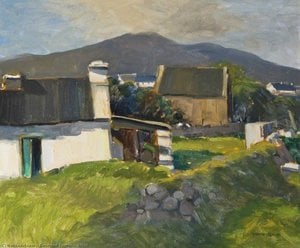
Turner’s artistic output extended beyond Connemara, encompassing evocative depictions of Achill Island and the charming Keel Cottages. Each painting embodies Turner-esque qualities—precise detail interwoven with expressive brushwork that breathes life into the canvases with palpable atmosphere. The cottages in Keel exemplify Turner's ability to portray domestic interiors with understated elegance—illuminated by soft light and rendered with remarkable attention to texture and form. These works underscore Turner’s dedication to capturing not merely visual appearances but also the soul of Irish rural existence—a testament to his artistic vision and enduring legacy.
Technique & Artistic Style
Turner's watercolor technique involved layering washes of color to achieve luminous effects—a method that prioritized tonal harmony and atmospheric depth. He meticulously blended hues to create subtle gradations—a hallmark of Turner’s stylistic approach that distinguished him from other artists of his time. His masterful use of glazing—applying thin translucent layers of pigment over previous washes—allowed him to build up complex textures and imbue the canvases with a sense of luminosity—a technique directly inherited from Turner's artistic predecessors.
Recognition & Legacy
Turner’s paintings garnered considerable acclaim during his lifetime, appearing in prestigious exhibitions at Tate Britain and Yale Center for British Art—institutions that celebrated his contribution to the revival of watercolor painting as a medium. His work was lauded for its artistic integrity and its ability to inspire contemplation—a testament to Turner's enduring influence on subsequent generations of artists. Desmond Turner’s legacy extends beyond individual artworks; he represents a pivotal figure in the resurgence of Romantic landscape painting—a movement that championed imagination, emotion, and an appreciation for the sublime.