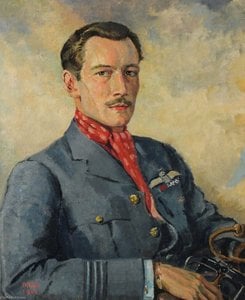
Cuthbert Orde, 1888 – 1968

Schilderijen van Cuthbert Orde: De 21 beroemdste werken, gerangschikt

Het beroemdste schilderij van Cuthbert Orde is John George Charles Henry Alton Alexander Chetwynd, 21st Earl of Shrewsbury and Waterford (1914–1980) (1937). Met One of the Few, 1956 en Air Marshal Sir Peter Drummond (1894–1945), KCB, MC, OBE, DSO wordt de trilogie van de drie werken die iedereen herkent voltooid. Onze catalogus bevat 21 werken van Cuthbert Orde; de 21 hieronder zijn de werken die de wereld het meest bekijkt, elk met het jaartal, het museum waar het zich bevindt en de reden waarom het belangrijk is.

Gerangschikt op basis van onze populariteitsscore, die de zoekopdrachten, bezoeken en bestellingen voor elk werk combineert. Bijgewerkt in november 2026.

Portret van Cuthbert Orde
Cuthbert Orde · 1888 – 1968
Geboren · overleden
1888 – 1968
Stroming
Contemporary realism
Werken in onze catalogus
21
Meest bekend
John George Charles Henry Alton Alexander Chetwynd, 21st Earl of Shrewsbury and Waterford (1914–1980) (1937)
Meeste werken in
National Trust

De 10 beroemdste schilderijen van Cuthbert Orde

John George Charles Henry Alton Alexander Chetwynd, 21st Earl of Shrewsbury and Waterford (1914–1980) (1937) door Cuthbert Orde
1

John George Charles Henry Alton Alexander Chetwynd, 21st Earl of Shrewsbury and Waterford (1914–1980)

1937 · Oil

The painting depicts a man positioned centrally against a heavy, draped curtain. He is dressed in a formal suit and wears a crown upon his head. His right hand holds a cigarette, with a thin trail of smoke rising from it. The subject's gaze is directed toward the viewer. In the background, several other figures are visible, though they remain secondary to the primary subject. The composition is structured around…

Cuthbert Orde, schilderijen 11 tot 21

De onderwerpen die Cuthbert Orde het meest schilderde

De vier onderwerpen die het meest voorkomen in deze meesterwerken, met van elk het mooiste voorbeeld.

Waar u de schilderijen van Cuthbert Orde kunt bekijken

Het museum met de meeste schilderijen op deze pagina.

Museum Stad Werken van Cuthbert Orde Schilderijen uit deze lijst
National Trust, Spring HillNational Trust Spring Hill 1 Laura Lenox Conyngham (b.1907), Mrs Robert Alexander

De beroemdste schilderijen van Cuthbert Orde, jaar voor jaar

Van 1931 tot 1945 beslaat de carrière van Cuthbert Orde 15 jaar, iets meer dan een decennium: hier is het jaar voor jaar, met de beroemdste schilderijen van elk jaar.

  1. 1931
  2. 1934
  3. 1936
  4. 1937
  5. 1940
  6. 1940
  7. 1940
  8. 1940
  9. 1940
  10. 1940
  11. 1940
  12. 1940
    Sir Winston Churchill (1874-1965) (1940) door Cuthbert Orde
    Rang 21 / 21

    Sir Winston Churchill (1874-1965)

    Leeftijd 52

    The painting Sir Winston Churchill (1874-1965) by Cuthbert Julian Orde is a masterpiece that captures the essence of one of history's most iconic figures. Created in 1940, this…

  13. 1941
  14. 1941
  15. 1941
  16. 1941
  17. 1941
  18. 1943
  19. 1945

Vragen over de schilderijen van Cuthbert Orde

Wat is het beroemdste schilderij van Cuthbert Orde?Toon het antwoord

John George Charles Henry Alton Alexander Chetwynd, 21st Earl of Shrewsbury and Waterford (1914–1980) (1937). Daarna volgen One of the Few, 1956 en Air Marshal Sir Peter Drummond (1894–1945), KCB, MC, OBE, DSO.

Hoe oud was Cuthbert Orde toen John George Charles Henry Alton Alexander Chetwynd, 21st Earl of Shrewsbury and Waterford (1914–1980) werd geschilderd?Toon het antwoord

49 jaar oud: John George Charles Henry Alton Alexander Chetwynd, 21st Earl of Shrewsbury and Waterford (1914–1980) dateert uit 1937 en Cuthbert Orde werd geboren in 1888.

Wat zijn de top 10 schilderijen van Cuthbert Orde?Toon het antwoord

John George Charles Henry Alton Alexander Chetwynd, 21st Earl of Shrewsbury and Waterford (1914–1980), One of the Few, 1956, Air Marshal Sir Peter Drummond (1894–1945), KCB, MC, OBE, DSO, Wing Commander Augustus Henry Orlebar (1897–1943), AFC, Field Marshal Sir William Robertson (1860–1933), Commandant, Staff College (1910–1913), Marquis of Londonderry, KG, PC, MVO, Group Captain F. V. Beamish, Bombing up a Wellington, Wireless Station at RAF Dishforth en Bomb Store. De bovenstaande ranglijst vermeldt het jaar en het museum van elk werk.

Hoeveel schilderijen heeft Cuthbert Orde gemaakt?Toon het antwoord

Onze catalogus bevat 21 werken van Cuthbert Orde, gedateerd van 1931 tot 1945.

Waar zijn de beroemdste schilderijen van Cuthbert Orde?Toon het antwoord

De meeste bevinden zich in National Trust (Spring Hill). De bovenstaande tabel somt de musea één voor één op.

Wanneer schilderde Cuthbert Orde de beroemdste werken?Toon het antwoord

In 1940: 8 van de 21 werken op deze pagina dateren uit die periode, waaronder Bombing up a Wellington.

Wat zijn de vroegste en de meest recente beroemde schilderijen van Cuthbert Orde?Toon het antwoord

De oudste op deze pagina is Wing Commander Augustus Henry Orlebar (1897–1943), AFC (1931), de nieuwste Air Marshal Sir Hugh P. Lloyd (1894–1981), KBE, CB, MC, DFC (1945).

Wat schilderde Cuthbert Orde het vaakst?Toon het antwoord

Military art (2), Portraiture (2) en British history (2), van de 21 werken op deze pagina.

Bij welke kunststroming behoort Cuthbert Orde?Toon het antwoord

Contemporary realism, zoals de schilderijen op deze pagina laten zien.

Over Cuthbert Orde

The Sky as a Canvas: The Life and Legacy of Cuthbert Julian Orde

In the annals of British art, few figures possess a biography as inextricably linked to the roar of engines and the scent of castor oil as Cuthbert Julian Orde. Born on 18 December 1888 in the coastal town of Great Yarmouth, Norfolk, Orde was a man whose artistic vision was forged in the very cockpit of history. He did not merely observe the dramatic shifts of the early twentieth century; he lived them, serving as a pilot in the Royal Flying Corps during the First World War. This dual identity—as both a combatant in the skies and a chronicler of the human spirit—allowed him to approach his subjects with an intimacy that few of his contemporaries could claim. His work transcends simple military documentation, offering instead a profound meditation on courage, duty, and the ephemeral beauty of flight.

Orde’s upbringing provided a foundation of classical refinement and deep-rooted tradition. Descended from a distinguished lineage, including the notable Major-General James Orde, he attended Framlingham College, where his early education fostered an appreciation for humanist ideals. This intellectual grounding would later manifest in his ability to imbue military portraits with a sense of dignity that moved beyond mere likeness. His marriage to Lady Eileen Wellesley, daughter of the 4th Duke of Wellington, further connected him to the upper echelons of British society, providing him access to the very figures who would become his most significant subjects.

A Mastery of Light and Texture

The aesthetic language of Orde’s work is defined by a masterful command of atmospheric perspective. He possessed a rare ability to use subtle gradations of color and tonal variation to recreate the vast, often turbulent, expanses of the sky. To capture the kinetic energy of aviation and the weight of military tradition, he frequently employed impasto—a technique involving thick, textured brushstrokes laden with pigment. This method allowed him to convey the physical presence of his subjects and the visceral reality of the elements, from the heavy fabrics of flight suits to the swirling clouds of a battlefield.

His technical prowess was particularly evident in his portraiture. Orde did not merely paint faces; he painted characters. Whether capturing the commanding presence of Sir Winston Churchill or the stoic authority of Field Marshal Sir William Robertson, his brushwork served to highlight the psychological depth of his sitters. Through a careful balance of realism and expressive texture, he achieved a sense of heroic grandeur that remains palpable to the modern viewer. His portraits of RAF pilots, in particular, serve as a poignant tribute to the men of the Battle of Britain, capturing the essence of an era defined by aerial struggle.

Historical Significance and Enduring Influence

The historical importance of Cuthbert Julian Orde lies in his role as a pioneer of aviation art. At a time when flight was transitioning from a daring novelty to a decisive instrument of war, Orde provided the visual vocabulary for this new frontier. His ability to blend the technical realities of aeronautics with the emotional gravity of wartime portraiture created a unique niche in British art history. His work serves as both a historical record and an emotional bridge to the past, preserving the memory of the pilots and leaders who shaped the twentieth century.

Beyond his individual achievements, Orde’s legacy is felt in the way he elevated military illustration to the realm of fine art. His contributions can be summarized through several key pillars of his career:

  • The Documentation of Heroism: Through his meticulous portraits of Allied pilots, he immortalized the human element of the Battle of Britain and the Royal Flying Corps.
  • Technical Innovation: His use of impasto and atmospheric perspective brought a new level of dynamism to the genre of war art.
  • Cultural Connection: By bridging the gap between the aristocratic traditions of his family and the gritty reality of frontline service, he created a uniquely British narrative of duty and adventure.

Though he passed away on 19 December 1968, Orde’s canvases continue to resonate. They remain vital windows into an age of transition, where the boundaries of the earth were being pushed upward into the heavens, captured forever by a man who knew exactly what it felt like to fly through them.