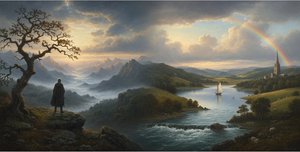
Een Eenzame Visie
Geboren in de Baltische havenstad Greifswald in 1774, werden de vroege jaren van Caspar David Friedrich gevormd door een diep gevoel van verlies. De dood van zijn moeder en broers wierp een lange schaduw over zijn jeugd, wat leidde tot een gevoeligheid voor sterfelijkheid die een centraal thema in zijn werk zou worden. Hij begon zijn opleiding onder zijn broer Christian, voordat hij kunst en theologie ging studeren aan de Universiteit van Leipzig. Hoewel hij geen van beide studies voltooide, zou deze dubbele interesse in het visuele en het spirituele zijn creatieve pad bepalen. Zijn technische vaardigheden werden verder verfijnd in Kopenhagen, waar hij in aanraking kwam met landschapstradities die hij uiteindelijk zou transformeren tot een medium om innerlijke emotionele staten uit te drukken.
Zijn benadering van het landschap bewoog zich weg van het minutieuze detail dat zijn voorgangers prefereerden. In plaats daarvan streefde hij ernaar de natuur te doordrenken met symbolische betekenis, waarbij hij natuurlijke elementen gebruikte om de menselijke ziel te representeren. Hij maakte vaak gebruik van Rückenfiguren—figuren die van achteren worden gezien—om de kijker uit te nodigen deel te nemen aan een contemplatieve ervaring. Zijn palet, vaak samengesteld uit gedempte blauwen, grijzen en bruinen, versterkte de sfeer van introspectie en plechtigheid die zijn oeuvre doordringt. Hij schilderde niet louter wat hij zag; hij schilderde het innerlijke weer van de menselijke geest.
De Taal van het Verhevene
Het werk van Friedrich benadrukt het verhevene, waarbij hij streeft naar een spirituele verbinding door de schaal van de natuurlijke wereld. Zijn composities plaatsen vaak eenzame figuren tegenover een uitgestrekt, vaak overweldigend landschap. In "Wanderer above the Sea of Fog" (ca. 1818) confronteert de silhouetachtige figuur een kolkende zee van mist, wat de spanning belichaamt tussen de menselijke aanwezigheid en het oneindige. "The Sea of Ice" (1824) presenteert een ijzige Arctische wildernis, een weergave van de immense kracht van de natuur en haar onverschilligheid tegenover het menselijk lot. Deze werken weerspiegelen een preoccupatie met de fragiliteit van het bestaan en de zoektocht naar betekenis binnen het landschap.
Zijn schilderijen maken vaak gebruik van specifieke elementen om deze innerlijke staten over te brengen:
- "The Abbey in the Oakwood" (1809-1810), waar een ruïne van een kerkhof en kale bomen wijzen op sterfelijkheid en spiritueel verval.
- "Chalk Cliffs on Rügen" (1818), dat atmosferisch licht gebruikt om de kustlijn te definiëren.
- "The Watzmann," een weergave van de majesteit van de bergen.
- "Evening Landscape with Two Men" (1830), een verstilde scène van contemplatie tijdens de schemering.
Nalatenschap en Herontdekking
De loopbaan van Friedrich kende geen gestage opmars. Hoewel hij tijdens zijn leven erkenning kreeg, nam zijn populariteit af naarmate de artistieke smaak verschoof naar andere stromingen. Hij stierf in Dresden in 1840, en voor een tijd verdween zijn naam uit de voorgrond van de kunstwereld. Zijn reputatie onderging een significante herontdekking in de late 20e eeuw, toen hij werd erkend als een centrale figuur in de Duitse Romantiek. Zijn nadruk op subjectieve ervaring en emotionele expressie plaveide de weg voor latere bewegingen, waaronder het Symbolisme en het Surrealisme.
Zijn invloed reikte tot kunstenaars die de innerlijke wereld wilden verkennen via visuele middelen. Door het rationalisme van de Verlichting te verwerpen ten gunste van emotie en verbeelding, legde hij de geest van een tijdperk vast. Zijn landschappen dienden als symbolen van nationale identiteit tijdens een periode van politieke fragmentatie in Duitsland. Vandaag de dag blijft zijn werk resoneren en herinnert het het publiek aan de diepe verbinding tussen de mensheid en de natuurlijke wereld.
Vraag en antwoord
Hoeveel kunstwerken van Caspar David Friedrich zijn beschikbaar om te bekijken?
U kunt 297 kunstwerken werken van Caspar David Friedrich bekijken op de Alle kunstwerken-pagina.
Waar zijn de kunstwerken van Caspar David Friedrich gegroepeerd per techniek te vinden?
Om alle werken van Caspar David Friedrich in een bepaald medium te vinden, kunt u de Alle technieken pagina van de kunstenaar gebruiken.
Hoe vind ik werken van Caspar David Friedrich in een specifiek kleurenpalet?
De werken van Caspar David Friedrich kunnen op basis van kleurpalet worden bekeken op de Op kleurpalet pagina van de kunstenaar.