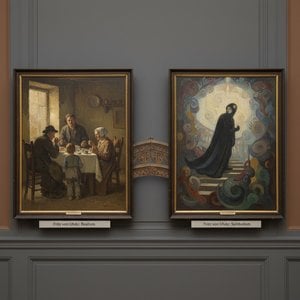
Carl Buchheister: A Pioneer of Constructivist Landscape Painting
Carl Buchheister (October 17, 1890 – February 2, 1964) emerged as a significant figure in German art during the turbulent years following World War I, establishing himself as one of the foremost practitioners of Constructivism—a revolutionary artistic movement that sought to liberate painting from representational illusionism and embrace geometric abstraction. Born in Hanover, Germany, Buchheister’s formative years coincided with the burgeoning intellectual ferment of Expressionism and Dada, shaping his artistic sensibilities and propelling him toward a distinctive visual language rooted in elemental forms and bold color palettes.- Early Influences: Like many artists of his time, Buchheister absorbed considerable inspiration from the landscapes of Edvard Munch and Friedrich Nietzsche, whose philosophical explorations mirrored the anxieties and uncertainties surrounding the postwar era. These influences instilled a preoccupation with psychological depth and emotional intensity—characteristics that would permeate his oeuvre throughout his career.
- Constructivist Principles: Embracing the tenets of Constructivism championed by artists like Wassily Kandinsky and Aleksandr Rodchenko, Buchheister rejected traditional perspective and tonal shading in favor of simplified geometric shapes arranged according to principles of balance and rhythm. He aimed to distill visual experience into its purest essence, prioritizing formal structure over detailed depiction.
- Notable Works: Buchheister’s artistic output comprises a series of striking landscape paintings—most notably “Composition Gowa,” “Composition Ursiem,” and “Composition Har”—that exemplify his Constructivist aesthetic. These canvases showcase monumental expanses of color punctuated by angular forms, conveying a sense of grandeur and immediacy that transcends mere visual observation.
Formal Innovation & Color Theory
Buchheister’s compositional strategies were meticulously crafted to evoke profound emotional responses in the viewer. He utilized techniques borrowed from photography—specifically the concept of “photographic illusion”—to create images that appeared to capture fleeting moments of atmospheric grandeur. His masterful manipulation of color—particularly hues derived from mineral pigments—further amplified the expressive power of his paintings. Analyzing geological formations and utilizing a palette informed by scientific observation, Buchheister sought to translate natural phenomena into visual metaphors for psychological states.- Geometric Abstraction: The artist’s canvases are dominated by large-scale geometric shapes—rectangles, triangles, and circles—arranged in harmonious configurations that prioritize spatial relationships over realistic representation.
- Mineral Pigments & Color Harmony: Buchheister meticulously selected mineral pigments—such as ultramarine blue and ochre—to achieve precise color matches and create visual compositions characterized by striking chromatic contrasts.
Legacy & Historical Significance
Carl Buchheister’s contribution to German art extends beyond his individual paintings; he served as a pivotal voice in advocating for Constructivism's role in shaping the artistic landscape of the Weimar Republic. His unwavering commitment to abstraction—coupled with his profound engagement with geological observation and psychological exploration—established him as a pioneer of a movement that anticipated many developments in postwar abstract expressionism. Buchheister’s work continues to resonate today, reminding us of the transformative potential of art to grapple with existential questions and convey visceral experiences.Further Exploration
For deeper insights into Carl Buchheister's artistic vision and his influence on subsequent generations of artists, consult resources such as Wikipedia (Vraag & Antwoord
Waar zijn de kunstwerken van Carl Buchheister gegroepeerd per kunststroming te vinden?
De stromingen waarin Carl Buchheister werkte, zijn te vinden op de Alle stromingen-pagina van de kunstenaar, waar de kunstwerken per stroming zijn gegroepeerd.
Is er een chronologisch overzicht van Carl Buchheister?
Een chronologisch overzicht van het werk van Carl Buchheister is beschikbaar op de Chronologie pagina van de kunstenaar, waar de kunstwerken in volgorde van creatie worden gepresenteerd, hoofdstuk voor hoofdstuk.
Waar komt Carl Buchheister vandaan?
Carl Buchheister werd geboren in Germany.