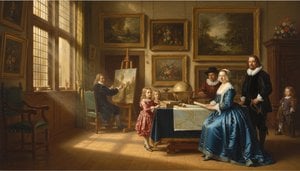
Bartholomeus Molenaer: A Painter of Everyday Life
Born circa 1618 in Haarlem, Netherlands, Bartholomeus Jansz. Molenaer emerged from a modest family lineage—Jan Mientsen Molenaer, a tailor, and Grietgen Adriaensdr.—creating an environment ripe for artistic cultivation. Like many artists of his era, he benefited from the familial tradition of painting; his brother Nicolaes Molenaer was already established as a landscape painter, shaping Bartholomeus’s formative years with invaluable exposure to artistic principles and practices. The Guild of St. Luke in Haarlem recognized this talent early on, granting him membership in 1640 – marking a pivotal step toward securing his professional future and aligning him with the influential artistic community of Haarlem.Family Background and Early Artistic Training
The Molenaer household instilled in Bartholomeus a deep appreciation for visual arts from childhood. Nicolaes Molenaer’s landscape paintings served as an important model, fostering within Bartholomeus a keen observational eye and a foundational understanding of artistic technique. This familial encouragement combined with the Guild’s recognition solidified his trajectory toward becoming a respected artist—a crucial element in establishing his career amidst Haarlem's vibrant artistic milieu.Style and Technique: Shadows and Domestic Interiors
Molenaer’s distinctive artistic style distinguished him from contemporaries preoccupied with grand narratives. Instead, he dedicated himself to capturing scenes of ordinary life – peasants engaged in activities like playing kolf (a medieval form of golf), tavern gatherings, or students studying together. His canvases breathed with palpable atmosphere, achieved through masterful use of chiaroscuro—dramatic contrasts between light and shadow—particularly prominent in the lower left corner of his paintings. This technique wasn’t merely stylistic; it conveyed psychological depth, inviting viewers to contemplate the subtleties of human emotion and social interaction. He skillfully imitated Adriaen Brouwer's style, signing his works with “AB,” a common practice during this period.Notable Works and Artistic Influences
Among Molenaer’s most enduring masterpieces is "A Wife Beating Her Husband," an arresting Baroque oil painting that portrays a domestic dispute with unflinching realism. The scene captures the tension and discomfort of the moment, conveying a powerful emotional narrative through precise observation and nuanced rendering. Similarly, “Great Cry Little Wool” exemplifies his ability to convey emotion through visual storytelling—a depiction of festive revelry set in a barnlike interior where participants engage in playful banter and celebrate the arrival of Twelfth Night. These paintings demonstrate Molenaer’s commitment to portraying human experience with honesty and compassion. His artistic influences included Adriaen Brouwer, Jan Miense Molenaer, and Nicolaes Molenaer—artists who shared his dedication to genre painting and his exploration of psychological realism.Legacy and Historical Significance
Despite a tragically brief career cut short by illness in 1650, Bartholomeus Molenaer left an indelible mark on Dutch art history. His paintings continue to resonate with audiences today due to their timeless portrayal of human relationships and social dynamics—a testament to his artistic vision and enduring skill. He is remembered as a master of domestic genre painting, contributing significantly to the development of Baroque aesthetics and solidifying Haarlem’s reputation as a center for artistic innovation during the Golden Age. His work serves as an invaluable window into the cultural values and anxieties of seventeenth-century Holland—a poignant reminder of the beauty found in everyday life and the power of art to illuminate human experience.Vraag en antwoord
Kan ik de werken van Bartholomeus Molenaer verkennen op onderwerp?
De werken van Bartholomeus Molenaer kunnen per onderwerp worden verkend op de Onderwerpsindex pagina van de kunstenaar.
Hoe populair zijn de kunstwerken van Bartholomeus Molenaer?
Er is een Statistieken-pagina voor Bartholomeus Molenaer, met statistieken over de kunstwerken van de kunstenaar op deze website.
Kan ik de werken van Bartholomeus Molenaer bekijken op basis van stemming?
De werken van Bartholomeus Molenaer kunnen per stemming worden bekeken op de Sfeercollectie pagina van de kunstenaar, waar de kunstwerken zijn gerangschikt op basis van hun vastgelegde stemmingen.