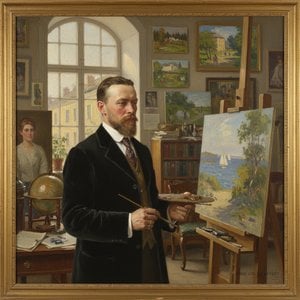
A Life Woven into the Finnish Soul
Akseli Gallen-Kallela, born Axel Waldemar Gallén in 1865 in Pori, Finland, wasn’t merely a painter; he was a visual poet of a nation finding its voice. His life unfolded against a backdrop of shifting political tides and a burgeoning national identity, deeply influencing his artistic trajectory. Initially raised in a Swedish-speaking family—a common reality within Finland at the time—Gallen-Kallela's eventual embrace and championing of Finnish culture was not simply an aesthetic choice but a deliberate act of cultural affirmation. His early years were marked by a tension between familial expectations and artistic ambition, leading him to Paris in 1884 to study at the Académie Julian. This period exposed him to the currents of European art, yet it also ignited within him a longing for the landscapes and folklore of his homeland.
The Parisian experience was formative, introducing him to artists like Albert Edelfelt and fostering friendships with figures such as August Strindberg. However, Gallén-Kallela’s artistic spirit proved resistant to complete assimilation into the prevailing European styles. He began returning frequently to Finland, drawn by a desire to capture the essence of its rural life and ancient mythology. This marked a turning point, a conscious decision to forge an artistic path rooted in Finnish identity. His early works reflected this shift, depicting scenes of peasant life with a realism tempered by a growing symbolic sensibility—a style that would soon become his signature.
The Kalevala’s Embrace: Myth and National Identity
Gallen-Kallela's most enduring legacy lies in his breathtaking illustrations of the Kalevala, Finland’s national epic. This collection of ancient folklore, poems, and myths became more than just subject matter for him; it was a wellspring of inspiration, a key to unlocking the soul of his nation. Paintings like The Defense of the Sampo (1897) and Lemminkäinen’s Mother (1893) are not mere illustrations but powerful visual interpretations that resonate with the epic’s themes of heroism, loss, and the struggle against adversity. He didn’t simply depict scenes from the Kalevala; he *embodied* them, infusing his canvases with a sense of primal energy and symbolic depth.
His approach was meticulous, involving extensive research into Finnish folklore, traditions, and landscapes. He sought to capture not just the narrative elements but also the underlying spiritual beliefs and cultural values embedded within the epic. This dedication elevated his work beyond mere illustration; it transformed him into a visual storyteller, a conduit for preserving and celebrating Finland’s cultural heritage. The impact of these works was profound, solidifying Gallen-Kallela's position as a pivotal figure in Finnish art and contributing significantly to the nation’s growing sense of self-awareness.
Beyond Myth: Symbolism, Expression, and Artistic Evolution
While inextricably linked with the Kalevala, Gallen-Kallela’s artistic range extended far beyond mythological subjects. He explored symbolism in works like Symposium (1894), a haunting depiction of Finnish artists engaged in intellectual discourse, subtly hinting at anxieties about national identity and cultural preservation. His style evolved over time, incorporating elements of Art Nouveau and later embracing the expressive power of color and form. A pivotal moment came with his journey to Kenya in 1909-1910, where he encountered a different culture and landscape that profoundly impacted his artistic vision.
This experience led to a shift towards more vibrant colors and bolder brushstrokes, foreshadowing the emergence of Expressionism. He continued to experiment with various mediums, including frescoes—most notably those commissioned for the Jusélius Mausoleum—and designs for textiles and furniture, demonstrating a holistic approach to art that extended beyond the confines of traditional painting. Even during periods of political turmoil, such as the Finnish Civil War in 1917-1918, Gallen-Kallela remained actively engaged, designing uniforms and decorations for the newly independent Finnish army.
A National Romantic Vision
Gallen-Kallela is considered a central figure in Finnish National Romanticism, an artistic movement that sought to celebrate Finland’s unique culture and identity. This movement aimed to revive interest in Finnish folklore, mythology, and language, rejecting the dominant Western European influences. Gallen-Kallela's work perfectly embodies this spirit, drawing inspiration from ancient tales and rural life while simultaneously exploring themes of national pride and cultural preservation. His paintings often depict scenes of Finnish landscapes and people with a sense of reverence and nostalgia, capturing the essence of what it meant to be Finnish during a period of intense national awakening.
A Lasting Legacy
Gallen-Kallela's influence on Finnish art and culture is immeasurable. He didn’t just paint pictures; he helped to define what it meant to be Finnish, visually articulating the nation’s identity during a period of profound transformation. His work continues to inspire artists today, serving as a testament to the power of art to shape national consciousness and preserve cultural heritage. His legacy is deeply intertwined with the very soul of Finland.