


Augustus Earle
Augustus Earle (1793–1838) was a london-born travel artist. Unlike earlier artists who worked outside europe and were employed on voyages of exploration or worked abroad for wealthy, often aristocratic patrons, earle was able to operate quite independently – able to combine his lust for travel with an ability to earn a living through art. The body of work he produced during his travels comprises a significant documentary record of the effects of european contact and colonisation during the early nineteenth century.James Earle, Augustus’s father, was an american-born artist who instilled in his son a passion for visual representation. Georgiana Caroline Smyth, Augustus’s mother, descended from John Carteret Pilkington, a prominent loyalist figure who had spent some years in england. This familial heritage undoubtedly shaped earle's artistic sensibilities.
Earle received his formative artistic training at the Royal Academy, where he honed his skills and established connections within the artistic community. From an early age, he demonstrated exceptional talent, exhibiting classical, genre and historical paintings that garnered considerable acclaim.
In 1815, at the tender age of twenty-two, earle embarked on a transformative journey with his half-brother William Henry Smyth aboard the *Scylla*, a vessel commanded by Admiral Exmouth—part of Britain’s naval expedition to explore the Mediterranean. This voyage yielded an extraordinary portfolio of drawings documenting the landscapes and cultures encountered during their travels through Sicily, Malta, Gibralter and North Africa.
Recognizing his burgeoning artistic potential, Smyth secured permission for earle to pursue his ambitions independently, fostering a unique blend of adventurous spirit and creative endeavour.
From March 1818 until late 1829, earle undertook an ambitious circumnavigation of the globe—a feat unprecedented in its time. His journey commenced in New York, where he captivated audiences with two paintings presented at the Pennsylvania Academy of Fine Arts. Subsequent expeditions took him to Rio de Janeiro and Chile, immersing him in the vibrant tapestry of Latin American life.
A pivotal moment arrived in December 1820 when earle boarded the *Duke of Gloucester* bound for Cape of Good Hope—a voyage driven by a desire to engage with Lord Amherst’s leadership of India. Amidst turbulent seas and unforeseen delays, earle found himself stranded on Tristan da Cunha, an uninhabited island where he befriended Thomas Gooch.
During his eight-month residency on Tristan da Cunha, earle diligently recorded the island's flora and fauna—creating a remarkable visual chronicle of its unique ecosystem. His sketches captured the essence of this remote locale, cementing his reputation as one of Britain’s foremost explorers.
Continuing his voyage in February 1824, earle sailed for Calcutta aboard the *Cyprus*, eager to pursue opportunities presented by Lord Amherst's administration.
He spent a brief period in Hobart, Tasmania—a destination chosen due to its burgeoning artistic community. Earle’s Tasmanian landscapes and portraits stand as testament to his ability to capture the spirit of colonial Australia.
Finally returning to England in late 1829, earle established himself as a respected artist in Sydney, where he produced numerous works reflecting the dynamism of the Australian frontier.
Among his most celebrated achievements was the lithographic print *Portrait of Bungaree*, depicting Aboriginal chieftain Bungaree alongside Fort Macquarie—a powerful image symbolizing Australia’s encounter with its indigenous population. Earle's artistic legacy continues to inspire admiration for its meticulous detail and evocative portrayal of a bygone era.
Augustus Earle’s oeuvre comprises approximately sixty paintings and drawings, primarily focused on landscapes, portraits and depictions of Aboriginal life—providing invaluable insight into the visual culture of the early nineteenth century.
- Notable Paintings: “A man-of-war's boat cutting out a French barque”, “View From The Sydney Hotel”
- Lithographic Print: “Portrait of Bungaree, a native of New South Wales, with Fort Macquarie, Sydney Harbour, in background"
His contribution to art history is undeniable; earle's work serves as a cornerstone for understanding the aesthetic sensibilities of his time and underscores the enduring power of visual storytelling.
Vraag en antwoord
Onder welke pseudoniemen of andere namen is Augustus Earle bekend?
Augustus Earle staat ook bekend onder de namen James Earle, Earle.
Is er een overzicht van alle onderwerpen die Augustus Earle heeft geschilderd?
De Onderwerpsindex van Augustus Earle biedt een overzicht van de kunstwerken van de kunstenaar, ingedeeld op onderwerp.
Waar kan ik alle kunstwerken van Augustus Earle bekijken?
Alle werken van Augustus Earle op deze website zijn te bekijken op de Alle kunstwerken pagina van de kunstenaar.
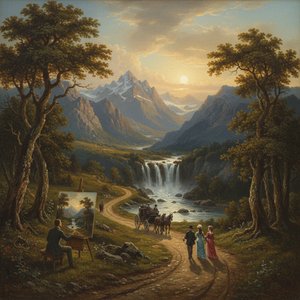


![Port Jackson, New South Wales [picture] / [augustus Earle] — Augustus Earle](/media/artworks/images-thumb/fb/08/fb08b9cec7c051c607c62da47c6f4247.jpg)

