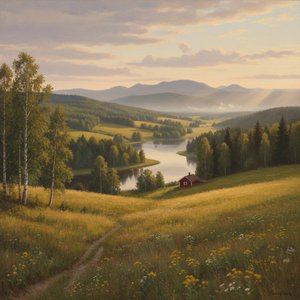
Anders Anderson Lundby: A Pioneer of Swedish Landscape Painting
Anders Anderson Lundby (1841 – 1923) stands as a towering figure in the annals of Swedish landscape painting, recognized for his masterful depictions of the Nordic wilderness and his unwavering commitment to realism. Born in Stockholm, Lundby’s artistic journey began modestly but swiftly ascended to prominence thanks to his exceptional talent and dedication to capturing the essence of Sweden's natural beauty.- Early Life & Education: Lundby received his formative artistic training at Konstakademin i Stockholm (Royal Academy of Arts), where he honed his skills under influential instructors, absorbing the principles of Impressionism alongside traditional academic methods. This dual influence proved crucial in shaping his distinctive style.
- The Influence of Impressionism: While firmly rooted in realism, Lundby’s artistic sensibilities were undeniably swayed by the burgeoning Impressionist movement. Artists like Claude Monet and Camille Pissarro instilled in him a fascination with capturing fleeting moments of light and atmosphere—a technique he skillfully integrated into his landscapes.
A Distinctive Style: Capturing the Soul of Sweden’s Winter Landscapes
Lundby's oeuvre is particularly celebrated for its breathtaking winterscapes. Unlike many contemporaries who favored idealized depictions, Lundby relentlessly pursued accuracy in portraying the harsh realities of Swedish winters—the biting winds, the snow-covered forests, and the icy lakes reflecting the pale sunlight. His canvases pulsate with palpable emotion, conveying not merely visual information but also a profound sense of solitude and contemplation. He achieved this remarkable feat through meticulous observation and painstaking brushwork, layering thin glazes to build up tonal gradations that faithfully reproduce the subtleties of natural light.- Technique & Materials: Lundby favored oil paints on canvas, utilizing a palette knife to apply thick impasto—textured paint—creating palpable physicality within his compositions. He meticulously studied geological formations and plant life, incorporating detailed anatomical accuracy into his depictions.
- Notable Works: Among Lundby’s most iconic paintings are “Winter Landscape” (1896) and “The Frozen Lake” (1903), which exemplify his stylistic prowess and artistic vision. These works remain treasured masterpieces of Swedish art history, admired for their compositional balance, tonal harmony, and evocative portrayal of the Nordic winter.
Development & Artistic Evolution
Throughout his prolific career spanning several decades, Lundby steadily refined his technique and expanded his artistic repertoire. Initially focused on capturing panoramic vistas, he gradually incorporated smaller-scale scenes depicting rural life—peasants tending their fields, fishermen hauling nets, and families gathered around hearth fires—adding depth and nuance to his artistic narrative. His later works demonstrate a growing sensitivity to color palettes and textural variations, reflecting an evolving understanding of the expressive potential of painting.Historical Significance & Legacy
Anders Anderson Lundby’s contribution to Swedish landscape painting is undeniable. He established himself as one of Sweden's foremost artists of his time, influencing subsequent generations of painters and cementing his place in the nation’s artistic heritage. His unwavering dedication to realism—combined with an astute grasp of Impressionist principles—produced images that continue to resonate with viewers today, transporting them back to the serene beauty of Sweden’s wintry landscapes and reminding us of the enduring power of art to capture the spirit of a particular place and time. Lundby's legacy persists as a testament to the importance of meticulous observation and artistic integrity.Vraag en antwoord
Onder welke pseudoniemen of andere namen is Anders Anderson Lundby bekend?
Anders Anderson Lundby staat ook bekend onder de namen Anders Andersen Lundby.
In welke perioden is de carrière van Anders Anderson Lundby onderverdeeld?
De Loopbaanoverzicht van Anders Anderson Lundby is een interactieve tijdlijn die de werken van de kunstenaar chronologisch presenteert, gegroepeerd in hoofdstukken per carrièreperiode.
Kan ik de werken van Anders Anderson Lundby bekijken op basis van stemming?
Op de Sfeercollectie van Anders Anderson Lundby zijn de kunstwerken van de kunstenaar gerangschikt op stemming.