De Ziel van de Geometrie: Het Leven en de Nalatenschap van Alfredo Volpi
Dwalen door de doeken van Alfredo Volpi is een reis naar het hart van de Braziliaanse identiteit, waar de grenzen tussen hoogmodernisme en volkstraditie oplossen in een levendige dans van kleur. Volpi, geboren in 1896 in Lucca, Italië, werd gedefinieerd door een diepgaande migratie—niet alleen over oceanen, maar ook door artistieke disciplines heen. Toen hij als jong kind in São Paulo aankwam, groeide hij op in de ritmische hartslag van een opkomende metropool, een omgeving die later de architectonische en culturele zaden zou vormen voor zijn meest iconische werken. Voordat hij ooit een penseel oppakte om zijn plaats in de annalen van de schilderkunst op te eisen, werkte Volpi als decoratieschilder, een beroep dat hem een diep respect bijbracht voor textuur, oppervlak en de tastbare schoonheid van het vakmanschap.
Zijn vroege jaren werden gekenmerkt door een zelfopgeleide vastberadenheid, een onvermoeibare zoektocht naar meesterschap die formele academies negeerde ten gunste van directe observatie. Aanvankelijk was zijn palet geworteld in het naturalisme; hij legde de uitgestrekte landschappen en het dagelijkse straatleven van São Paulo vast met een oog voor atmosferische waarheid. Beïnvloed door het emotionele gewicht van het expressionisme en de lichtdoorlatende nuances van het impressionisme, ademden zijn vroege olieverfschilderijen de vitaliteit van de Braziliaanse buitenwijken. Toch was zelfs in deze vormende werken een rusteloze geest zichtbaar—een verlangen om het overbodige weg te strippen en de structurele essentie onder de huid van de realiteit te vinden.
Een Revolutie van Vorm en Tempera
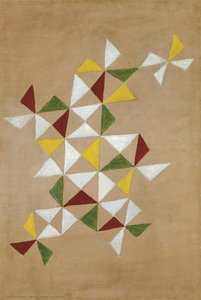
Het midden van de jaren dertig markeerde een seismische verschuiving in Volpi’s creatieve traject, toen hij zich begon weg te bewegen van representatieve landschappen naar de rigoureuze, analytische schoonheid van de geometrische abstractie. Dit was niet louter een verandering van onderwerp, maar een volledige heruitvinding van het canvas als een vlak van pure interactie. Geïnspireerd door constructivistische principes en de strakkere geometrieën van kunstenaars als Kazimir Malevich, begon Volpi de wereld te reduceren tot haar fundamentele componenten: vierkanten, rechthoeken en driehoeken. Echter, in tegenstelling tot de koude, mechanische precisie die men vaak vindt in de Europese abstractie, bleef de geometrie van Volpi diep menselijk en warm.
Centraal in deze evolutie stond zijn meesterschap in tempera. Door de overstap te maken van olie naar dit delicate medium, bereikte hij een lumineuze, diafane kwaliteit waardoor licht door dunne, transparante pigmentlagen kon dringen. Deze techniek gaf zijn werk een unieke texturele rijkdom, waarbij de beweging van de penseelstreek zichtbaar bleef—een subtiele herinnering aan de hand van de kunstenaar binnen de abstracte vorm. Zijn composities begonnen de "historische façades" en de ritmische "bandeirinhas" (kleine vlaggetjes) te bevatten die zijn handelsmerk zouden worden. Deze elementen waren niet slechts vormen; het waren echo's van de Braziliaanse volksarchitectuur en volksfeesten, getransformeerd tot een verfijnde taal van patroon en ritme.
De Kruising van Moderniteit en Traditie
Wat Volpi werkelijk boven zijn tijdgenoten verheft, was zijn vermogen om de kloof tussen de avant-garde en het volkse te overbruggen. Hoewel hij zich in de jaren vijftig bezighield met de intellectuele strengheid van de Concretistische beweging, liet hij de "volkse" ziel van zijn onderwerpen nooit los. Zijn werk bestaat in een prachtige spanning:
Als pionier van de Braziliaanse geometrische abstractie liet Alfredo Volpi een nalatenschap na die blijft resoneren in de zalen van musea zoals MASP en Centro Pecci. Hij bewees dat abstractie geen ontsnapping aan de realiteit hoefde te zijn, maar juist een diepere manier kon zijn om deze te zien. Door zijn ogen werd de eenvoudige geometrie van een vlag of een venster een diepgaande meditatie over balans, licht en de blijvende geest van een cultuur. Zijn leven blijft een testament aan de kracht van de zelfopgeleide kunstenaar om het visuele landschap van een natie te herscheppen.
Vraag & Antwoord
Kan ik de werken van Alfredo Volpi bekijken op basis van stemming?
De werken van Alfredo Volpi kunnen per stemming worden bekeken op de Sfeerruimte pagina van de kunstenaar, waar de kunstwerken zijn gerangschikt op basis van hun vastgelegde stemmingen.
Hoe populair zijn de kunstwerken van Alfredo Volpi?
Statistieken over de werken van Alfredo Volpi zijn beschikbaar op de Statistieken pagina van de kunstenaar.
Waar komt Alfredo Volpi vandaan?
Alfredo Volpi werd geboren in Italie.