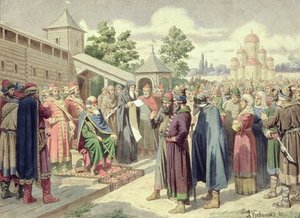
The Chronicles of Canvas: The Life and Legacy of Aleksei Danilovich Kivshenko
Aleksei Danilovich Kivshenko was far more than a mere chronicler of the past; he was a visual poet who breathed life into the turbulent eras of Russian history. Born on March 22, 1851, amidst the quiet surroundings of a small stud farm in the Tula Governorate, his origins were humble, rooted in the life of a serf belonging to Count Sheremetev. Yet, within this modest beginning lay the seeds of greatness, nurtured by a father whose passion for art and music ignited a flame in young Aleksei. By the age of nine, the boy’s talent was already being shaped under the watchful eye of the legendary Ivan Kramskoi at the Imperial Society for the Encourably of the Arts, marking the beginning of a journey that would lead him to the highest echelons of the Russian artistic establishment.
His formal education at the Imperial Academy of Arts, spanning from 1867 to 1877 under the guidance of Kārlis Hūns, provided the technical foundation necessary for his later mastery. While he briefly explored the worlds of technology and medicine through auditing classes, his heart remained tethered to the brush and palette. To sustain himself during these formative years, Kivshenko worked as a scribe for the Admiralty Board, a role that perhaps deepened his connection to the administrative and military structures of the empire—themes that would later dominate his most profound works.
A Journey Through Light and War
The evolution of Kivshenko’s style was profoundly shaped by his travels across the European continent. Following a prestigious foreign fellowship in 1880, he ventured through the artistic hubs of Paris, Düsseldorf, and Munich. In Munich, the influence of masters like Gabriel von Max and Wilhelm von Diez infused his work with a refined sense of atmosphere and psychological depth. This period of wandering was not merely an academic pursuit but a spiritual expansion that allowed him to blend the rigorous traditions of Russian realism with the nuanced tonal gradations found in Western European painting.
Upon his return to Russia, Kivshenko’s ascent was meteoric. In 1884, he was honored with the title of "Academician," a recognition that signaled his arrival as a premier voice in the movement. His talent for capturing the grandeur and the grit of conflict led to a momentous commission from Tsar Alexander III. Tasked with depicting scenes from the recent Russo-Turkish War, Kivshencko traveled to Transcaucasia, immersing himself in the landscapes and cultures of the region. These sketches were not merely observational; they were visceral, capturing the heat of battle and the heavy weight of imperial destiny.
The Master of Historical Narrative
Kivshenko’s oeuvre is a tapestry woven from threads of military triumph, pastoral serenity, and the quiet dignity of everyday life. While he is most celebrated for his sweeping historical compositions—notably those documenting the Russo-Turkish Wars—his versatility allowed him to master genre scenes and hunting studies that captured the rhythmic pulse of Russian life. His association with the Peredvizhniki, or the Wanderers, placed him within a circle of artists dedicated to social realism, yet he maintained a unique ability to infuse historical events with a sense of Romantic idealism.
His later years were marked by continued scholarly and artistic exploration. In 1891, alongside Nikodim Kondakov, he participated in an archaeological expedition to Palestine and Syria, returning with a wealth of sketches that documented the ancient architecture and daily customs of the Levant. This thirst for authenticity defined his entire career. Though his life was tragically short, ending in Germany in 1895 at the age of forty-four, Kivshenko left behind a legacy of profound historical significance. He remains a vital link in the chain of Russian art, a painter who did not just show us what happened, but allowed us to feel the very breath of history.
Explore the profound symbolism of military uniforms in art history. From Victorian portraits to realistic lithographs, discover how artists capture power, identity, and historical legacy through the intricate details of martial regalia and command.
Explore the profound iconography of authority through iconic military portraits. Discover how master painters captured command, regalia, and historical prestige in classical oil paintings, perfect for discerning collectors seeking timeless elegance.
Explore the profound depth of Russian Realism. From the social truths of the Peredvizhniki to epic folklore, discover the soulful power of masters like Perov and Yaroshenko through our expert art history insights and museum-quality reproductions.
Hoi! Ik kan je helpen bij het kiezen van een kunstwerk, het volgen van een bestelling of het beantwoorden van vragen over de garantie. Waarmee kan ik je van dienst zijn?