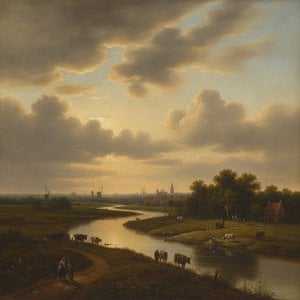
Maurice (1567-1625), Prince of Orange, Lying in State
ALLEGORIE DE LA TREVE DE 1609 ENTRE L'ARCHIDUC D'AUTRICHE, GOUVERNEUR DES PAYS BAS DU SUD, ET LES ETATS DES PAYS BAS DU NORD
Dance of Death
Mediums:
olieverf op canvas
acryl op canvas
Corpus themes:
social commentary
religious allegory
jan brueghel's influence
Room fit: woonkamer
Movements:
baroque
dutch golden age
A Life Forged in Flight: The World of Adriaen Pietersz van de Venne
Adriaen Pietersz van de Venne, a name resonating with the vibrant energy of the Dutch Golden Age, was more than just a painter; he was a visual storyteller, a social commentator, and a versatile artist who navigated the complex currents of 17th-century life. Born in Delft in 1589, his very origins were steeped in upheaval. His parents, fleeing religious persecution in the Southern Netherlands, instilled within him a sense of displacement that perhaps fueled his keen observation of societal fractures and human foibles. This early experience shaped not only his artistic vision but also his commitment to using art as a mirror reflecting the world around him—its joys, its sorrows, and its often-pointed ironies. Van de Venne’s education began in Leiden, where he immersed himself in the intellectual ferment of the university town, acquiring a grounding in Latin that would later serve him well in understanding classical allegories and humanist thought. His formal artistic training commenced with Simon de Valk, a master goldsmith and painter, followed by an apprenticeship with Jeronimus van Diest, honing his skills in the delicate art of grisailles—monochrome paintings executed in shades of gray, a technique that would become a hallmark of his style.
Early Influences and Artistic Formation
Van de Venne’s formative years were marked by exposure to influential artistic currents. His parents' decision to relocate from the Southern Netherlands – a region embroiled in religious conflict between Catholics and Protestants – instilled within him a profound awareness of social instability and shaped his worldview. This sensitivity translated into an eagerness for knowledge, leading him to Leiden University where he pursued studies in Latin—a crucial skill for interpreting classical texts and humanist ideals that would permeate his artistic thinking. Recognizing the importance of disciplined training, he enrolled as a student under Simon de Valk, a respected goldsmith and painter who instilled in him foundational techniques of craftsmanship and visual representation. Subsequently, he apprenticed himself to Jeronimus van Diest, mastering the art of grisailles—a technique characterized by its monochromatic palette and meticulous attention to detail—which would become an integral element of his distinctive artistic style. This early training provided him with a solid technical base upon which to build his burgeoning creative vision.
From Middelburg to The Hague: Embracing Flemish Tradition
By 1614, Van de Venne relocated to Middelburg, Zeeland—a city renowned for its flourishing maritime trade and artistic patronage. Here, he encountered the profound influence of Jan Brueghel the Elder and Pieter Bruegel the Younger, whose depictions of peasant life and allegorical scenes captivated him with their expressive realism and symbolic depth. These Flemish masters championed a style that prioritized observation and emotional resonance—a stylistic approach that profoundly impacted Van de Venne’s artistic sensibilities. During this period, he created Fishing for Souls – a monumental grisaille depicting the theological debates surrounding the Reformation – demonstrating his ability to translate complex philosophical ideas into compelling visual narratives. This masterpiece exemplifies his commitment to conveying moral and spiritual truths through symbolic imagery, cementing his reputation as an artist capable of tackling ambitious themes with intellectual rigor and artistic finesse. The Brueghels’ emphasis on portraying everyday life alongside grand allegorical representations served as a guiding principle for Van de Venne's subsequent artistic endeavors.
A Flourishing Career: Commissions, Guild Membership, and Artistic Recognition
Van de Venne’s professional life unfolded with remarkable success. He established himself as a book illustrator and print designer—a vocation that thrived during the Golden Age of Dutch publishing—collaborating closely with his brother Jan, who served as a publisher and art dealer. His artistic output spanned diverse genres: portraits commemorating noble families, historical paintings recounting significant events from Dutch history, and genre scenes capturing the vibrancy of daily life in Middelburg and later The Hague. He was repeatedly elected dean of the Guild of Saint Luke—the influential professional organization overseeing artistic practice in The Hague—a testament to his standing within the art community and his advocacy for upholding standards of excellence. In 1656, he joined Confrerie Pictura—an association dedicated to elevating the status of artists and fostering a more scholarly approach to artistic training—further solidifying his position as a leader among his peers. His prolific output garnered considerable acclaim from contemporaries and secured commissions from prominent figures such as Frederik Hendrik, the Dutch Stadholder—demonstrating his versatility and securing recognition for his artistic achievements.
Legacy and Enduring Influence
Adriaen Pietersz van de Venne’s contribution to Dutch art history is undeniable. He stands alongside Rembrandt and Vermeer as one of the most celebrated painters of the Golden Age, embodying the ideals of humanist observation and moral reflection that characterized the era. His masterful use of grisailles—particularly his depiction of the destitute and maimed—continues to inspire artists today, serving as a poignant reminder of the human condition and the importance of compassion. Beyond his artistic output, Van de Venne’s role as guild dean and member of Confrerie Pictura underscores his commitment to fostering intellectual discourse and elevating the status of art within society. His legacy extends beyond individual artworks—it resides in his influence on subsequent generations of artists and scholars who recognized him as a beacon of artistic excellence and humanist conviction. His enduring impact testifies to the power of art to illuminate both beauty and truth, ensuring that Adriaen Pietersz van de Venne’s name will forever resonate within the annals of Dutch cultural history.
Door de redactie van WahooArt.com
Kunstquiz
Er is slechts één goed antwoord op elke vraag.
Vraag 1:
Wat was een prominente onderwerpbloem in Van de Venne’s genre schilderijen vanaf 1618?
Vraag 2:
In welk jaar verhuisde Van de Venne naar Gouda?
Vraag 3:
Waarom werd Van de Venne een bekende figuur binnen het Gilde Sint Lucas?
Vraag 4:
Welke kunstenaar oefende een belangrijke invloed uit op Van de Venne’s stijl tijdens zijn tijd in Middelburg?
Vraag 5:
Wat voor soort kunstvorm gebruikte Van de Venne om zijn werk te verspreiden en een publiek bewustzijn te creëren?
Ontdek de 10 meesterwerken van de Gouden Eeuw! Leer over Rembrandt, Vermeer & andere Hollandse schilders. Prachtige kunst reproducties voor uw interieur. Museumkwaliteit prints op WahooArt.com.
Discover the breathtaking beauty of Dutch Golden Age landscapes. Explore the mastery of light, chiaroscuro, and 17th-century realism through an expert art history lens, celebrating the enduring legacy of the Dutch Masters for discerning collectors and art lovers.
Explore the life & work of Adriaen van Ostade, a leading Dutch Golden Age painter. Discover his realistic genre scenes, social commentary, and lasting influence on art history. Learn more at WahooArt.
Hoi! Ik kan je helpen bij het kiezen van een kunstwerk, het volgen van een bestelling of het beantwoorden van vragen over de garantie. Waarmee kan ik je van dienst zijn?