The Illusion of Infinity: Defining Linear Perspective To gaze upon a truly great Renaissance masterpiece is to experience a profound sense of vertigo, a sudden realization that the flat surface of a canvas has dissolved into an endless window. This b...
To encounter a true Renaissance masterpiece is to experience a profound sense of vertigo, a sudden realization that the flat surface of a canvas has dissolved into an endless window. This breathtaking phenomenon is not merely a trick of the light or a clever arrangement of colors; it is the result of linear perspective, one of the most significant intellectual triumphs in the history of human expression. At its core, linear perspective is a mathematical system designed to mimic how the human eye perceives the world—a method where parallel lines appear to converge as they recede into the distance, creating a structured illusion of three-dimensional space on a two-dimensional plane. Before this discovery, much of medieval art relied upon hierarchical scaling, where the importance of a figure was dictated by their size rather than their position in space. The introduction of perspective fundamentally altered the viewer's relationship with the artwork, inviting us not just to observe a sacred scene, but to step into it.
The dawn of this spatial revolution can be traced back to the streets of Florence, specifically to the brilliant mind of Filippo Brunelleschi. An architect and engineer of unparalleled vision, Brunelleschi did more than just design the magnificent dome of the Florence Cathedral; he decoded the geometry of sight itself. Through rigorous experiments involving mirrors and precise measurements, he demonstrated that the convergence of lines toward a single point could be calculated with mathematical certainty. This was not merely an artistic innovation but a scientific one, bridging the fundamental gap between the humanities and the empirical sciences. By applying the principles of geometry to the canvas, artists were suddenly equipped with a tool that could render the physical world with unprecedented accuracy, allowing for the creation of believable, measurable reality.
Atmospheric Nuance: Mastering Depth through Aerial Perspective
Aerial perspective, or atmospheric perspective, is the effect the atmosphere has on the appearance of an object as viewed from a distance. As the distance between an object and a viewer increases, the contrast between the object and its background de...
While linear perspective provides the structural skeleton of depth, it is aerial perspective—often referred to as atmospheric perspective—that breathes life and air into the composition. This technique captures the subtle effect that the atmosphere has on the appearance of an object as viewed from a distance. As the distance between an object and a viewer increases, the contrast between the object and its background decreases, and the fine details begin to soften. The colors of the object become less saturated and shift toward the color of the atmosphere, which is typically a delicate blue when sunlit. This mastery of light and air allows a painter to suggest vast, receding landscapes that extend far beyond the physical limits of the frame.
This technique has a long and storied history in visual art, appearing in ancient Roman frescoes such as those found in the Villa of Livia and in early Chinese landscape painting. The polymath Leonardo da Vinci was perhaps the most celebrated practitioner of this method, utilizing it in iconic works like The Annunciation and the Mona Lisa to create a sense of infinite, misty distance. By reducing the contrast of high spatial frequencies—the fine lines and sharp edges—Leonardo introduced a technique known as sfumato, which allows forms to emerge from the shadows with a dreamlike, seamless quality. For the discerning collector, recognizing these subtle shifts in tone and saturation is essential to appreciating the atmospheric depth that distinguishes a masterwork from a mere imitation.
Architectural Precision: The Renaissance Blueprint for Spatial Realism
A Master of Bruges: The Life and Art of Petrus Christus Petrus Christus, a name perhaps less immediately recognizable than his contemporaries Jan van Eyck or Rogier van der Weyden, nevertheless occupies a pivotal position in the development of Early ...
The application of perspective was never solely about landscape; it was an architectural endeavor that transformed the very nature of composition. During the Italian Renaissance, painters and architects worked in a symbiotic relationship to create environments that felt structurally sound and physically inhabitable. This era saw the rise of artists who treated the canvas as a stage for complex, multi-layered scenes. The use of two-point or three-point perspective allowed for the depiction of buildings and interiors with such precision that the viewer could almost sense the weight of the stone and the volume of the halls.
In the works of masters like Piero della Francesca and Masaccio, we see a rigorous adherence to these spatial laws. These artists utilized vanishing points located along or above the horizon line to guide the eye through complex architectural marvels toward a singular, focused destination. This mastery of space transformed painting from a symbolic medium into a window onto a tangible reality. Even in the later works of the Northern Renaissance, such as those by Petrus Christus, we see an increasingly sophisticated understanding of these principles. Christus, a master of Bruges, pushed the boundaries of realism by creating paintings with a remarkably convincing sense of depth and three-dimensionality, subtly evolving the techniques established by his predecessor, Jan van Eyck, to create more structured and clear architectural settings.
Breaking the Plane: From Classical Illusion to the Radical Spatially Lacerated Canvas
A Life Forged in Spatialism Lucio Fontana, a name synonymous with radical innovation in 20th-century art, was born into a world poised between tradition and modernity. His journey began not in Italy, the nation he would come to define within the arti...
As art history progressed, the pursuit of depth moved from creating an illusion of space to physically interacting with it. For centuries, the goal was to use paint to trick the eye into seeing a world behind the canvas. However, the 20th century brought a radical departure from this tradition. The advent of Spatialism, led by the visionary Lucio Fontana, sought to dismantle the conventional picture plane entirely. Fontana, born in Argentina and deeply influenced by the dynamism of his era, believed that traditional painting was limited by its two-dimensionality. He did not merely want to represent space; he wanted to incorporate it as an integral element of the artwork itself.
In his iconic Spatial Concept series, Fontana employed a technique he termed “spatially lacerating.” Rather than using brushstrokes to suggest depth, he used a razor blade to create precise, clean cuts into the surface of the canvas. These were not acts of destruction but deliberate interventions designed to reveal a void—an opening onto an unseen space beyond the confines of the artwork. By puncturing or incising the canvas, Fontana transformed the painting into a portal, suggesting that the true depth of art lies in the infinite, uncontainable space that exists behind the material surface. This movement represented a profound shift from the illusionistic depth of the Renaissance to a conceptual exploration of the cosmos and the very nature of reality.
The Collector's Eye: Evaluating Spatial Complexity in Fine Art
The Architecture of Vision: Understanding Composition as Visual Grammar Composition (visual arts) In visual arts, composition (meaning "putting together") is the organization of an artwork. It is often used interchangeably with various terms such as ...
For the sophisticated collector, understanding these various modes of perspective is vital when curating a collection that speaks to both historical significance and aesthetic innovation. Whether one is drawn to the mathematical rigor of a Renaissance landscape, the soft, atmospheric beauty of an Impressionist vista, or the radical, physical depth of a contemporary abstraction, the ability to evaluate how an artist manages space adds profound value to the acquisition process. A truly great work of art does not merely sit upon a wall; it commands the room by manipulating the viewer's perception of volume, distance, and light.
When considering acquisitions, one must look beyond the subject matter to the "visual grammar" of the composition—the tension between presence and absence, and the rhythmic pulse of lines that direct the gaze. A masterfully composed piece uses perspective to create a dialogue with the viewer, guiding them through a choreographed journey of discovery. As you build your collection, whether through the acquisition of hand-painted oil reproductions that honor these classical traditions or through the pursuit of avant-garde originals, remember that the true power of art lies in its ability to transcend the flat surface and offer us a window into the infinite.
At WahooArt.com, we celebrate this enduring legacy of spatial mastery. We specialize in providing collectors with exquisite, hand-painted oil reproductions that capture the very soul of these historical techniques—from the precise linear perspective of the Old Masters to the delicate atmospheric nuances of the Impressionists. Our artists, all holders of prestigious Fine Arts degrees, utilize traditional methods on 100% cotton canvas to ensure that every brushstroke and tonal shift is rendered with museum-grade authenticity. Whether you are seeking a large-scale mural to transform an architectural space or a bespoke custom portrait that reimagines your own history, our team is dedicated to preserving the profound magic of depth and dimension in every piece we create.
Explore the captivating world of Giovanni Paolo Panini, master of Roman vedute painting. Discover his technique, iconic works, influence on art history & collecting advice from experts at WahooArt.
Elevate your art collection with our expert guide to mastering composition. Discover the profound impact of the Golden Ratio, Rule of Thirds, and diagonal dynamics used by the Old Masters to create timeless visual harmony and emotional depth.
Explore the profound impact of linear perspective on Renaissance art. Discover how masters like Brunelleschi and Uccello used mathematical precision to create breathtaking depth and spatial illusion in iconic historical masterpieces.
Hoi! Ik kan je helpen bij het kiezen van een kunstwerk, het volgen van een bestelling of het beantwoorden van vragen over de garantie. Waarmee kan ik je van dienst zijn?



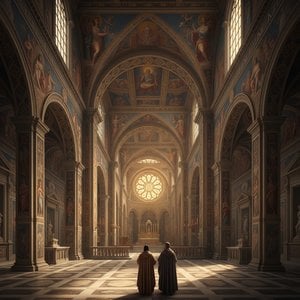 Mastering Depth: The Architectural Power of Linear Perspective in Renaissance Masterpieces
 Aerial perspective
 Petrus Christus
 Lucio Fontana
 Master the Frame: Composition Secrets to Level Up Your Visual Impact


