


x
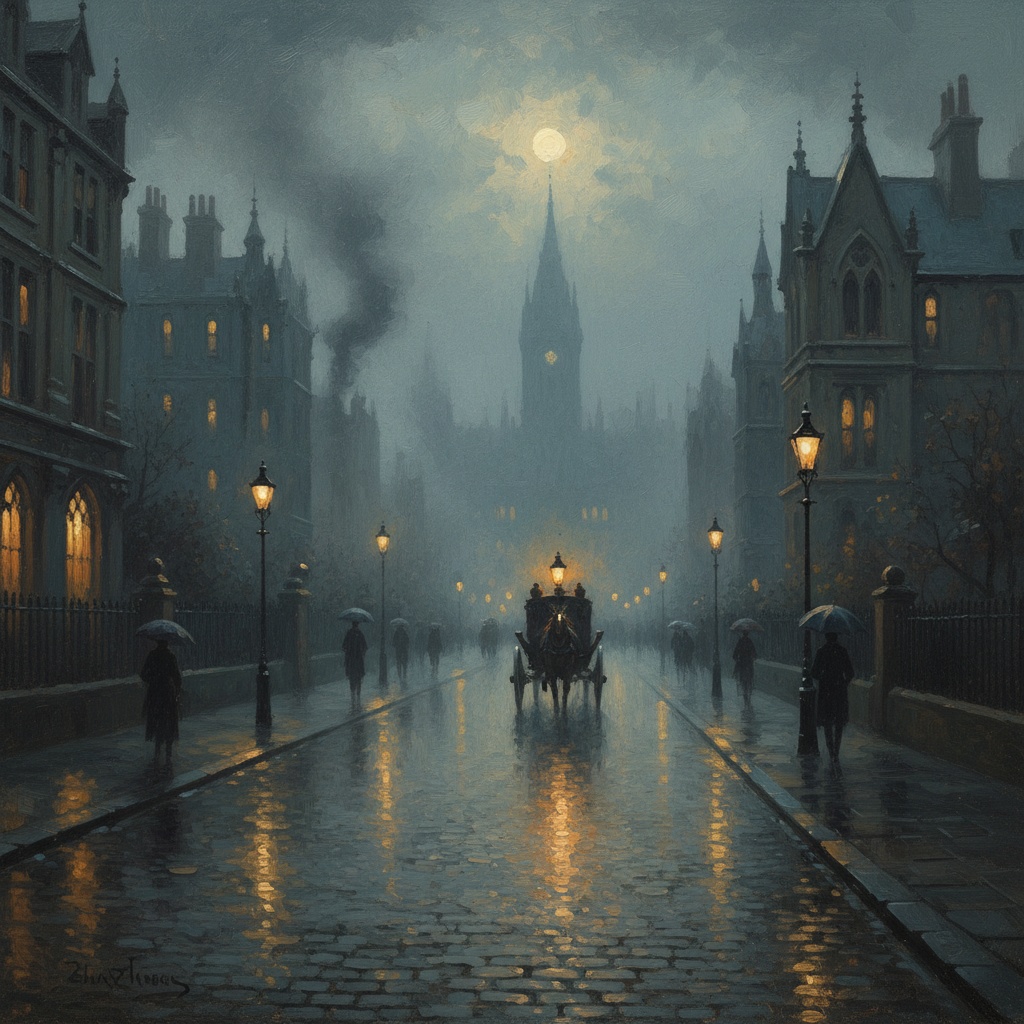
Victorian painting refers to the distinctive styles of painting in the United Kingdom during the reign of Queen Victoria (1837–1901). Victoria's early reign was characterised by rapid industrial development and social and political change, which made...
John Atkinson Grimshaw, a name perhaps less immediately recognizable than his Pre-Raphaelite contemporaries, nevertheless occupies a vital and deeply compelling space within the Victorian art world. He wasn't painting idyllic country scenes or mythological dramas; instead, he turned his gaze to the burgeoning industrial cities of England – Leeds, Glasgow, Liverpool – and, crucially, he painted them at night. This was a radical departure. Before Grimshaw, nocturnal landscapes were largely relegated to the realm of sketches or romanticized imaginings. He brought an unprecedented realism to these scenes, capturing not just the physical appearance of gaslit streets and moonlit docks, but also the very *atmosphere* of Victorian urban life – its energy, its melancholy, its quiet beauty.
Born in 1836, Grimshaw’s path to artistic recognition was unconventional. He began his career as a railway clerk, a profession that undoubtedly exposed him to the changing face of England and fueled his fascination with industrial progress. However, it was a deep-seated passion for art that ultimately led him to abandon a stable career in favor of pursuing painting. This self-taught artist possessed an innate talent for observation and a keen eye for detail, qualities that would become hallmarks of his distinctive style. He wasn’t concerned with academic rules or established traditions; he forged his own path, driven by a desire to depict the world as *he* saw it – a world increasingly defined by the glow of artificial light and the rhythms of modern industry.
Grimshaw’s realism wasn’t accidental. He was an early adopter of photography, recognizing its potential as a tool for capturing accurate detail and complex compositions. While he never explicitly claimed to trace photographs directly onto canvas, it is widely accepted that he employed techniques like the camera obscura or lenses to project scenes, aiding in his rendering of perspective and intricate architectural elements. This practice was controversial at the time; some critics dismissed it as a shortcut, arguing that true artistry lay in painting from life without mechanical assistance. However, Grimshaw’s defenders pointed out that he wasn't simply copying photographs – he used them as a foundation upon which to build his own unique vision.
The use of these techniques allowed him to overcome limitations in traditional draughtsmanship and focus on what truly mattered: the interplay of light and shadow, the texture of surfaces, and the overall atmospheric effect. He wasn’t interested in precise topographical accuracy; rather, he sought to evoke a mood, a feeling – the sense of being present in those bustling Victorian streets under the cloak of darkness. This innovative approach set him apart from his contemporaries and paved the way for new forms of realism in painting.
The true genius of Grimshaw lies in his mastery of atmosphere. He understood that light is not merely a visual phenomenon but an emotional one. His paintings are suffused with a soft, ethereal glow, created through meticulous layering of oil paints and a subtle understanding of color theory. The gas lamps casting long shadows on cobbled streets, the moonlight shimmering on water, the fog swirling around industrial buildings – these aren’t simply depicted; they *feel* tangible, almost palpable.
His palette, while rooted in Victorian sensibilities, was surprisingly sophisticated. He wasn't afraid to use bold colors, but he always tempered them with subtle grays and browns to create a sense of depth and realism. The contrast between the warm glow of artificial light and the cool tones of the night sky is particularly striking in his work, adding to the overall dramatic effect. This careful manipulation of color and light allowed him to capture not just what the eye sees but also what the heart feels – the romance, the mystery, and the quiet solitude of Victorian urban life.
 Liverpool from Wapping
Discover John Atkinson Grimshaw’s ‘Liverpool from Wapping’ (1875). A captivating Victorian cityscape blending realism & impressionism, showcasing Liverpool's industrial spirit. #VictorianArt #Grimshaw
Grimshaw’s oeuvre is rich with iconic works that exemplify his unique style. ‘Liverpool from Wapping’ (1875) is a prime example, showcasing the bustling port city bathed in moonlight. The painting captures the industrial spirit of Liverpool, but it also reveals a sense of quiet beauty and melancholy. Similarly, ‘Glasgow Docks’ presents a mesmerizing urban scene, with ships silhouetted against the night sky and reflections shimmering on the water. These paintings aren't simply depictions of places; they are evocative portraits of a specific time and place, imbued with emotion and atmosphere.
‘Forge Valley Near Scarborough,’ though depicting a more rural setting, demonstrates his skill in capturing moonlight effects and romantic landscapes. Throughout his career, Grimshaw consistently returned to these themes – urban scenes illuminated by gaslight, moonlit paths winding through the countryside, solitary figures lost in contemplation. These recurring motifs speak to his deep connection with the natural world and his fascination with the human condition.
John Atkinson Grimshaw's influence extends far beyond the Victorian era. His work bridged the gap between Romanticism and Realism, capturing both the beauty and the grit of modern life. James McNeill Whistler famously acknowledged Grimshaw as a pioneer of nocturne painting, recognizing his mastery of atmospheric effects and subtle color palettes. While he faced criticism during his lifetime for his unconventional techniques, his paintings were widely admired by collectors and critics alike.
Today, Grimshaw’s work continues to captivate audiences with its evocative power and timeless appeal. His paintings offer a glimpse into a bygone era – a time of rapid industrial change, social upheaval, and artistic innovation. They remind us that even in the midst of progress and modernity, there is still room for beauty, romance, and quiet contemplation. The enduring popularity of his work speaks to its universal themes and his unique ability to capture the essence of the human experience.
For those interested in collecting John Atkinson Grimshaw’s art, a range of options are available. Original oil paintings command significant prices, reflecting their rarity and historical importance. However, high-quality reproductions offer an accessible way to experience his work. WahooArt.com specializes in handmade oil paintings meticulously recreated from original masterpieces, allowing you to own a stunning reproduction of your favorite Grimshaw scene. When considering a purchase, pay attention to the size and condition of the artwork, as well as its provenance – the history of ownership. Look for pieces that capture his signature atmospheric effects and meticulous detail.
Exploring the market through reputable art dealers and online platforms like WahooArt.com is essential. Consider focusing on works that resonate with your personal taste and aesthetic preferences. Whether you’re a seasoned collector or just beginning to appreciate Victorian art, John Atkinson Grimshaw offers a wealth of beauty, history, and emotional depth to discover.

Journey through Impressionistic Realism with 10 iconic masterpieces by Monet, Renoir & Van Gogh. Explore art history, techniques & find museum-quality reproductions for your home at WahooArt.com. Discover all masterpieces online!

Ontdek de 10 meest iconische meesterwerken van de Romantiek! Van Delacroix tot Friedrich, leer over emotie, drama & kleur in deze beweging. Museumkwaliteit kunst reproducties op WahooArt.com. Exploreer de collectie online!


Blijf op de hoogte van het laatste kunstnieuws, exclusieve aanbiedingen en decoratie-ideeën.
Vertel ons over uw project en onze kunstexperts geven u 3 gepersonaliseerde kunstsuggesties.
Wij stellen 3 opties speciaal voor u samen – Gratis!


