Biografie van de kunstenaar
Ben Nicholson OM: A Life in Abstract Art
Ben Nicholson OM (1894–1982) was a British painter and sculptor whose groundbreaking exploration of abstraction revolutionized the landscape of modern British art. Born Benjamin Lauder Nicholson at Denham, Buckinghamshire, he descended from a family steeped in artistic tradition – his father, Sir William Nicholson, and mother, Mabel Pryde, were both accomplished painters—a lineage that profoundly shaped his own creative trajectory.
Early Life and Artistic Training
Nicholson’s formative years were marked by rigorous academic pursuits. He attended Tyttenhangar Lodge Preparatory School in Seaford, Heddon Court in Hampstead, and Gresham's School in Holt, Norfolk, imbibing a foundational understanding of artistic principles. His formal education culminated at the Slade School of Fine Art (1910–1911), where he forged connections with fellow artists like Paul Nash, Stanley Spencer, Mark Gertler, and Edward Wadsworth—artists who would become pivotal companions in his artistic journey. Anecdotally, Nicholson spent considerable time engrossed in billiards during this period, perceiving within the game’s geometric patterns and dynamic movement a latent aesthetic potential.
Artistic Development and Influences
Nicholson's initial artistic endeavors leaned towards naturalistic still lifes, mirroring his father’s stylistic sensibilities. However, around 1926, he embarked on a transformative voyage into abstraction, decisively influenced by Synthetic Cubism and the pioneering work of Pablo Picasso. This pivotal shift wasn’t merely stylistic; it represented a fundamental reimagining of artistic expression. Further enriching his artistic vision were encounters with Piet Mondrian—whose reductive geometric style championed clarity and order—and Henri Rousseau—whose primitivist approach rekindled an appreciation for raw emotion and instinctive representation. These influences coalesced into a distinctive aesthetic language that would characterize Nicholson’s subsequent oeuvre. He became deeply involved with movements like the Seven and Five Society, Unit One, and Abstraction-Création, actively participating in dialogues about artistic innovation and redefining boundaries within British art.
Major Works and Artistic Style
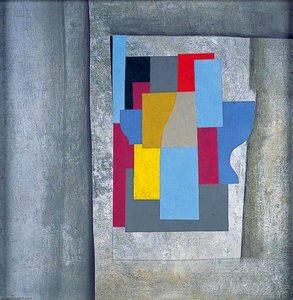
Nicholson's legacy rests primarily upon his monumental relief sculptures—beginning in 1933—which fused painting with sculptural elements to create immersive visual experiences. The white reliefs of the mid-1930s stand as emblems of Nicholson’s artistic achievement, embodying a masterful synthesis of form and color. Alongside these ambitious undertakings, he produced compelling still lifes and landscapes that incorporated geometric forms and muted palettes—demonstrating his versatility as an artist. Notably, “The Nicholson Wall,” commissioned for Sutton Place in Guildford, Surrey, served as a testament to his conviction that abstract art should transcend elitism and engage a broader audience. He experimented extensively with materials – oil paint, pencil, gravel, masonite – combining them in inventive ways to achieve unprecedented textural and chromatic effects.
Legacy and Historical Significance
Ben Nicholson is recognized as an indispensable figure in modern British art—a catalyst for abstraction and relief sculpture—whose work garnered international acclaim and cemented his place among the foremost artists of his time. Exhibitions at prestigious venues such as the Venice Biennale and retrospectives at major museums worldwide underscored his enduring artistic significance. He received numerous accolades, including the Order of Merit in 1968, acknowledging his contribution to British culture. Nicholson’s paintings command considerable prices at auction—reflecting their intrinsic artistic merit and historical importance; “Sept 53 (Balearic)” fetched $1,650,500 at Christie's New York in 2011, while “Fiddle and Spanish Guitar” achieved €3,313,000 at Christie’s Paris in 2012. Generations of artists have drawn inspiration from Nicholson’s pioneering approach to abstraction—his unwavering dedication to exploring form and space—establishing him as a cornerstone of artistic innovation.



 Bestel schilderij
 Verstuur
 Delen
Delen
 Details

 Download
 Vergelijkbare werken
 Röntgenfoto
 Diavoorstelling
 Lees meer






































 De optie voor glas is alleen beschikbaar bij een formaat kleiner dan 110 cm.