


The Venetian Context: A Unique Renaissance Landscape
The Venetian Renaissance had a distinct character compared to the general Italian Renaissance elsewhere. The Republic of Venice was topographically distinct from the rest of the city-states of Renaissance Italy as a result of their geographic locatio...
The Renaissance did not arrive in Venice as a sudden, sweeping transformation, but rather as a gradual infusion of new ideas into an already thriving and remarkably distinct artistic culture. Unlike Florence, the cradle of early Humanism, Venice was geographically isolated – a maritime republic whose wealth stemmed from trade, not land ownership. This unique position fostered a spirit of independence and a pragmatic approach to art that prioritized beauty, color, and sensory experience over strict classical imitation. The city’s very fabric—its canals, its opulent palaces, the play of light on water—shaped an aesthetic sensibility profoundly different from that of the mainland Italian states. Venetian artists were less concerned with linear perspective and anatomical precision than with capturing the shimmering effects of atmosphere and the richness of materials. This environment provided fertile ground for a painter like Carlo Crivelli to flourish, a master who synthesized the lingering traditions of Gothic decorative art with emerging Renaissance techniques.
The Republic’s political stability, coupled with its economic prosperity, created a robust market for devotional works. Churches and confraternities commissioned altarpieces not merely as expressions of faith but also as displays of civic pride and wealth. This demand fueled a distinctive style characterized by elaborate ornamentation, meticulous detail, and a profound sense of reverence. While Florence looked to the past for inspiration in classical antiquity, Venice embraced its Byzantine heritage and the vibrant traditions of the East, creating a visual language that was both opulent and deeply spiritual.
Crivelli’s Early Formation & Gothic Roots
 Wikipedia: Carlo Crivelli
Carlo Crivelli (c. 1430 – c. 1495) was an Italian Renaissance painter of conservative Late Gothic decorative sensibility, who spent his early years in the Veneto, where he absorbed influences from the Vivarini, Squarcione, and Mantegna. He left the V...
Carlo Crivelli (c. 1430 – c. 1495) emerged from this complex milieu, his artistic journey initially steeped in the late Gothic traditions of Venice. Born into a family of painters, he received his early training within workshops influenced by Jacobello del Fiore and the Vivarini family—artists who still employed techniques like gold leaf backgrounds and intricate punchwork detailing. A period of study with Francesco Squarcione in Padua exposed him to a broader range of influences, including the work of Andrea Mantegna, though Crivelli’s path diverged significantly from Mantegna's classical rigor. A brief imprisonment in 1457 for an adulterous affair marked a turning point, prompting his departure from Venice and a relocation to Zadar (then part of Venetian territory) and ultimately the March of Ancona.
It was in the Marches that Crivelli developed his signature style—a distinctive blend of Gothic elegance and Renaissance naturalism. He remained remarkably consistent throughout his career, eschewing the experimentation favored by many of his contemporaries. His commitment to tempera painting, even as oil paint gained prominence, further underscores his conservative aesthetic sensibilities. He advertised himself consistently as “Carolus Crivellus Venetus,” a deliberate assertion of his Venetian origins despite spending most of his active years outside the city.
Symbolism & Devotion: Unpacking the Narrative Layers
 Enthroned Madonna
Admire Carlo Crivelli’s ‘Enthroned Madonna,’ a stunning Early Renaissance masterpiece! Explore its rich details, symbolism & Venetian artistry – a captivating work of art.
Crivelli’s paintings are not simply beautiful objects; they are complex theological statements imbued with layers of symbolism. His altarpieces, often fragmented today, were originally conceived as unified narratives designed to guide viewers through a devotional experience. Works like “St Peter & St Paul” (1490) exemplify his masterful use of chiaroscuro and intricate detail to convey spiritual weight. The figures are not idealized but possess a tangible presence, their expressions conveying both solemnity and humanity. Every element—the folds of drapery, the architectural setting, even the fruits scattered across the surface—contributes to the overall meaning.
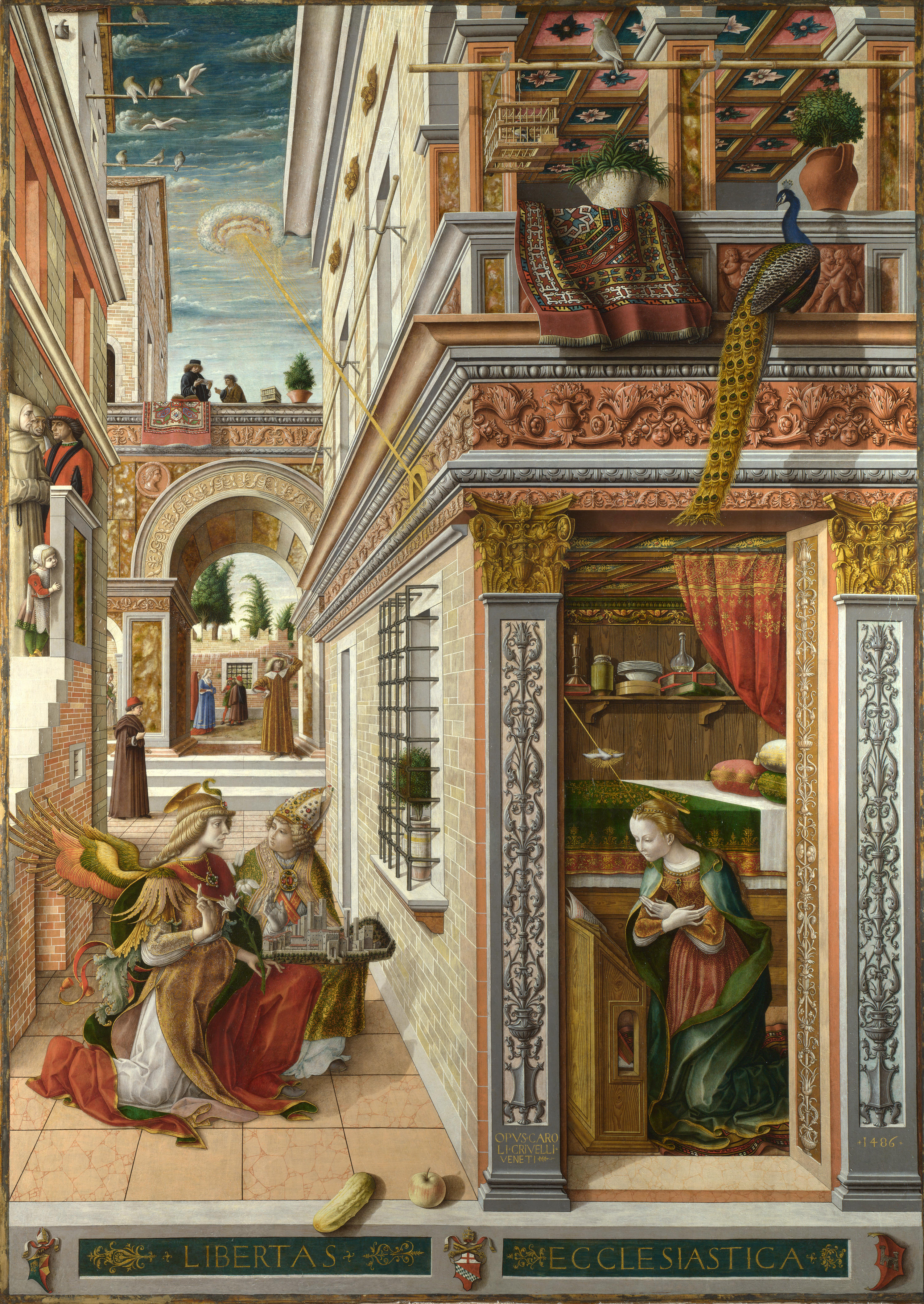
The inclusion of specific objects is particularly significant. Fruits, for example, often symbolize abundance and divine grace, while meticulously rendered fabrics represent wealth and status. His frequent use of cucumbers has been interpreted as a personal signature, though its precise significance remains debated. More broadly, Crivelli’s paintings are filled with *cartellini*—small scrolls bearing inscriptions that offer theological explanations or identify the figures depicted. These serve not merely as labels but as invitations to contemplation and deeper understanding.
Master of Detail: Trompe-l'œil and Material Presence
 Carlo Crivelli
Carlo Crivelli (1435-1495) was a Venetian Renaissance painter known for his detailed late Gothic style, 'trompe l'oeil' techniques & devotional works like Madonnas. Explore his art and legacy.
Carlo Crivelli’s technical virtuosity is perhaps most evident in his extraordinary attention to detail and his innovative use of *trompe-l'œil*. He possessed an unparalleled ability to render textures—the sheen of silk, the glint of jewels, the rough surface of stone—with astonishing realism. This skill extended beyond mere imitation; he often incorporated raised elements into his paintings, such as modeled armor or fruit that appears to project from the panel’s surface. His “Enthroned Madonna” is a prime example, showcasing his ability to create a sense of depth and tangibility through meticulous layering and precise brushwork. The gold leaf backgrounds, punched with elaborate patterns, further enhance the painting's opulent quality, creating an otherworldly glow that draws the viewer into the sacred space.
This mastery of material presence wasn’t simply about showcasing technical skill; it was integral to Crivelli’s devotional aims. By rendering objects with such lifelike precision, he sought to create a tangible connection between the earthly and the divine, inviting viewers to experience the sacred as something immediate and real. The effect is often startlingly modern, anticipating later developments in realism and illusionism.
Crivelli’s Legacy: A Distinct Voice in Renaissance Painting
Despite his consistent style and relative isolation from the major artistic centers of Italy, Carlo Crivelli left an indelible mark on Renaissance painting. His work stands as a testament to the enduring power of Gothic traditions and the unique character of Venetian art. While Vasari largely overlooked him—a reflection of his Florentine bias—Crivelli’s paintings were highly sought after by collectors during his lifetime and continue to captivate audiences today.
His influence can be seen in the work of numerous followers, collectively known as the “Crivelleschi,” who imitated his distinctive style. However, none fully captured his unique blend of Gothic elegance, Renaissance naturalism, and profound spiritual depth. Today, Crivelli is recognized as a master of his craft—a painter whose works offer a compelling glimpse into a lesser-known but equally fascinating corner of the Italian Renaissance. Explore the beauty and intricacy of Carlo Crivelli’s masterpieces with WahooArt.com, where museum-quality reproductions bring his timeless vision to life.


