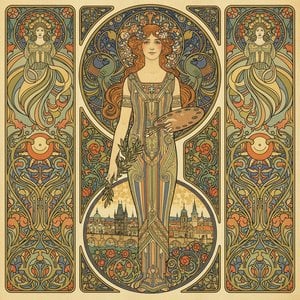
Vlastimil Kosvanec: A Voice of Czech Realism and Social Commentary
Vlastimil Kosmanec (1887-1961) stands as a pivotal figure in Czech art history, recognized not merely for his technical skill but also for his unwavering commitment to portraying the complexities of human experience with both meticulous realism and biting satire. Born in Karlín, Prague, Kosmanec’s artistic journey spanned decades, witnessing significant shifts within Czechoslovakian society and culture – transformations he consistently reflected in his prolific output as a painter, graphic designer, and illustrator.
- Early Life & Education: Kosmanec received his formative artistic training at the Prague School of Fine Arts, where he honed his skills under influential instructors who championed traditional Czech painting techniques. This grounding in classical aesthetics would prove invaluable as he navigated the evolving landscape of European art movements throughout his career.
- The Symbolist Influence: Like many artists of his era, Kosmanec initially embraced the tenets of Symbolism, drawn to its exploration of psychological depth and evocative imagery. His early works demonstrate a fascination with mythological themes and dreamlike landscapes—a stylistic hallmark that distinguishes him from later realist endeavors.
- The Rise of Realism & Social Engagement: By the 1920s, Kosmanec transitioned towards a more grounded approach, aligning himself with the burgeoning realism movement. However, he never abandoned his critical perspective; instead, he skillfully integrated social commentary into his artistic vision. He became particularly renowned for his illustrations accompanying literary classics like “Les Misérables” and “The Good Soldier Švejk,” where he captured the spirit of Czech society with astute observation and wry humor.
- Notable Achievements & Artistic Style: Kosmanec’s oeuvre encompasses a diverse range of subjects—portraits, landscapes, genre scenes—all executed with remarkable precision and sensitivity to detail. His distinctive style combined meticulous realism with subtle symbolic elements, creating images that resonated deeply with audiences. He achieved considerable acclaim for his illustrations of “Les Misérables,” capturing the emotional intensity of Victor Hugo’s epic tale with masterful brushstrokes.
- Legacy & Historical Significance: Kosmanec's contribution to Czech art extends beyond individual artworks; he served as a teacher and mentor, nurturing generations of aspiring artists. His unwavering dedication to portraying human experience—both its beauty and its suffering—continues to inspire admiration. He remains an enduring symbol of Czech artistic integrity and intellectual curiosity during the tumultuous years of the interwar period and beyond.
His work serves as a testament to the power of art to engage with social issues, offering nuanced interpretations of Czech history and culture. Kosmanec’s legacy resides not only in his impressive artistic output but also in his role as a champion of humanist values—a conviction that permeated throughout his life's creative endeavors.