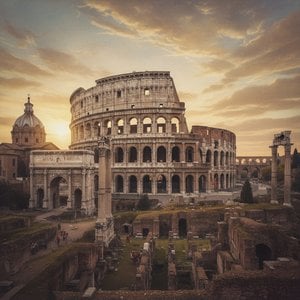
The Zenith of Neoclassicism in Rome
Vincenzo Camuccini, a master chronicler of classical grandeur and religious devotion, stands as one of the most significant figures in the artistic landscape of early 19th-century Rome. Born into an environment steeped in art—his initial tutelage came from his brother Pietro, a restorer, and the engraver Pietro Leone Bombelli—Camuccini’s early years were marked by diligent study. He spent much of his formative time immersed in the techniques of the old masters, absorbing centuries of artistic tradition. This rigorous foundation proved crucial, allowing him to later establish himself as the premier academic painter of his era within the vibrant, yet demanding, atmosphere of Roman art.
Embracing Greco-Roman Themes and Academic Rigor
As an original artist, Camuccini became a key proponent of the Neoclassical school that flourished in Rome, a movement deeply invested in the ideals and aesthetics derived from Greek and Roman antiquity. His early breakthrough as an independent painter arrived around 1798 with a monumental canvas depicting the Death of Caesar. This work immediately drew comparisons to the classicizing themes favored by Jacques-Louis David, though art historians suggest that both artists were rather emerging from a shared current: the powerful resurgence of interest in Greco-Roman narratives and styles. His commitment to these grand historical subjects defined much of his mature style.
Major Commissions and Artistic Flourishing
Camuccini’s reputation grew through increasingly important commissions that showcased both his skill and the prevailing tastes of the Church and aristocracy. A notable early undertaking was his work on an incredulity of St. Thomas, commissioned by the Vatican in 1800, which involved replicating a mosaic's grandeur. His talents were further displayed when he contributed to large-scale decorative cycles; for instance, alongside Gaspare Landi, he painted a presentation within the temple for the chapel of the Madonna of the Rosary in Piacenza in 1806. These collaborative and independent efforts cemented his status among Rome's leading artistic minds.
A Life of Travel and Enduring Influence
The call of art led Camuccini beyond the Eternal City’s walls. He was invited to Munich and, significantly, to Paris. In Paris, he found himself in the orbit of towering figures such as Napoleon, David, Perodet, and Gérard, absorbing the currents of contemporary European art. While his travels broadened his scope, his core strength remained rooted in history painting—the depiction of moments from classical or religious narratives. Whether through grand historical scenes or more intimate works like a betrothal of Psyche, Camuccini’s hand consistently conveyed a sense of noble drama and academic polish. His career stands as a testament to the enduring power of Neoclassicism, leaving behind a legacy that continues to inspire those who appreciate the meticulous detail and sweeping narratives found in his masterful reproductions.
질의응답
Vincenzo Camuccini의 작품을 기법별로 모아볼 수 있는 곳은 어디인가요?
모든 매체 페이지에서는 Vincenzo Camuccini의 작품을 기법별로 모아볼 수 있습니다.
Vincenzo Camuccini 작가는 어떤 사조에 참여했나요?
Vincenzo Camuccini의 작품은 작가의 모든 사조 페이지에서 사조별로 둘러보실 수 있습니다.
Vincenzo Camuccini의 작품 중 몇 점을 둘러보실 수 있나요?
모든 작품 보기 페이지에서 Vincenzo Camuccini의 작품 작품 27점점을 만나보실 수 있습니다.
특정 팔레트의 Vincenzo Camuccini 작품은 어떻게 찾을 수 있나요?
Vincenzo Camuccini의 작품은 작가의 컬러 팔레트별 페이지에서 컬러 팔레트별로 둘러보실 수 있습니다.
Vincenzo Camuccini의 모든 작품은 어디에서 볼 수 있나요?
본 웹사이트에 등록된 Vincenzo Camuccini의 모든 작품은 작가의 모든 작품 보기 페이지에서 확인하실 수 있습니다.
Vincenzo Camuccini은(는) 어느 시대에 활동했나요?
Vincenzo Camuccini은(는) 19th Century 시대에 활동했습니다. 이 시기는 역사적 맥락에서 작가의 활동 위치를 보여줍니다.
Vincenzo Camuccini 작가의 작품을 연도별로 어떻게 확인할 수 있나요?
Vincenzo Camuccini의 작품을 연도별로 정리하여 보여주는 작품 연대기 페이지입니다.