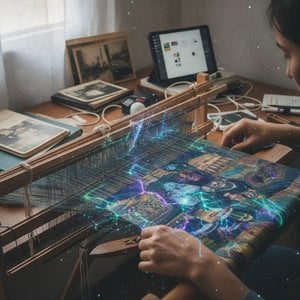
A Legacy Woven in Tradition: The Art of vanina g. bujalter ruiz
vanina g. bujalter ruiz is more than a weaver; she is a custodian of Argentinian textile heritage, an artist who breathes new life into ancient techniques while simultaneously pushing the boundaries of contemporary craft. Born and still residing in Buenos Aires, Argentina, vanina’s artistic journey began not as a solitary pursuit but as a continuation—a passing down of knowledge from her mother, Mimi Bujalter, a pivotal figure within the Argentine textile art movement and founder of the esteemed Argentine Centre. This familial foundation instilled in vanina a deep respect for the loom, the warp and weft, and the stories embedded within every thread.
Her work isn’t simply about creating beautiful objects; it's an exploration of urban handicraft, a dialogue between tradition and modernity. Vanina masterfully employs high-loom weaving, flat cloth techniques, and twill methods, utilizing a diverse palette of materials—cotton, wool, and acrylic fiber—to create pieces that are both tactile and visually arresting. The textures she achieves speak to the inherent richness of the materials themselves, while her compositions often hint at subtle narratives, inviting contemplation and connection.
The Influence of Mimi Bujalter and the Argentine Textile Renaissance
To understand vanina’s art is to acknowledge the profound influence of her mother, Mimi Bujalter. Mimi was a driving force in establishing textile art as a legitimate form of artistic expression within Argentina during a period when it was often relegated to the realm of domestic craft. She championed experimentation and collaboration, fostering a community of artists dedicated to preserving and evolving traditional techniques. Vanina’s early immersion in this environment provided her with not only technical skills but also a critical understanding of the historical context of her chosen medium.
The Argentine textile art movement itself was experiencing a renaissance during Mimi's time, fueled by a desire to reclaim indigenous traditions and celebrate local materials. This spirit of cultural revival continues to resonate in vanina’s work, which often incorporates elements that pay homage to the diverse weaving practices found throughout Argentina and South America. She doesn’t merely replicate these techniques; she reinterprets them through a contemporary lens, creating pieces that are both rooted in history and distinctly her own.
Recognition and Artistic Achievements
Vanina bujalter ruiz's dedication to her craft has not gone unnoticed. Her work has garnered significant recognition, including the prestigious UNESCO Seal of Excellence—a testament to the cultural importance and artistic merit of her weavings. She has been honored with acquisition awards at both the 4th and 1st Biennial of Urban Crafts in Buenos Aires (2011 & 2005 respectively), further solidifying her position as a leading figure within the Argentinian art scene.
Beyond accolades, vanina’s impact extends to education. She has generously shared her knowledge through teaching workshops and exhibitions throughout Argentina and internationally, inspiring a new generation of weavers and fostering an appreciation for the artistry of textiles. Her pieces are not confined to galleries; they reside in museum collections and private homes, becoming cherished objects that connect people with the rich cultural heritage of Argentina.
Exploring vanina’s Artistic Vision: A Contemporary Tapestry
Looking at works like “Red Belt” and “Red Scarf”, one is immediately struck by the textural realism and quiet contemplation they evoke. “Red Belt,” a black and white portrait, demonstrates her ability to translate form and emotion through the medium of photography, while the scarves showcase her mastery of color and weave structure. These pieces are not merely representations; they are explorations of light, shadow, and the subtle nuances of human expression.
Her art is characterized by a deliberate fusion of techniques—a blending of traditional methods with contemporary sensibilities. She isn’t afraid to experiment with new materials or push the boundaries of what weaving can be. This willingness to innovate, coupled with her deep respect for tradition, makes vanina g. bujalter ruiz a truly unique and compelling artist. Her work serves as a powerful reminder that art is not static; it is a living, breathing entity that evolves with each generation, carrying the stories of the past into the future.