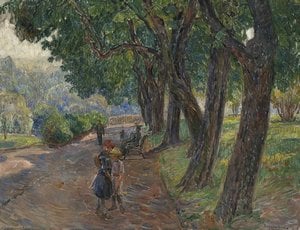
Thorolf Holmboe: A Painter of Northern Light
Thorolf Holmboe (1866-1935) stands as a pivotal figure in late 19th and early 20th-century Norwegian art, a painter whose evocative landscapes and intimate portraits captured the spirit of his homeland – particularly its rugged northern regions. More than simply documenting scenery, Holmboe imbued his work with a profound sense of place, reflecting both the grandeur of nature and the quiet dignity of its inhabitants. His career spanned diverse styles, from early Naturalism and Impressionism to a mature aesthetic informed by Symbolism and a deep appreciation for traditional craftsmanship, ultimately establishing him as one of Norway’s most celebrated artists.
Born in Vefsn, Nordland county, Holmboe's artistic journey began under the tutelage of Hans Gude in Berlin and later with Fernand Cormon in Paris. These formative years exposed him to a broad range of European artistic currents, including the burgeoning Naturalist movement focused on depicting everyday life and the vibrant Impressionism that sought to capture fleeting moments of light and color. However, Holmboe’s true inspiration lay within Norway itself. He returned repeatedly to his native Nordland, drawn by its dramatic coastline, towering mountains, and the resilient communities who called it home. This connection fueled a distinctive artistic voice – one characterized by a meticulous attention to detail, a masterful use of light and shadow, and an undeniable affection for the region’s unique character.
Early Works & Influences
Holmboe's early paintings reveal a strong influence from Naturalism. His depictions of rural life, particularly scenes of fishermen and farmers working the land, are rendered with remarkable realism and social awareness. These works demonstrate an engagement with contemporary issues and a desire to portray the lives of ordinary people. Simultaneously, he was deeply affected by Impressionistic techniques, evident in his use of broken brushstrokes and vibrant color palettes to capture the atmospheric effects of light on the Norwegian landscape. The influence of Symbolism is also apparent, particularly in his later works, where he employed muted tones and suggestive imagery to evoke a sense of mystery and emotional depth.
Crucially, Holmboe’s artistic development was shaped by his family history. His grandfather, Michael Wide Holmboe, was a bailiff involved in settling the Målselvdalen valley, an event that profoundly impacted the region's social and economic landscape. This historical context informed Holmboe’s interest in depicting the lives of those who had adapted to the challenging conditions of northern Norway. The legacy of his ancestors also instilled within him a deep respect for tradition and craftsmanship – values he would later champion through his work with Porsgrunds Porselænsfabrik, the renowned Norwegian porcelain manufacturer.
Porsgrund & Decorative Arts
A significant turning point in Holmboe’s career came with his appointment as an artist at Porsgrunds Porselænsfabrik in 1906. This collaboration proved to be extraordinarily fruitful, allowing him to combine his artistic talents with a burgeoning interest in design and craftsmanship. Over the next two decades, he created a vast body of decorative work for the factory – intricate patterns, motifs inspired by nature, and elegant vignettes that adorned porcelain tableware, textiles, and other objects. These designs were not merely decorative; they possessed a profound sense of place and reflected Holmboe’s deep understanding of Norwegian folklore and artistic traditions.
His Porsgrund work demonstrated a shift towards a more stylized and symbolic approach to painting. He employed a distinctive “Düsseldorf” perspective, characterized by its meticulous detail and atmospheric effects, alongside the vibrant colors and decorative patterns that were hallmarks of the era. This period represents a remarkable synthesis of his artistic sensibilities – blending his earlier realism with a newfound appreciation for design and craftsmanship.
Legacy & Recognition
Thorolf Holmboe’s contribution to Norwegian art is undeniable. His paintings, particularly those depicting the landscapes and people of Nordland, are treasured works of national significance. He was recognized throughout his career with numerous awards and honors, including a Knight's Cross of the Order of St. Olav in 1900 and the Petter Dass Medalje in 1912 – an accolade bestowed upon artists who had contributed to the cultural heritage of Northern Norway. His work is prominently featured in the National Gallery of Norway, ensuring that his artistic legacy will continue to inspire generations of art lovers.
Beyond his individual achievements, Holmboe played a vital role in promoting Norwegian art and design both domestically and internationally. He was a respected teacher and mentor, nurturing the talents of younger artists, and his work helped to establish Norway as a center for decorative arts and craftsmanship. Thorolf Holmboe’s paintings remain powerful testaments to the beauty and resilience of the Norwegian landscape and its people – enduring symbols of national identity and artistic excellence.
질의응답
Thorolf Holmboe의 작품을 연도순으로 어디에서 볼 수 있나요?
Thorolf Holmboe의 작품 연표를 확인해 보세요: 작품 연대기 페이지에서 작품들을 제작 날짜순으로 보실 수 있습니다.
키워드별로 분류된 Thorolf Holmboe의 작품은 어디에서 볼 수 있나요?
Thorolf Holmboe의 키워드별로 페이지에서는 작가의 작품들을 키워드별로 모아볼 수 있습니다.
Thorolf Holmboe의 모든 작품은 어디에서 볼 수 있나요?
본 웹사이트에 등록된 Thorolf Holmboe의 모든 작품은 작가의 모든 작품 보기 페이지에서 확인하실 수 있습니다.