Robert Spear Dunning: Master of Opulent Still Life
Robert Spear Dunning (1829-1905) stands as a pivotal figure in the late 19th-century American art scene, particularly renowned for his exquisitely detailed and dramatically lit still life paintings. More than simply depicting fruit and flowers, Dunning crafted immersive scenes of abundance and luxury, reflecting the prosperity and aesthetic sensibilities of his era. His work represents a significant contribution to the Fall River School of painting, a movement characterized by its focus on domestic subjects rendered with remarkable realism and an emphasis on capturing light and texture.
Born in Brunswick, Maine, in 1829, Dunning’s early life was shaped by the rhythms of industry and maritime labor. He spent his formative years working in a cotton mill before embarking on a brief career at sea – experiences that undoubtedly informed his later depictions of natural materials and their interaction with light. This practical grounding, combined with an innate artistic talent, led him to pursue formal training, initially under James Roberts in East Thomaston, Maine, and subsequently in New York City’s prestigious National Academy of Design, where he studied under the esteemed Daniel Huntington. Huntington's influence is evident in Dunning’s early work, particularly his portraits and landscapes, but it was in Fall River that Dunning truly established his unique artistic identity.
The Fall River School and a New Vision of Still Life
Dunning’s arrival in Fall River coincided with a period of remarkable growth for the city, fueled by its thriving textile industry. This economic prosperity fostered a burgeoning cultural scene, and Dunning played a key role in shaping its artistic landscape. He co-founded the Fall River Evening Drawing School in 1870, alongside John E. Grouard, providing accessible art education to the community and nurturing a new generation of artists. This school became a cornerstone of the Fall River School, an artistic movement distinguished by its focus on domestic subjects – particularly still life – rendered with meticulous detail and a heightened sense of realism.
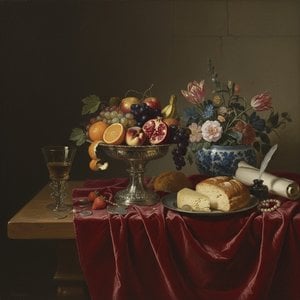
Unlike earlier still life traditions that often prioritized idealized representations or allegorical symbolism, Dunning’s paintings were rooted in direct observation. He meticulously depicted the textures, colors, and reflections of everyday objects—apples, pears, peaches, grapes, silverware, ceramics – creating scenes that felt both familiar and utterly captivating. His compositions frequently featured elaborate table settings, often incorporating highly polished surfaces and carved edges, reflecting the opulence of the Victorian era. The influence of the “trompe l’oeil” technique is apparent in his work, as he skillfully rendered reflections to create a sense of depth and illusionism, drawing the viewer into the scene.
Technique and Style: Light, Texture, and Detail
Dunning's technical mastery was legendary. He possessed an extraordinary ability to capture the nuances of light and shadow, transforming ordinary objects into shimmering spectacles. His brushwork was remarkably delicate, allowing him to build up layers of color and texture with astonishing precision. The surfaces of his paintings—the glossy skin of a peach, the velvety fuzz of a grape, the reflective sheen of silver—were rendered with an almost photographic realism. He employed a limited palette, primarily utilizing rich reds, yellows, greens, and browns, to create a sense of warmth and intimacy.
His compositions were carefully balanced, often employing the principle of symmetry or asymmetry to achieve visual harmony. Dunning’s meticulous attention to detail extended beyond the objects themselves; he also paid close attention to the background—often rendering neutral tones that served to enhance the brilliance of his still life subjects. The use of mirrors and reflective surfaces was a particularly innovative element of his style, adding layers of complexity and visual interest.
Legacy and Recognition
Robert Spear Dunning’s work enjoyed considerable success during his lifetime, earning him recognition from prominent art institutions such as the National Academy of Design, the American Art-Union, and the Boston Art Club. His paintings are now housed in prestigious collections across North America, including the Smithsonian American Art Museum, the Fall River Historical Society, and the Pennsylvania Academy of the Fine Arts. His influence can be seen in the work of subsequent generations of still life painters, cementing his place as a key figure in American art history.
Dunning’s legacy extends beyond his individual paintings; he played a crucial role in establishing Fall River as a center for artistic innovation and fostering a vibrant community of artists. His dedication to meticulous observation, technical skill, and an appreciation for the beauty of everyday objects continues to inspire artists today.
질의응답
Robert Spear Dunning의 작품을 컬러 팔레트별로 둘러볼 수 있나요?
컬러 팔레트별 페이지에서는 Robert Spear Dunning의 작품들을 색상 팔레트별로 모아볼 수 있습니다.
미술 사조별로 분류된 Robert Spear Dunning의 작품은 어디에서 볼 수 있나요?
Robert Spear Dunning 작가가 활동했던 예술 사조는 작품을 사조별로 분류하여 보여주는 작가의 모든 사조 페이지에서 확인하실 수 있습니다.
Robert Spear Dunning의 작품 중 몇 점을 둘러보실 수 있나요?
모든 작품 보기 페이지에서 Robert Spear Dunning의 작품 작품 28점점을 만나보실 수 있습니다.