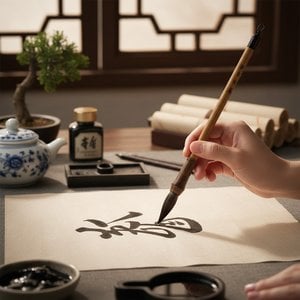
A Life Immersed in Brush and Ink: The World of Ren Xun
Ren Xun, a name resonating within the annals of Qing Dynasty painting, lived a life deeply entwined with artistic tradition yet boldly stepping into new stylistic territories. Born around 1835 in Xiaoshan, Zhejiang province, China, he emerged from a family already steeped in the world of brush and ink—his brother, Ren Xiong, being a prominent figure in their shared pursuit. This familial foundation proved crucial to his development, providing both early instruction and a constant source of inspiration. While details surrounding his formative years remain somewhat scarce, it’s clear that Ren Xun inherited not only a passion for painting but also an environment conducive to honing his skills. He wasn't merely replicating existing styles; he was absorbing them, analyzing their strengths, and preparing to forge his own path within the vibrant Shanghai art scene.The Shanghai School and a Distinctive Style
Ren Xun’s artistic maturation coincided with the flourishing of the Shanghai School of painting—a movement characterized by its eclectic approach, blending traditional techniques with popular aesthetics and an increasing awareness of Western influences. He quickly became recognized as one of the “Four Rens” alongside his brother Ren Xiong, Ren Bonian, and Ren Yu, a testament to their collective impact on shaping the artistic landscape of 19th-century Shanghai. His primary focus lay in human figure painting, and he masterfully adopted the style of Chen Hongshou, known for his expressive lines and dynamic compositions. However, Ren Xun didn’t simply imitate; he infused Chen's techniques with a unique sensibility, creating figures that were both elegant and imbued with a subtle psychological depth. His work often featured scenes from everyday life, portraits, and literati subjects—reflecting the tastes of Shanghai’s burgeoning merchant class and intellectual circles. He was known for his rigorous study, balancing meticulous copying of masterworks with keen observation of life itself, resulting in paintings that felt both grounded and refined.Technique and Themes: A Synthesis of Tradition and Innovation
Ren Xun's technical prowess lay in his ability to manipulate line and wash, creating a sense of movement and vitality within his compositions. He was particularly adept at employing various line drawing techniques—the “High Antiquity Wandering Silk Line Drawing,” the precise “Iron Wire Line Drawing,” and the fluid grace of “Flowing Clouds and Running Water” lines—demonstrating a remarkable versatility. His paintings weren’t merely decorative; they were imbued with a sense of narrative, often hinting at stories or emotions beyond what was immediately visible. The literati style is particularly evident in his landscapes and figure studies, where scholars and officials are depicted amidst serene natural settings, embodying ideals of contemplation and refined taste. His work wasn’t about grand historical narratives but rather the quiet moments of human existence. He skillfully balanced detailed rendering with expressive brushwork, creating a harmonious interplay between form and spirit.Legacy and Lasting Influence
Ren Xun's life was cut short in 1893, yet his artistic legacy endured. His paintings continue to be admired for their technical brilliance, emotional resonance, and distinctive style—a testament to his ability to synthesize tradition with innovation. Today, his work is held in the permanent collections of prestigious museums worldwide, including the Palace Museum in Beijing, the British Museum in London, the Metropolitan Museum of Art in New York, and numerous universities and institutions across the globe. He remains a pivotal figure in understanding the evolution of Chinese painting during the Qing Dynasty, particularly the dynamic developments within the Shanghai School. His influence can be seen in the works of later artists who sought to balance traditional techniques with modern sensibilities, solidifying his place as a master painter and an important contributor to China’s rich artistic heritage.A Collector's Perspective
The enduring appeal of Ren Xun’s work lies not only in its historical significance but also in its inherent beauty and emotional depth. Collectors are drawn to the subtle nuances of his brushwork, the expressive quality of his figures, and the sense of tranquility that permeates his compositions.- His paintings offer a glimpse into the life and culture of 19th-century Shanghai.
- The rarity of his works adds to their desirability.
- Ren Xun’s mastery of technique makes his paintings visually captivating.
질의응답
Ren Xun의 작품 세계는 시간이 흐름에 따라 어떻게 변화했나요?
Ren Xun의 예술적 여정은 연대기 페이지에서 시기별로 펼쳐집니다. 이곳에서는 작가의 활동 시기를 장(chapter)으로 나누어 작품들을 연대순 타임라인 형태로 한눈에 확인할 수 있습니다.
Ren Xun의 작품 중 몇 점을 둘러보실 수 있나요?
모든 작품 보기 페이지에서 Ren Xun의 작품 작품 4점점을 만나보실 수 있습니다.
Ren Xun의 출생 도시와 국가는 어디인가요?
Ren Xun은(는) China의 Xiaoshan에서 태어났습니다.
Ren Xun의 작품을 매체별로 찾아볼 수 있나요?
특정 매체로 제작된 Ren Xun의 모든 작품을 확인하시려면, 작가의 모든 매체 페이지를 이용해 주세요.
미술 사조별로 분류된 Ren Xun의 작품은 어디에서 볼 수 있나요?
모든 사조 페이지에서는 Ren Xun의 작품을 예술 사조별로 모아 볼 수 있습니다.
Ren Xun 작가의 출신 국가는 어디인가요?
Ren Xun은(는) China에서 태어났습니다.
Ren Xun의 작품을 팔레트별로 모아둔 곳은 어디인가요?
컬러 팔레트별 페이지에서는 Ren Xun의 작품들을 색상 팔레트별로 모아볼 수 있습니다.