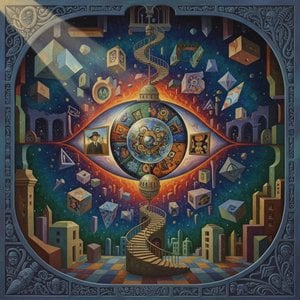
Ray Lowell Burggraf: A Life in Color Construction
Early Life and Education
Born in 1938 in Morrow County, Ohio – specifically Mount Gilead – Ray Lowell Burggraf embarked on a journey that would establish him as a significant figure in contemporary art. His formative years were spent immersed in the rural landscapes of his birthplace, an environment that would later profoundly influence his artistic vision.
Artistic Development and Influences
Burggraf’s artistic development is deeply rooted in the modernist landscape tradition, particularly drawing inspiration from the Impressionists and Neo-Impressionists. He meticulously studied the color theories of Michel Eugène Chevreul and Wilhelm Rood, foundational principles that became central to his unique approach. His work consciously echoes the techniques of artists like Georges Seurat, particularly in its exploration of optical mixing and vibrant color relationships.
Key Characteristics of Burggraf’s Work
- Visual Excitation: Burggraf's paintings are designed to stimulate the viewer's perception, creating a dynamic visual experience.
- Pulsating Patterns & Vibrating After-Images: He masterfully employs patterns and color combinations that generate optical effects, leaving lasting impressions on the eye.
- Illusionistic Spaces: His compositions often feature unconventional perspectives and spatial arrangements, challenging traditional notions of depth and form.
- Multifocal Opticality: Burggraf’s work encourages viewers to actively engage with the painting, shifting their focus to discover multiple points of visual interest.
- Precision & Elegance: Despite the complexity of his color constructions, Burggraf maintains a remarkable level of technical precision and aesthetic refinement.
Materials and Techniques
Burggraf primarily works with acrylic paint and wood, often incorporating materials like plexiglas and even UV light to enhance the visual effects of his “color constructions.” He is known for his meticulous application of paint, achieving a crisp elegance that defines his style.
Major Achievements and Exhibitions
Throughout his career, Burggraf’s work has been exhibited extensively across the United States, as well as internationally in Sweden and Korea. A significant milestone was his founding membership in 1981 of the non-profit 621 Gallery in Tallahassee, Florida, where he served as its first president. In 2004, he collaborated with fellow faculty members at Florida State University to create “A Mysterious Clarity,” a traveling exhibition that gained widespread recognition and was showcased in numerous museums and galleries, including the Brevard Art Museum.
Historical Significance and Legacy
Ray Burggraf’s work stands out for its rigorous attention to technique and its exploration of the relationship between color, perception, and environment. He has brought the role of environmentally-focused artwork to the forefront of scholarly debate. His contributions have solidified his position as a notable figure in contemporary art, inspiring artists and scholars alike with his innovative approach to color construction and optical illusion.