무료 아트 컨설팅

x

1732 - 1816

주요 정보

  • Copyright status: Public domain
  • Born: 1732
  • Color intensity: 단색
  • Died: 1816
  • Creative periods:
    • late medieval
    • mature period
  • Art period: 근세 초
  • 더 보기…
  • Top-ranked work: A Maid Hoser Sappa From The Midst Of A Kiettel
  • Lifespan: 84 years
  • Works on APS: 41
  • Top 3 works:
    • A Maid Hoser Sappa From The Midst Of A Kiettel
    • Country People In Blekinge, Sweden
    • Anchor-forge
  • Movements: baroque
  • Typical colors: 중립톤

Pehr Hilleström: A Window into 18th-Century Swedish Life

Pehr Hilleström (1732-1816) stands as a remarkably insightful chronicler of his era, a Swedish painter whose genre scenes offer an unparalleled glimpse into the daily rhythms and social fabric of Stockholm during the late 18th century. More than just a recorder of appearances, Hilleström meticulously captured the nuances of domestic life, the bustling workshops of craftsmen, and the subtle details that defined the lives of both the wealthy elite and the working class. His work, now housed in prestigious collections worldwide, is not merely decorative; it’s a valuable historical document, providing a remarkably intimate portrait of Sweden's Gustavian society.

Early Life and Artistic Training

Born on the island of Väddö in Roslagen, Sweden – a region steeped in maritime tradition – Hilleström’s early life was shaped by his family’s connection to the local vicar. This upbringing instilled in him a deep appreciation for the natural world and a keen observational eye. His artistic journey began with instruction from Johan Philip Korn, a landscape artist known for his detailed depictions of Swedish scenery. However, it was his time at the Royal Swedish Academy of Fine Arts in Stockholm that truly molded his style and provided him with the foundational skills he would later employ to such remarkable effect. Under the tutelage of Guillaume Taraval, a master of portraiture and historical painting, and Jean Eric Rehn, an architect renowned for his elegant designs, Hilleström absorbed the principles of Baroque art while simultaneously developing his own distinctive approach.

A Journey into Tapestry and Workshop Life

Hilleström’s artistic development took a significant turn during a formative study trip between 1757 and 1758. He traveled extensively through Paris, Belgium, and Holland, immersing himself in the diverse artistic traditions of Europe. Crucially, this journey introduced him to the intricate world of tapestry weaving – a skill he mastered to an extraordinary degree. He established his own weaving workshop in Stockholm from 1759 onwards, demonstrating a remarkable entrepreneurial spirit alongside his artistic pursuits. This experience provided him with invaluable insight into the production processes and materials used by artisans, knowledge that would later inform his paintings with astonishing accuracy. He wasn’t simply depicting scenes; he was meticulously reconstructing them based on direct observation and detailed study.

Genre Painting: Capturing the Essence of Everyday Life

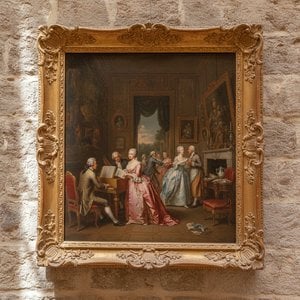
Hilleström is most celebrated for his genre paintings – works that focus on everyday life, rather than grand historical or mythological subjects. He possessed a rare ability to capture the essence of ordinary moments, transforming seemingly mundane scenes into compelling narratives. His paintings frequently depict interiors of upper- and middle-class homes in Stockholm, showcasing exquisitely rendered furniture, clothing, and domestic objects. These details are not merely decorative; they offer invaluable information about the material culture of the time – revealing the fashions, tastes, and social customs of 18th-century Sweden. He also painted scenes from the workshops of craftsmen, capturing the energy and activity of mills, blacksmiths, and other early industrial workplaces. His meticulous attention to detail—the textures of fabrics, the gleam of metal tools, the expressions on the faces of his subjects—creates a vivid sense of authenticity.

Legacy and Historical Significance

Pehr Hilleström’s contribution to Swedish art is profound. He served as a professor at the Royal Academy of Arts for many years, shaping the artistic education of future generations. His work provides an exceptionally rich source of information about 18th-century Swedish society – offering insights into social hierarchies, economic activities, and cultural values. His paintings are not simply beautiful works of art; they are windows into a bygone era, allowing us to connect with the lives and experiences of those who came before us. The meticulous detail he included in his work has made him an invaluable resource for historians and researchers studying Swedish history and culture. His legacy endures as one of Sweden’s most important genre painters, a master of capturing the spirit of his time.