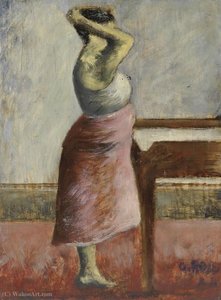
Ottone Rosai: Bridging Futurism and Renaissance Reverie
Ottone Rosai (1895–1957) stands as a singular figure in Italian art history, embodying the complex interplay between avant-garde experimentation and humanist tradition. Born in Florence during a period of fervent artistic renewal—the burgeoning Fascist era—Rosai’s oeuvre reflects this duality, characterized by luminous landscapes imbued with Impressionistic sensibilities alongside portraits that subtly echo Renaissance ideals. His journey from youthful Futurism to mature contemplation cemented his reputation as one of Italy's foremost landscape painters and a champion of stylistic synthesis.
Early Influences & Futurist Engagement
Rosai’s formative years coincided with the ascendance of Futurism in Florence, where he became deeply involved with Ardengo Soffici and other prominent artists. The Futurist movement’s embrace of dynamism, speed, and technological advancement profoundly impacted Rosai's artistic vision. He participated actively in exhibitions showcasing Futurist aesthetics, notably the Galleria Sprovieri show in Rome in 1914, alongside Soffici—a collaboration that solidified their shared commitment to challenging conventional artistic norms. This engagement wasn’t merely stylistic; it represented a broader philosophical stance questioning established hierarchies and celebrating the transformative power of modernity. The influence of Umberto Boccioni's sculptural explorations of movement is palpable in Rosai’s early canvases, demonstrating an eagerness to translate Futurist principles into visual form.
From Impressionism to Renaissance Revival
Despite his initial affiliation with Futurism, Rosai swiftly transitioned towards a more contemplative aesthetic—one rooted in the traditions of Italian painting from Giotto to Raphael. This stylistic shift wasn't abrupt but rather a gradual process driven by an unwavering fascination with the expressive potential of color and texture. He meticulously studied the works of Piero della Francesca and Andrea Mantegna, absorbing their mastery of perspective and compositional balance. Rosai’s landscapes gained a remarkable luminosity—a hallmark of Impressionism—yet retained the structural elegance characteristic of Renaissance painting. This fusion resulted in canvases that captured not only visual beauty but also profound emotional resonance.
Notable Works & Artistic Legacy
Rosai's artistic output spanned several decades, producing numerous paintings and etchings that continue to captivate audiences today. Among his most celebrated pieces are “Untitled (209)” and “Untitled (382),” both masterful depictions of Tuscan landscapes rendered in muted hues and textured brushstrokes—a testament to his dedication to Impressionistic technique. These canvases exemplify Rosai’s ability to convey atmosphere and emotion with remarkable subtlety. Furthermore, his contribution to the Venice Biennale cemented his position as a leading voice within the international art scene. His retrospective at Palazzo Capponi in 1920 and the subsequent biennale exhibitions showcased the breadth of his artistic exploration and solidified his enduring influence on subsequent generations of painters.
A Synthesis of Vision & Technique
Ottone Rosai’s legacy resides not merely in his impressive body of work but also in his pioneering approach to stylistic synthesis—a rare accomplishment that distinguishes him from many of his contemporaries. He demonstrated an unparalleled sensitivity to color and light, skillfully blending Impressionistic vibrancy with Renaissance structural precision. His canvases serve as enduring reminders of the transformative power of artistic experimentation while honoring the heritage of Italian art history. Rosai’s unwavering pursuit of beauty and truth—expressed through a distinctive visual language—continues to inspire artists and scholars alike.