Ursula von Rydingsvard: Sculpting the Echoes of Trauma and Resilience
Born in Germany during a tumultuous period – 1942, a year etched in history by war and displacement – Ursula von Rydingsvard’s life has been profoundly shaped by experiences that resonate deeply within her art. Her early years were marked by instability and upheaval, born into Polish and Ukrainian peasant farming families subjected to the horrors of Nazi forced labor. This formative backdrop, witnessing firsthand the brutality of conflict and the fragility of human existence, became a silent but powerful catalyst for her artistic journey. The subsequent migration to Plainville, Connecticut, in 1950 offered a new beginning, yet the echoes of the past continued to reverberate, subtly informing her creative vision.
Von Rydingsvard’s artistic education began at Columbia University's Studio Art program, where she honed her skills and developed a distinctive approach. Crucially, she rejected the prevailing trends of Minimalism, finding instead inspiration in the inherent qualities of cedar – a material that offered both grandeur and a poignant sense of humility. This deliberate choice speaks volumes about her artistic philosophy: to explore complex emotions through forms that are simultaneously monumental and deeply personal. Her work expanded beyond sculpture, incorporating bronze, animal intestines (a technique she developed later), textiles, and delicate handmade paper, demonstrating a willingness to experiment with diverse materials and textures.
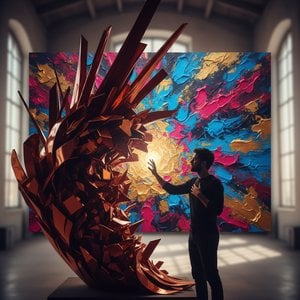
The artist’s oeuvre is characterized by an exploration of memory, loss, and the enduring power of nature. While often described as abstract, her sculptures are imbued with a quiet intensity, inviting viewers to contemplate the unseen narratives embedded within their forms. Recurring motifs – skeletal structures, fragmented shapes, and organic textures – suggest a dialogue with mortality and the cyclical processes of life and decay. Her work isn’t about literal representation but rather about evoking emotional responses and prompting reflection on universal themes.
A Life Shaped by Displacement and Activism
Von Rydingsvard's early life was dramatically altered by World War II, a period marked by the displacement of her family and the loss of loved ones. The trauma of witnessing violence and experiencing profound instability left an indelible mark on her psyche – a mark that she would later channel into her art. The death of her father in 1917, compounded by the loss of her brother and sister’s fiancé during the war, created a landscape of grief and uncertainty that profoundly shaped her worldview.
However, Von Rydingsvard's artistic pursuits were not solely driven by personal sorrow. She was also deeply engaged in social activism, particularly within the context of women’s suffrage and racial equality. Her involvement with the Virginia Commission on Interracial Cooperation demonstrated a commitment to bridging divides and advocating for justice. Her work as a secretary for the Richmond chapter of the Equal Suffrage League highlighted her dedication to securing voting rights for women, including Black women who faced systemic barriers to participation in the political process. This dual focus – artistic expression and social engagement – reveals a complex and nuanced perspective on the human condition.
The Destruction of Art and the Seeds of Resilience
A pivotal moment in Von Rydingsvard’s life, and a significant event in art history, occurred during World War II. In October 1942, as Nazi forces occupied Paris, a bonfire was lit in the gardens of the Galerie nationale du Jeu de Paume, consuming an immense collection of “degenerate art.” This act of cultural destruction included masterpieces by Picasso, Dalí, Ernst, Klee, Léger, and Miró – artists whose work challenged prevailing aesthetic norms. Von Rydingsvard’s father, a staunch critic of Nazi ideology, was deeply affected by this event, further fueling his commitment to artistic freedom and the preservation of human creativity.
The destruction of these works served as a potent symbol of oppression and censorship, but it also inadvertently revealed medieval frescoes hidden beneath the ashes – a testament to the enduring power of art to survive even in the face of deliberate obliteration. This event undoubtedly shaped Von Rydingsvard’s artistic sensibility, reinforcing her belief in the importance of resilience, remembrance, and the preservation of cultural heritage.
A Legacy of Form and Feeling
Ursula von Rydingsvard's career has spanned over seven decades, during which she has established herself as one of America’s leading sculptors. Her work is represented in numerous museum collections worldwide, including the National Museum of Women in the Arts in Washington, D.C., and the Whitney Museum of American Art in New York City. She has received prestigious awards, including the International Sculpture Center Lifetime Achievement Award in 2014 and the NMWA’s Lifetime Achievement Award for Excellence in the Arts in 2019.
Von Rydingsvard's sculptures continue to resonate with audiences today, offering a profound meditation on memory, loss, and the enduring capacity of the human spirit. Her art is not merely aesthetically pleasing; it’s a deeply felt expression of personal experience and a poignant reflection on the complexities of history – a testament to an artist who has transformed trauma into beauty and silence into voice.