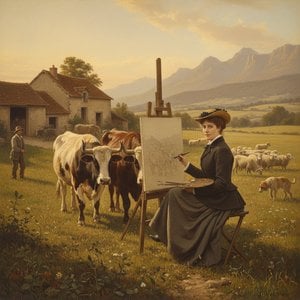
Lodovico Bigola: A Master of Detail and Correggio’s Legacy
Born in Parma, Italy, in 1822, Lodovico Bigola emerged as a significant figure within the Italian art scene during the late 19th century. His life was inextricably linked to the artistic currents of his time, particularly the revival of interest in the High Renaissance and, crucially, the profound influence of Correggio. Bigola’s career wasn't defined by grand, revolutionary gestures; rather, it unfolded through a meticulous dedication to observation, reproduction, and a deep understanding of classical techniques – making him a vital link between the past and the burgeoning modern art world.
Bigola’s early life offered little indication of his future artistic pursuits. However, he quickly demonstrated an exceptional talent for drawing and engraving, skills honed through diligent study and apprenticeship. Parma, a city steeped in artistic tradition thanks to its association with Correggio, provided the perfect environment for his development. The artist's formative years were spent absorbing the atmosphere of the region and studying the works of Correggio, whose frescoes in the Duomo di Parma profoundly shaped Bigola’s aesthetic sensibilities. This fascination with Correggio became a defining characteristic of his work – he wasn’t merely copying; he was striving to recapture the luminosity, illusionistic depth, and delicate detail that characterized the master's style.
The Art of Reproduction: Technique and Style
Bigola’s primary contribution to the art world lies in his remarkable ability to reproduce classical artworks with astonishing accuracy. He wasn’t a painter in the traditional sense; instead, he specialized in engraving and drawing, meticulously translating the forms and colors of paintings – particularly those by Correggio and other Renaissance masters – onto paper. His process involved painstaking observation, often requiring him to spend countless hours studying original works under varying light conditions. This dedication resulted in engravings that were remarkably faithful to their source material, capturing not just the outlines but also subtle tonal variations and atmospheric effects.
His technique was characterized by a remarkable level of detail. Bigola employed a sharp point and a steady hand, rendering textures with incredible precision – from the folds of drapery to the delicate brushstrokes of paint. He mastered the use of cross-hatching and stippling to create nuanced shading and depth, mimicking the effects of oil paint on canvas. Crucially, he understood that reproduction wasn’t simply about creating a copy; it was about conveying the *spirit* of the original work – its mood, its composition, and its inherent beauty.
Influences and Connections
Bigola's artistic journey was profoundly shaped by several key influences. As previously mentioned, Correggio remained his most consistent inspiration, but he also drew upon the works of Raphael, Giulio Romano, and other Renaissance masters. Furthermore, Bigola’s work reflects a broader trend within 19th-century Italy – a renewed interest in classical antiquity and a desire to revive the artistic traditions of the past. He was part of a larger movement that sought to preserve and disseminate the legacy of Italian art for future generations.
Interestingly, Bigola’s work intersected with other prominent artists of his time. His engravings were frequently commissioned by wealthy patrons and collectors, including members of the aristocracy and the burgeoning middle class who appreciated the beauty and elegance of classical art. His connections to Bologna – a center of artistic activity during this period – are also notable, as evidenced by the online resources that highlight Bolognese artists working in Rome during the early 17th century.
Legacy and Historical Significance
Lodovico Bigola’s legacy is primarily one of meticulous craftsmanship and faithful reproduction. He wasn't a revolutionary artist who challenged artistic conventions, but his dedication to preserving and disseminating classical art ensured that these masterpieces remained accessible to a wider audience. His engravings served as invaluable visual resources for scholars, collectors, and anyone interested in the beauty of the Renaissance.
While he may not be as widely celebrated as some of his contemporaries, Bigola’s work offers a fascinating glimpse into the artistic practices and cultural values of 19th-century Italy. His commitment to detail, his deep understanding of classical techniques, and his unwavering admiration for Correggio solidify his place as a significant – if often overlooked – figure in the history of Italian art.