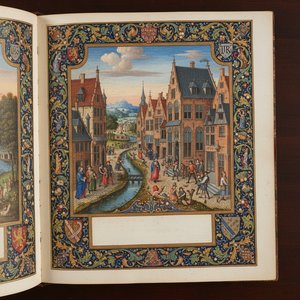
Lucas Gassel: Master of Landscapes
Lucas Gassel (c. 1485 – Brussels, 1568/69) stands as a singular figure in sixteenth-century Flemish art—a painter who defied prevailing trends and carved out his own distinctive path within the burgeoning landscape genre. While contemporaries like Joachim Patinir and Herri met de Bles meticulously crafted panoramic vistas imbued with symbolic grandeur, Gassel approached landscapes with an almost unsettling freedom, prioritizing atmospheric perspective and textural detail over strict realism.
- Early Life & Training: Born in Helmond, Netherlands, Lucas Gassel’s formative years unfolded amidst the artistic ferment of Antwerp. Tradition suggests he honed his skills under the tutelage of established masters, absorbing influences from the Antwerp School and establishing himself as a prominent artist within its vibrant milieu.
- Brussels Years & Patronage: Moving to Brussels around 1520, Gassel secured commissions from influential patrons—including Cardinal Wolsey—and participated actively in the intellectual discourse of his time. His connections with humanist thinkers like Dominicus Lampsonius underscore his engagement with broader cultural currents.
- Style & Technique: Unlike many of his peers who sought to emulate Patinir’s monumental compositions, Gassel cultivated a markedly different aesthetic. He favored matte colors, eschewed excessive ornamentation, and prioritized graphic clarity—a stylistic choice that imbued his landscapes with an understated elegance and a sense of timelessness.
- Notable Works: Gassel's oeuvre comprises approximately 60 paintings, predominantly landscape scenes interspersed with biblical narratives and allegorical figures. Among his most celebrated works are “Landscape with the Penitent St Jerome” and “An Extensive Landscape With The Flight Into Egypt,” which exemplify his masterful manipulation of light and color to convey profound emotional resonance.
- Legacy & Influence: Gassel’s contribution to landscape painting extends beyond mere stylistic innovation; he fundamentally reshaped the genre's expressive potential. His pioneering approach—characterized by a deliberate rejection of academic conventions—anticipated developments in later artistic movements and cemented his position as one of the foremost practitioners of his era.
His distinctive style, summarized by Karel van Mander as “he accentuates the graphic aspect, prefers matte colors, avoids too much accuracy and the overload of details,” reflects a conscious effort to transcend mere visual representation—aiming instead for an immersive experience that engages both intellect and emotion. Luc Serck aptly describes Gassel’s technique as “smooth artwork and subtle glaze,” highlighting his meticulous attention to surface texture and luminosity.
Furthermore, Gassel's fascination with biblical themes—particularly the Flight into Egypt—served as a springboard for exploring profound spiritual concepts within the framework of expansive landscapes. These compositions are not merely scenic vistas; they are carefully constructed narratives designed to provoke contemplation and convey moral lessons.
His work continues to inspire artists today, demonstrating the enduring power of artistic vision to transcend temporal boundaries and communicate universal truths.