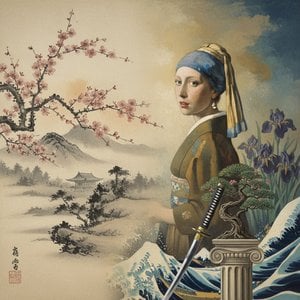
Kishi Ganryo (岸良, 岸), born in Kyoto around 1798, emerged from a lineage steeped in artistic tradition. His father, Kishi Ganku (岸駒), was himself a prominent retainer of Prince Arisugawa Yoshimune, establishing a connection to the imperial court that would profoundly shape Ganryo’s career trajectory. This familial influence instilled within him an appreciation for refined aesthetics and a dedication to mastering the techniques of Japanese painting—specifically, the Kano School tradition. Recognizing his talent early on, Ganku entrusted Ganryo's education to renowned Kano painters, ensuring he received comprehensive instruction in composition, brushwork, pigment preparation, and stylistic considerations crucial to achieving excellence within this influential artistic movement.The Kano School, founded by Kano Eitoku (1543-1615), championed a style characterized by meticulous detail and harmonious balance—a legacy Ganryo diligently absorbed.
Service to the Imperial Court and Artistic Development
Ganryo’s life was inextricably linked with service to the Tokugawa shogunate, securing him positions within the imperial administration and fostering access to influential patrons. This patronage afforded him invaluable opportunities for artistic experimentation and allowed him to hone his skills under masters like Maruyama Okyo (1738-1825) and Matsumura Goshun (1764-1849), figures who championed the *nanga* style—a genre blending landscape painting with calligraphy and poetry. The *nanga* tradition emphasized spontaneity and emotional expression alongside technical precision, representing a significant departure from the formal Kano School aesthetic.
Ganryo’s involvement in court affairs provided him with insight into the cultural values of his time, informing his artistic vision.
Exposure to diverse influences broadened his stylistic repertoire, resulting in works that seamlessly blended Kano and *nanga* techniques.
Notable Works and Artistic Style
Ganryo’s artistic output is notable for its delicate landscapes imbued with subtle tonal variations—a hallmark of the Kano School's emphasis on atmospheric perspective. However, he also produced rare floral scrolls featuring meticulously rendered blossoms and foliage, demonstrating a mastery of botanical illustration alongside compositional considerations.
“Watermill in the Mountains” exemplifies Ganryo’s ability to capture the essence of nature with understated elegance.
His use of layered brushstrokes—a technique inherited from Goshun—created textured surfaces that conveyed depth and dynamism.
Legacy and Historical Significance
Kishi Ganryo stands as a pivotal figure in the history of Edo-period Japanese painting, representing the culmination of Kano School traditions while simultaneously embracing the expressive qualities of *nanga*. His works serve as testament to the artistic dynamism of his era—a period marked by both cultural conservatism and intellectual ferment. As a retainer of Prince Arisugawa Yoshimune and a respected artist within Kyoto’s artistic milieu, Ganryo contributed significantly to the preservation and advancement of Japanese painting traditions.His influence extended beyond his own lifetime, shaping the stylistic sensibilities of subsequent generations of Kishi painters—including Gantai, Ganryo, Gankei, Gansei—solidifying his place as one of Japan’s most accomplished landscape artists. His surviving paintings continue to inspire admiration for their beauty and technical virtuosity, offering invaluable insights into the artistic culture of 18th-century Kyoto.
WahooArt.com 편집팀 작성
예술 상식 퀴즈
각 질문의 정답은 하나뿐입니다.
질문 1:
What was Kishi Ganryo’s primary role during his lifetime?
질문 2:
Kishi Ganryo’s artistic style is characterized by:
질문 3:
Which school of Japanese painting did Kishi Ganryo initially study?
질문 4:
What is Kishi Ganryo known for creating?
질문 5:
Who was Kishi Ganryo’s father, who greatly influenced his artistic development?
Explore the profound beauty of Japanese landscape painting. From Hokusai's iconic vistas to Zen-inspired compositions, discover the spiritual depth and historical mastery of Ukiyo-e art in this expert cultural retrospective.
Explore the profound influence of Japanese artistry on global masterpieces. From Ukiyo-e prints to Zen aesthetics, discover how Eastern elegance transformed Western art history in this deep cultural reflection for fine art enthusiasts and collectors.
Explore the ephemeral beauty of Japanese Ukiyo-e art. From the dynamic warriors of Kuniyoshi to serene landscapes, discover the profound history, masterful techniques, and global influence of these iconic woodblock prints in our deep cultural retrospective.