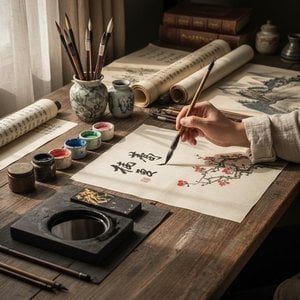
Early Life and Familial Foundations
Kanō Naonobu, born in Kyoto in 1607, emerged from a lineage deeply entrenched within the prestigious Kanō school of painting—a dynasty that had, for generations, served as artistic custodians to Japan’s ruling elite. His very existence was interwoven with the fate and flourishing of this influential style. Naonobu wasn't simply born into the Kanō tradition; he inherited a vibrant, evolving aesthetic already shaped by his father, Kanō Takanobu, and destined for further transformation through his elder brother, the celebrated Kanō Tan’yū. The early Edo period was one of consolidation under the Tokugawa shogunate, and the Kanō school found itself uniquely positioned as the official art style, tasked with visually representing the power and legitimacy of the new regime. This political context profoundly shaped Naonobu's artistic trajectory.
The atmosphere within his family workshop would have been one of intense study and rigorous training. Young Naonobu absorbed not only technical skills—brushwork, pigment preparation, composition—but also a deep understanding of classical Chinese painting, which formed the bedrock of the Kanō aesthetic. However, he wasn’t merely replicating established forms; he was part of a dynamic process of adaptation and innovation. His brother Tan'yū, already demonstrating exceptional talent, served as both mentor and rival, pushing Naonobu to refine his own unique voice within the broader Kanō framework.
Collaboration with Tan’yū and Defining a Personal Style
Naonobu’s artistic career is inextricably linked to his collaborative work with Kanō Tan’yū. The brothers frequently undertook commissions jointly, often working side-by-side on large-scale projects for the shogunate and prominent temples. These collaborations weren't simply a division of labor; they were complex dialogues where each artist brought distinct strengths to bear. While Tan’yū was renowned for his meticulous detail and refined elegance, Naonobu developed a style characterized by a bolder use of negative space—ma—and a remarkable mastery of ink wash painting (suiboku-ga). He wasn't afraid to leave areas of the canvas unpainted, allowing the emptiness to resonate with meaning and create a sense of dynamic tension.
This preference for ma wasn’t merely an aesthetic choice; it reflected a deeper philosophical sensibility rooted in Zen Buddhism. The deliberate use of empty space invited contemplation and suggested the infinite beyond the representational world. Naonobu's ink landscapes, often imbued with a sense of atmospheric depth and subtle gradations of tone, captured the essence of nature rather than its literal appearance. He skillfully employed broken brushstrokes and washes to evoke mist-shrouded mountains, cascading waterfalls, and ancient forests—scenes that resonated with the spiritual ideals favored by the warrior class.
Major Commissions and Artistic Achievements
Throughout his relatively short career – he died in 1650 at the age of 43 – Naonobu contributed to numerous significant commissions. He played a crucial role in decorating Nikkō Tōshō-gū, the lavish mausoleum of Tokugawa Ieyasu, alongside Tan’yū. Their work there exemplifies the Kanō school's ability to synthesize diverse stylistic elements—classical Chinese motifs, Japanese Yamato-e traditions, and bold decorative patterns—into a cohesive and visually stunning whole.
Beyond Nikkō, Naonobu excelled in creating fusuma-e (sliding door paintings) and byōbu-e (folding screen paintings). His screens often featured dynamic compositions populated with tigers, dragons, and other powerful symbols of strength and good fortune. He also produced a series of exquisite portraits, capturing the likenesses of prominent figures while imbuing them with a sense of dignity and authority. His ability to balance representational accuracy with expressive brushwork set him apart. A notable example is his work on the screens for the Kyoto Imperial Palace, showcasing his refined technique and understanding of courtly aesthetics.
Legacy and Historical Significance
While often overshadowed by the more celebrated Tan’yū during their lifetimes, Naonobu's contributions to the Kanō school are increasingly recognized today. His innovative use of negative space and mastery of ink wash painting profoundly influenced subsequent generations of artists. He demonstrated a willingness to experiment within the established Kanō framework, pushing the boundaries of the style while remaining true to its core principles.
Naonobu’s work embodies the spirit of the early Edo period—a time of political stability and cultural flourishing. His paintings served not only as decorative objects but also as powerful statements of authority and spiritual belief. He helped solidify the Kanō school's position as the dominant artistic force in Japan, shaping the visual landscape for centuries to come. His legacy lies not just in the beauty of his individual works but also in his contribution to a broader aesthetic tradition that continues to resonate with audiences today.
- Style: Bold use of negative space (ma), mastery of ink wash painting (suiboku-ga).
- Influences: Kanō Takanobu, Kanō Tan’yū, classical Chinese painting, Zen Buddhism.
- Major Works: Decorations at Nikkō Tōshō-gū, fusuma-e and byōbu-e featuring tigers and dragons, portraits of prominent figures.
- Historical Context: Early Edo period, Tokugawa shogunate, Kanō school as official art style.
질의응답
Kanō Naonobu의 작품을 색상별로 모아둔 곳은 어디인가요?
색상별 인덱스 페이지에서는 Kanō Naonobu의 작품들을 색상별로 모아 보실 수 있습니다.
미술 사조별로 분류된 Kanō Naonobu의 작품은 어디에서 볼 수 있나요?
Kanō Naonobu 작가가 활동했던 예술 사조는 작품을 사조별로 분류하여 보여주는 작가의 모든 사조 페이지에서 확인하실 수 있습니다.
Kanō Naonobu가 그린 모든 주제를 한눈에 볼 수 있는 개요가 있나요?
Kanō Naonobu의 작품은 작가의 주제별 아틀라스 페이지에서 주제별로 찾아보실 수 있습니다.