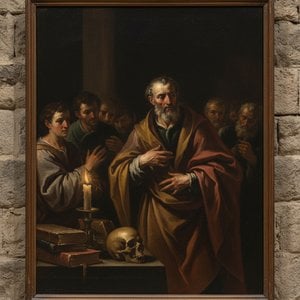
Juan del Castillo (1590-1657): Seville’s Baroque Visionary
Juan del Castillo (c. 1590 – c. 1657) remains a somewhat enigmatic figure in the annals of Spanish Baroque art, yet his contribution to Sevillian artistic heritage is undeniable. Born in Seville, Spain, little biographical detail survives beyond confirming his birthdate and place—a common predicament for artists of his era. Despite this paucity of information, scholars recognize him as one of the foremost painters active during the 1630s and 1640s, a period marked by considerable artistic dynamism in Andalusia. His legacy rests primarily on his prolific output of religious frescoes and paintings, notably within the University Chapel of Seville—a testament to his skill and dedication to portraying faith with profound beauty.- Early Life & Training: Precise details regarding Castillo’s formative years are scarce. He apprenticed under Cristóbal Muñoz, a respected artist known for his depictions of biblical scenes, undoubtedly shaping Castillo's artistic sensibilities from an early age. This apprenticeship instilled in him the stylistic conventions of the Baroque movement—characterized by dramatic lighting, rich color palettes, and meticulous attention to detail—elements that would permeate his subsequent works.
- Notable Commissions & Patronage: Castillo’s career flourished thanks to generous patronage from prominent ecclesiastical figures and noble families throughout Seville. He undertook numerous commissions for churches and private residences, producing canvases that celebrated saints, biblical narratives, and allegorical themes. These projects allowed him to hone his technique and explore innovative compositional approaches.
- The University Chapel: Castillo’s most enduring achievement is arguably his involvement in the decoration of the University Chapel—the sole surviving building from Seville's original university complex. He collaborated with Bautista Martínez, creating a monumental fresco cycle depicting scenes from the Old Testament, showcasing masterful perspective and conveying spiritual fervor. This chapel stands as an exceptional example of Baroque art and continues to inspire admiration for its grandeur and artistic merit.
- Influence & Legacy: Castillo’s work exerted considerable influence on his protégé, Bartolomé Esteban Murillo, who adopted many stylistic features characteristic of Castillo's oeuvre—particularly the use of soft lighting and idealized figures—establishing Murillo as one of Spain’s most beloved Baroque painters. Castillo’s artistic vision contributed to shaping the aesthetic landscape of Seville during his lifetime and beyond, securing his place among the pivotal artists of the Baroque period.
Stylistic Characteristics & Artistic Technique
Castillo's paintings are distinguished by several stylistic hallmarks that align seamlessly with the broader trends of the Spanish Baroque. He favored a luminous palette—often employing warm hues—to imbue his canvases with an ethereal quality, mirroring the spiritual aspirations of his time. Furthermore, he skillfully manipulated perspective to create immersive environments and convey depth within his compositions. Attention to anatomical accuracy was paramount, reflecting the humanist ideals prevalent during Castillo’s era. However, unlike some contemporaries who embraced theatrical grandeur, Castillo's style retained a sense of restraint and elegance—a hallmark of Sevillian Baroque artistry.Major Works
Among Castillo’s impressive body of work are several celebrated paintings that exemplify his artistic prowess. “Visitation” exemplifies his masterful depiction of religious emotion and compositional balance. Similarly, “Saint Felix Of Valois” showcases his ability to capture the serene dignity of saintly figures within a beautifully rendered setting. The series "From the series" demonstrates Castillo’s versatility in portraying diverse subjects—religious iconography alongside landscapes—demonstrating his artistic range and technical mastery.Historical Significance
Juan del Castillo's contribution to Seville’s artistic heritage transcends mere stylistic innovation; he embodies the spirit of a transformative period in Spanish history. His work reflects the fervent piety of the Baroque era, mirroring the profound religious convictions that underpinned Sevillian society. Moreover, his collaboration with Martínez on the University Chapel underscores the importance of collective creativity and artistic dialogue—a testament to Seville’s vibrant cultural milieu during Castillo's lifetime. Today, Castillo’s paintings continue to resonate with audiences worldwide, serving as enduring reminders of Spain’s Baroque splendor and artistic legacy.질의응답
Juan Del Castillo의 작품을 분위기별로 모아둔 곳은 어디인가요?
Juan Del Castillo의 작품은 각 작품에 담긴 분위기에 따라 분류된 아티스트의 무드 룸 페이지에서 무드별로 감상하실 수 있습니다.
Juan Del Castillo 작가의 작품을 감상할 수 있는 3D 가상 투어가 있나요?
Juan Del Castillo의 3D 뮤지엄는 작가의 작품들을 가상 3D 갤러리로 선보이는 페이지입니다.
Juan Del Castillo의 연도별 활동 기록이 있나요?
Juan Del Castillo의 연대기는 작가의 활동 시기별로 분류된 작품들을 연대순으로 보여주는 스크롤 방식의 타임라인입니다.