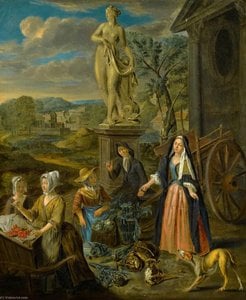
Joseph van Aken: The Drapery Painter of Georgian London
Joseph van Aken (c. 1699 – 1749) stands as a pivotal figure in the artistic landscape of eighteenth-century England, renowned primarily for his mastery of drapery painting—a technique that elevated portraiture to new heights of realism and sophistication. Born around 1699 in Antwerp, Belgium, van Aken’s early life remains shrouded in obscurity, leaving historians to reconstruct his formative years from scant biographical evidence. Unlike many Flemish artists of his era who documented their training meticulously, records indicate that he lacked formal apprenticeship under a recognized master, suggesting an autodidactic approach honed through observation and experimentation—a characteristic that would permeate his artistic practice throughout his life.- Early Career & Antwerp Period: Van Aken began his artistic journey in Antwerp, where he cultivated a distinctive style rooted in the traditions of Flemish Baroque painting. His initial canvases showcased genre scenes and conversation pieces, capturing everyday life with meticulous detail and imbued with a subtle psychological insight—a hallmark of the Antwerp School’s emphasis on portraying human emotion and social interaction. Notable works from this period include “The Washerwomen,” a vibrant depiction of domestic labor executed in rich colors and textured brushstrokes that exemplifies the stylistic conventions prevalent at the time.
- Arrival in London & Patronage: Around 1720, van Aken embarked on an ambitious transatlantic voyage to London, accompanied by his brothers Alexander and Arnoldus—all accomplished painters who sought to establish themselves within the burgeoning artistic milieu of England’s capital city. Recognizing the potential for collaboration and professional advancement, he joined forces with fellow artists like Peter Tillemans and Jean Baptiste Mercier, forming part of a vibrant Antwerp diaspora that invigorated London's art scene. Immediately upon his arrival, van Aken secured commissions from prominent patrons—including Thomas Hudson and Allan Ramsay—who recognized his exceptional talent for rendering fabric textures with unparalleled accuracy.
The Technique of Drapery Painting: Innovation & Influence
Van Aken’s contribution to art history transcends mere stylistic imitation; he fundamentally transformed the practice of drapery painting, elevating it from a supplementary craft to an integral component of portraiture itself. Prior to van Aken's intervention, drapery painters typically focused on replicating surface appearances—creating idealized representations of textiles that served primarily as decorative embellishments. However, van Aken approached this task with intellectual rigor and artistic ambition, delving into the physics of light and color to achieve a level of realism previously unattainable. He meticulously studied how fabric interacted with illumination, painstakingly recreating folds, creases, and sheen effects with astonishing precision—a feat accomplished through innovative compositional strategies and masterful brushwork.- Hudson & Ramsay Collaborations: His partnership with Thomas Hudson proved particularly fruitful, resulting in a series of iconic portraits that solidified van Aken’s reputation as the foremost drapery painter of his era. Hudson recognized van Aken's ability to capture not only the visual appearance but also the psychological essence of his subjects—a characteristic that resonated deeply with audiences accustomed to theatrical portraiture. Similarly, Allan Ramsay embraced van Aken’s stylistic vision, commissioning him to decorate several canvases for his aristocratic clientele and establishing a lasting legacy of artistic excellence.
- Beyond Portraiture: While drapery painting constituted van Aken's primary vocation, he occasionally ventured into genre painting—producing evocative scenes that captured the spirit of London life with remarkable sensitivity. His “Covent Garden Market” series exemplifies his ability to convey atmosphere and emotion through nuanced observation and skillful rendering—a testament to his versatility as an artist.
Legacy & Historical Significance
Joseph van Aken’s influence extended far beyond the confines of his immediate artistic circle, shaping the aesthetic sensibilities of Georgian England and establishing a precedent for future generations of portrait painters. His meticulous technique—characterized by its unwavering commitment to realism and its profound understanding of optical principles—became synonymous with excellence in drapery painting and profoundly impacted the visual culture of the period. Moreover, van Aken’s patronage network—spanning from Thomas Hudson to Allan Ramsay—facilitated the dissemination of artistic innovation and fostered a collaborative environment that propelled London's art scene to unprecedented heights of prestige. Today, his paintings reside in museums across Europe and North America—serving as enduring reminders of his extraordinary talent and indelible contribution to the history of art.Notable Works
- “The Washerwomen”
- “A Musical Party on a Terrace”
- “Covent Garden Market” (multiple versions)
- “The Old Stocks Market”
Q&A
Joseph Van Aken은(는) 어느 시대의 작품을 남겼나요?
Joseph Van Aken은(는) Early Modern 시대에 활동했습니다. 이 시기는 역사적 맥락 속에서 작가의 예술적 위치를 보여줍니다.
Joseph Van Aken 작가의 작품 관련 통계 정보는 어디에서 확인할 수 있나요?
Joseph Van Aken의 방문 통계 페이지에서는 이 사이트에 등록된 작가의 작품들을 바탕으로 산출된 통계 정보를 제공합니다.
Joseph Van Aken 작가의 작품을 연도별로 어떻게 확인할 수 있나요?
Joseph Van Aken의 작품을 연도별로 정리하여 보여주는 작품 연대기 페이지입니다.