José Leonardo: A Baroque Master of Spanish Drama
José Leonardo, known also as Jusepe Leonardo (Calatayud, 1601 – Zaragoza, 1652), stands as a pivotal figure in the vibrant tapestry of 17th-century Spanish Baroque painting. Born into a modest family in Calatayud, a city nestled within the province of Zaragoza, his artistic journey began under the tutelage of Eugenio Caxés and later with Pedro de las Cuevas – formative experiences that shaped his distinctive style. Leonardo’s career blossomed primarily within the court of Madrid, where he became renowned for his dramatic battle scenes and emotionally charged religious compositions, earning him a coveted position as painter to the King. His legacy endures not just through his impressive body of work but also through his intriguing story – one marked by both royal patronage and whispers of personal struggles.
Early Life and Artistic Training
Leonardo’s early life was steeped in the traditions of the Aragonese countryside. Calatayud, with its rich history and artistic heritage, provided a fertile ground for his nascent talent. His initial training under Eugenio Caxés exposed him to the prevailing styles of the time, while Pedro de las Cuevas instilled a more rigorous approach to technique and composition. These early influences laid the groundwork for Leonardo’s later development, particularly his mastery of dynamic movement and theatrical lighting – elements that would become hallmarks of his distinctive style. Notably, he was influenced by the works of Caravaggio, whose dramatic use of chiaroscuro (the contrast between light and dark) profoundly impacted Leonardo's approach to depicting figures and creating a sense of drama within his paintings.
Royal Patronage and Major Works
Leonardo’s career truly ascended upon gaining recognition by the Spanish court in Madrid. He was commissioned to execute several significant works for the Royal Alcázar, the palace of Buen Retiro, showcasing his ability to capture historical events with both accuracy and artistic flair. Among his most celebrated achievements are “The Surrender of Juliers” and “The March of the Duke of Feria’s Troop upon Acqui,” monumental battle scenes that demonstrate his exceptional skill in rendering complex compositions filled with figures and movement. These works, characterized by their dramatic intensity and meticulous detail, solidified Leonardo's reputation as one of the foremost military painters of his era. Furthermore, he contributed to the decoration of the Sacristy of the Royal Chapel alongside Félix Castello, a testament to his standing within the artistic circles of the court. His unfinished “Reliquary” in the same chapel highlights a period of personal struggle and perhaps creative frustration. A portrait of Alaric the Goth, now residing in the Royal Collections, further underscores his versatility and ability to capture the essence of historical figures.
Technique and Style
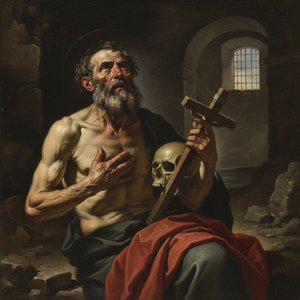
Leonardo’s artistic style is immediately recognizable for its dramatic intensity, dynamic compositions, and masterful use of light and shadow. He was a student of Caravaggio, adopting the artist's technique of *tenebrism*, employing strong contrasts between light and dark to create a sense of theatricality and heighten emotional impact. His figures are often depicted in moments of intense action or profound emotion, rendered with remarkable realism and psychological depth. Leonardo’s brushwork is characterized by its energetic quality, conveying a sense of movement and vitality. He skillfully utilized color to enhance the drama of his scenes, employing rich, saturated hues to draw attention to key elements and create a visually arresting effect. His compositions are rarely static; instead, they pulsate with energy, drawing the viewer into the heart of the action.
Legacy and Historical Significance
Despite facing personal challenges towards the end of his life – rumors circulated about alcoholism and mental instability – José Leonardo left an indelible mark on Spanish Baroque art. His dramatic battle scenes and emotionally charged religious compositions continue to captivate viewers today, offering a glimpse into the turbulent world of 17th-century Spain. Leonardo’s influence can be seen in the works of subsequent generations of Spanish painters, who adopted his techniques and embraced his approach to depicting historical events and religious narratives. His work is now housed in major museums across Spain and beyond, ensuring that his artistic legacy will endure for centuries to come. He remains a significant figure in understanding the evolution of Baroque painting and the powerful role art played in shaping the cultural landscape of his time.