Jorge Damiani (1934 – 2010): A Pioneer of Uruguayan Abstract Expressionism
Jorge Damiani, born in Montevideo, Uruguay, in 1934, was a pivotal figure in Uruguayan art history—a sculptor and painter who carved out a distinctive path through the landscape of mid-century modernism. His artistic journey began at the Círculo de Bellas Artes in Montevideo, where he honed his skills and developed an uncompromising style characterized by bold colors, geometric forms, and a profound exploration of visual abstraction. Damiani’s work stands as testament to Uruguay's burgeoning creative spirit during this period.
Early Life and Artistic Influences
Damiani’s upbringing fostered a deep appreciation for artistic pursuits. Growing up in Montevideo instilled within him an understanding of Uruguayan culture and traditions, which would later inform his artistic vision. He pursued formal training at the Círculo de Bellas Artes, immersing himself in movements like Surrealism and Constructivism—influences that undeniably shaped his approach to composition and color palettes. These formative experiences cemented his belief in the power of abstraction as a means of conveying emotion and intellectual concepts.
A Singular Artistic Style: Geometric Abstraction
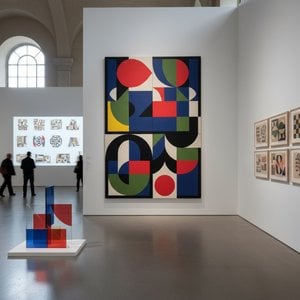
Damiani’s artistic signature is instantly recognizable: monumental canvases dominated by geometric shapes – squares, rectangles, circles—executed with meticulous precision and vibrant hues. Unlike many artists of his time who sought to represent the external world realistically, Damiani deliberately distanced himself from figurative art, prioritizing instead the exploration of pure visual language. His paintings aren’t merely decorative; they are meditations on form, color, and spatial relationships—attempts to distill complex ideas into simplified visual symbols. Recurring motifs included spirals and grids, reflecting a fascination with mathematical principles and their capacity to generate harmonious patterns.
Career Highlights and Recognition
Damiani's prolific output spanned decades of artistic experimentation and exhibition. He was a founding member of the Facultad de Artes Visuales (FAC), Uruguay’s premier art institution, which championed avant-garde aesthetics and fostered dialogue between artists and critics. His work gained international acclaim through solo exhibitions in Buenos Aires, New York City, Rio de Janeiro, and Mexico City—establishing him as one of Uruguay's most respected visual artists. Notably, his paintings were included in major biennials such as São Paulo and Venice, securing his place within the canon of Latin American art. Furthermore, Damiani’s pieces reside in prominent collections including The Ballarat Fine Art Gallery and The Hastings Museum & Art Gallery, demonstrating the enduring impact of his artistic legacy.
Legacy and Influence
Jorge Damiani's contribution to Uruguayan art extends beyond his individual achievements; he inspired a generation of younger artists to embrace abstraction and geometric forms as expressive tools. His unwavering commitment to stylistic innovation continues to resonate within contemporary Uruguayan art practice, solidifying his position as an enduring icon of modernist creativity. He remains remembered not only for his distinctive visual language but also for his dedication to fostering artistic discourse and promoting Uruguay’s cultural identity on the global stage.