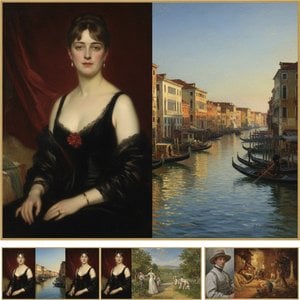
John Syme (1795–1861): A Portraitist of Edinburgh Society
John Syme (1795–1861) stands as a prominent figure in Scottish portraiture during the Victorian era, celebrated for his meticulous depictions of Edinburgh’s upper crust and imbued with an understated elegance that continues to resonate today. Born in Edinburgh, Syme's artistic journey began early, nurtured by familial encouragement and fueled by a fascination with classical art – particularly the works of Rembrandt and Joshua Reynolds – which profoundly shaped his stylistic approach. His formative years were spent honing his skills under the tutelage of John Ramsay, a respected landscape painter who instilled in Syme a disciplined technique focused on capturing subtle nuances of light and texture.
- Early Life & Training: Syme’s upbringing fostered an appreciation for intellectual pursuits alongside artistic endeavors. He pursued studies at Edinburgh University, gaining knowledge in mathematics and natural philosophy – disciplines that would inform his understanding of anatomy and perspective.
- Academic Recognition: Syme gained considerable acclaim within the Royal Scottish Academy (RSA), where he served as President from 1847 to 1853. This position afforded him influence over artistic discourse and allowed him to champion innovative approaches to portraiture, prioritizing psychological realism alongside technical precision.
- Notable Commissions & Style: Syme’s prolific output encompassed commissions ranging from aristocratic families to prominent businessmen, cementing his reputation as a sought-after artist. His distinctive style characterized by soft brushstrokes, luminous skin tones, and careful attention to detail—particularly evident in portraits of women—became synonymous with Edinburgh’s Victorian aesthetic.
Syme's artistic vision was deeply rooted in the humanist ideals prevalent during his time, reflecting a commitment to portraying subjects with dignity and compassion. He skillfully employed chiaroscuro – the dramatic interplay of light and shadow – to sculpt form and convey emotion, mirroring techniques championed by Rembrandt and Reynolds. His portraits weren’t merely representations of likeness; they aimed to capture the inner life of his sitters, conveying their character and temperament through subtle expressions and gestures. The artist's sister Maria Syme was also a talented painter who collaborated with him on several projects.
- Influences: Syme’s artistic sensibilities were undeniably shaped by the Baroque masters Rembrandt and Joshua Reynolds, whose mastery of light and shadow served as inspiration for his own compositions.
- Technique & Materials: He favored oil paints mixed with turpentine and linseed oil, meticulously applying thin layers to achieve a velvety surface finish that enhanced luminosity and depth.
John Syme’s legacy extends beyond his impressive oeuvre; he played an instrumental role in establishing the RSA as a bastion of artistic excellence and fostering a dialogue about the role of art in society. His enduring portraits continue to captivate viewers with their beauty and psychological insight, offering a glimpse into the social landscape of Victorian Edinburgh and securing his place among Scotland’s most celebrated artists. The National Galleries of Scotland proudly houses numerous Syme paintings, allowing visitors to experience firsthand the artistry and sophistication of this remarkable figure.
질의응답
John Syme의 작품들은 어떤 분위기를 담고 있나요?
John Syme의 무드 룸는 작가의 작품들을 분위기별로 모아볼 수 있는 페이지입니다.
John Syme은(는) 어느 시대에 활동했나요?
John Syme은(는) 19th Century 시대에 활동했습니다. 이 시기는 역사적 맥락에서 작가의 활동 위치를 보여줍니다.
특정 주제에 따른 John Syme의 작품을 어떻게 찾을 수 있나요?
John Syme의 키워드별로 페이지에서는 작가의 작품들을 키워드별로 모아볼 수 있습니다.