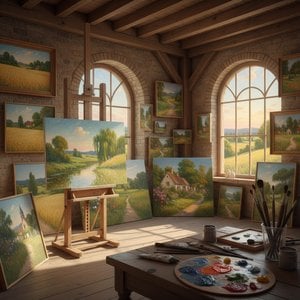
A Life Immersed in Light: The World of Jesse Dale Cast
Jesse Dale Cast, born in 1900 and passing in 1976, was a British painter whose work quietly captures the essence of a bygone era. While not a household name, his meticulous landscapes and interiors offer a poignant glimpse into the interwar period and beyond, revealing an artist deeply attuned to light, atmosphere, and the subtle beauty of everyday life. Cast’s artistic journey wasn't marked by dramatic shifts or revolutionary statements; instead, it was one of consistent refinement, dedicated observation, and a profound love for his chosen subjects – primarily the coastal scenes and sun-drenched interiors of Majorca. He represents a fascinating strand within British Impressionism, blending traditional draughtsmanship with a sensitivity to color that evokes both tranquility and a gentle melancholy. His life remains somewhat shrouded in mystery, details often gleaned from auction records and the paintings themselves, but through his art, a clear personality emerges: one of patience, precision, and an unwavering commitment to capturing the fleeting moments of beauty around him.
Early Influences and Artistic Development
Cast’s early training is not extensively documented, however, it's evident that he possessed a strong foundation in traditional painting techniques. His work displays a mastery of perspective, anatomy (particularly in his depictions of figures within interiors), and an understanding of light and shadow reminiscent of Victorian academic painters.
However, the rigid formality of those earlier styles gradually gave way to a more fluid approach, influenced by the burgeoning Impressionist movement. The impact of artists like John Singer Sargent and even early Post-Impressionists can be detected in his evolving brushwork and color palette.
- Early Focus: Initial works often featured detailed studies of British landscapes, demonstrating a keen eye for topographical accuracy.
- Shift to Majorca: A pivotal moment came with Cast’s discovery of Majorca in the 1930s. The island's unique light and architecture became a lifelong obsession.
- Watercolor Mastery: He quickly established himself as a skilled watercolorist, exploiting the medium’s transparency to capture the shimmering effects of sunlight on stone walls and Mediterranean waters.
The move to Majorca wasn't merely a change of scenery; it was a transformation. The island offered a palette of colors and textures that ignited his artistic sensibility, prompting him to embrace a looser, more expressive style while retaining his characteristic precision.
Majorcan Light: A Defining Theme
Cast’s most celebrated works are undoubtedly those depicting Majorca. He wasn't interested in grand vistas or dramatic landscapes; instead, he focused on the intimate details of island life – sun-dappled courtyards, whitewashed walls, rustic interiors, and glimpses of the Mediterranean Sea through open windows.
His paintings aren’t simply representations of places; they are evocations of a feeling—the warmth of the Spanish sun, the stillness of a summer afternoon, the quiet charm of rural life.
He became particularly adept at capturing the interplay of light and shadow on stone surfaces, rendering the textures of weathered walls with remarkable sensitivity. His interiors often feature figures engaged in everyday activities – reading, sewing, or simply relaxing – adding a human element to his serene compositions. These scenes are not narratives; they are moments suspended in time, imbued with a sense of peaceful contemplation. The use of watercolor was central to this effect, allowing him to create luminous washes and subtle gradations of color that perfectly capture the island’s unique atmosphere.
Technique and Style: A Blend of Tradition and Impressionism
Cast's technique is characterized by a remarkable level of control and precision, even within his more impressionistic works. He employed a layered approach, building up tones and textures through multiple washes of watercolor or delicate brushstrokes of oil paint.
His compositions are carefully balanced, often featuring strong horizontal lines that create a sense of stability and calm.
- Detailed Underdrawing: Evidence suggests he began each painting with a meticulous underdrawing, ensuring accurate perspective and composition.
- Layered Watercolor Washes: He skillfully employed watercolor washes to create luminous effects and subtle gradations of color.
- Oil Paint Refinement: While known for his watercolors, Cast also worked in oil paint, using it to achieve greater depth and texture.
- Subtle Color Palette: His palette was typically restrained, favoring muted tones and harmonious combinations of blues, greens, ochres, and browns.
While influenced by Impressionism, Cast never fully abandoned his traditional training. He didn’t seek to capture the fleeting impression of a moment; rather, he aimed to create a lasting image that conveyed the essence of a place or feeling. This unique blend of tradition and innovation is what sets his work apart.
Historical Significance and Legacy
Jesse Dale Cast's historical significance lies not in groundbreaking innovations but in his ability to capture a specific time and place with remarkable sensitivity and skill. His paintings offer a valuable glimpse into the interwar period and the allure of Majorca as an artistic retreat.
He represents a generation of British artists who sought refuge from the industrial world in the beauty of nature, embracing a more contemplative and lyrical approach to painting.
Although he didn’t achieve widespread fame during his lifetime, Cast's work has experienced a resurgence in popularity in recent years. Collectors are drawn to the quiet charm and technical mastery of his paintings, recognizing their enduring appeal. His legacy lies in his ability to create images that evoke a sense of peace, tranquility, and a deep appreciation for the simple beauty of life – a testament to an artist who found inspiration not in grand gestures but in the subtle nuances of light and atmosphere. His work continues to resonate with those seeking a connection to a more gentle and contemplative past.