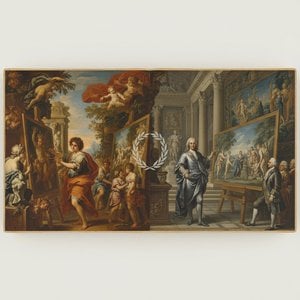
Jean Michelin (1616–1670): A Huguenot Painter Bridging Bamboccianti Tradition and Religious Expression
Jean Michelin (1616–1670) stands as a significant, yet often overlooked, figure in 17th-century French art. Born in Paris during the turbulent era of religious conflict between Catholics and Protestants – specifically Huguenots – his artistic journey reflects both the stylistic conventions of Bamboccianti painting and a profound engagement with Christian themes. While overshadowed by contemporaries like Rembrandt and Vermeer, Michelin’s distinctive style and enduring legacy continue to fascinate scholars and collectors alike.
Early Life & Training: Little is known definitively about Michelin's formative years beyond his birth in Paris. He honed his artistic skills under the tutelage of Jean Baptiste Tourigny, a prominent Bamboccianti painter who championed the use of stucco modeling to create illusionistic landscapes and architectural scenes—a technique heavily influenced by Italian Renaissance precedents. This training instilled in Michelin a meticulous attention to detail and a masterful command of perspective, shaping his approach to painting for decades to come.
Bamboccianti Style & Landscape Painting: Michelin’s early works exemplify the Bamboccianti style, characterized by expansive landscapes rendered with remarkable realism through stucco modeling. These panoramic vistas—often depicting pastoral scenes populated by animals and figures—were immensely popular in France during his time, capturing the spirit of humanist idealism prevalent at the dawn of the Baroque period. His paintings like “The Baker’s Cart” exemplify this technique beautifully, transporting viewers to idyllic countryside settings with astonishing accuracy.
Religious Commissions & Artistic Evolution: As Michelin matured as an artist, he transitioned towards more ambitious religious commissions. He produced numerous altarpieces and devotional panels depicting biblical narratives—particularly scenes from the Old Testament—demonstrating a growing interest in conveying spiritual emotion and theological symbolism. These works reveal a shift away from purely decorative landscapes toward a deeper engagement with Christian iconography.
Notable Achievements & Recognition: Michelin achieved considerable renown during his lifetime, securing commissions from influential patrons and gaining recognition for his artistic prowess. Perhaps his most celebrated achievement is “The Adoration of the Shepherds,” currently housed in The Louvre Museum—a monumental fresco that showcases Michelin’s mastery of color, composition, and expressive brushwork. This masterpiece remains a testament to his skill and enduring influence on French Baroque art.
Legacy & Historical Significance: Though Michelin's output was relatively modest compared to other artists of his era, his contribution to Bamboccianti painting and religious art is undeniable. He represents an important link between humanist landscape painting and the burgeoning Baroque tradition in France—a period marked by dramatic stylistic changes and a fervent desire to express faith through visual imagery. His work continues to inspire admiration for its technical brilliance and artistic sensitivity.
Influences & Artistic Context
Michelin’s artistic sensibilities were profoundly shaped by the intellectual currents of his time, particularly the humanist revival championed by figures like Nicolas Cochin and Jean Baptiste Tourigny. The rediscovery of classical texts and ideals fueled a renewed interest in naturalism and illusionistic representation—principles that underpinned both Bamboccianti painting and Michelin's religious compositions. Furthermore, he absorbed influences from Italian Renaissance artists such as Raphael and Michelangelo, whose works served as models for achieving grandeur and conveying spiritual profundity.
Exploring Michelin’s Oeuvre
To appreciate Jean Michelin’s artistic legacy fully, one must delve into his extensive oeuvre—spanning landscapes, portraits, and religious paintings. His Bamboccianti landscapes—characterized by meticulous detail and atmospheric perspective—offer a glimpse into the humanist vision of the Baroque era. Simultaneously, his devotional panels convey profound spiritual emotion through carefully crafted symbolism and expressive brushwork. Examining these artworks reveals Michelin’s unwavering commitment to artistic excellence and his ability to capture both the beauty of nature and the solemn grandeur of religious faith.
Resources for Further Study
For those interested in exploring Jean Michelin's life and work in greater depth, several valuable resources are available:
Reproductions of Jean Michelin's masterpieces—including “The Baker’s Cart” and “The Adoration of the Shepherds”—are available at WahooArt.com, allowing collectors and enthusiasts alike to experience the enduring beauty and artistic innovation of this Huguenot painter.
WahooArt.com 편집팀 작성
아트 퀴즈
각 질문의 정답은 하나뿐입니다.
문항 1:
What artistic style is Jean Michelin primarily known for?
문항 2:
In which museum can you find a masterpiece by Jean Michelin – “The Baker’s Cart”?
문항 3:
Jean Michelin was a devout Protestant artist. What type of art did he frequently produce?
Explore the life & art of Simon Vouet, a pivotal French Baroque painter who introduced Italian styles to France. Discover his masterpieces and lasting influence on 17th-century art.
Explore the life & art of Émile Jean Horace Vernet, a master of Romantic Realism. Discover his captivating battle scenes, portraits, and Orientalist works – a window into 19th-century France. Learn about his techniques & enduring legacy.
Explore the captivating world of Jean-Louis Forain, a master Impressionist chronicler of Belle Époque Paris. Discover his satirical paintings, realistic scenes & lasting legacy. Learn about collecting Forain's art today!