Janos Kmetty: A Pioneer of Modern Hungarian Painting
Janos Kmetty, born in Miskolc, Hungary, in 1889 and passing away in 1975, stands as a pivotal figure in the development of modern art within his homeland. More than simply a painter, he was a theorist, an educator, and a key catalyst for artistic innovation during a period of profound social and political change. His career, spanning nearly six decades, witnessed the evolution from early Cubist experimentation to a mature style characterized by a harmonious blend of abstraction and observation, firmly establishing him as one of Hungary’s most significant 20th-century artists.
Early Influences and Parisian Awakening
Kmetty's artistic journey began with formal training at the Ferenc Szablya-Frischauf Free School in Budapest, followed by a crucial year spent studying at the Julian Academy in Paris. This period proved transformative, exposing him to the revolutionary currents of European art – particularly the groundbreaking work of Paul Cézanne, Pablo Picasso, and Georges Braque. The influence of Cézanne is especially pronounced; Kmetty’s early works demonstrate a deliberate attempt to capture the essence of form through careful observation and geometric simplification, mirroring Cézanne's exploration of volume and space. The impact of Cubism, with its fragmented perspectives and simultaneous viewpoints, is equally evident, laying the groundwork for his later stylistic developments. This immersion in Parisian artistic circles fueled a desire to break from traditional representational painting and embrace a more dynamic and expressive approach.
A Bridge Between Movements: Kecskemét, Nagybánya, and Szentendre
Returning to Hungary in 1912, Kmetty joined the influential Kecskemét artists’ colony, a breeding ground for avant-garde experimentation. He then spent time at the Nagybánya artist colony, absorbing the atmosphere of this vibrant artistic community. These early experiences shaped his artistic philosophy, emphasizing the importance of observation and the exploration of new forms. Throughout the 1920s and 30s, Kmetty frequently worked in Szentendre, a renowned artists’ settlement on the Danube River, further refining his style and engaging with fellow creatives. This period saw him actively involved in the New Society of Artists, contributing to the burgeoning cultural scene of Budapest. His work during this time began to incorporate elements of Fauvism, characterized by bold colors and expressive brushstrokes, alongside the geometric precision of Cubism.
Style and Subject Matter: From Geometric Abstraction to Landscape
Kmetty’s artistic style evolved significantly over his career. Initially rooted in Cubist principles – sharp angles, fragmented forms, and a deliberate distortion of perspective – he gradually moved towards a more lyrical and atmospheric approach. His early portraits are notable for their psychological depth and subtle emotionality, often rendered with a restrained palette and a focus on capturing the essence of his subjects. Later works increasingly featured landscapes, particularly scenes from Nagybánya and Szentendre, reflecting a shift toward a more contemplative and harmonious style. These landscapes are characterized by muted colors, simplified forms, and a sense of tranquility. He skillfully employed geometric structures to create a feeling of order and balance, while simultaneously injecting elements of spontaneity and emotion into his compositions. The influence of the Fauvist movement is also apparent in his later works, with their vibrant color palettes and expressive brushwork.
Legacy and Recognition
Janos Kmetty’s contributions to Hungarian art are considerable. He was awarded the Kossuth Prize, Hungary's highest cultural honor, in 1949, a testament to his enduring influence. His work has been exhibited extensively throughout Hungary and abroad, and he played a vital role in educating generations of young artists. Beyond his artistic achievements, Kmetty’s theoretical writings – including “Festő voltam és vagyok” (I Was and Am a Painter) – offer valuable insights into his creative process and philosophical outlook. Today, his paintings are held in prominent museums and private collections, ensuring that this remarkable artist's legacy continues to inspire and captivate audiences. His work remains a significant example of early 20th-century modernism in Hungary, bridging the gap between European avant-garde movements and the unique artistic traditions of his country.
WahooArt.com 편집팀 작성
아트 퀴즈
각 질문의 정답은 하나뿐입니다.
문항 1:
Janos Kmetty initially studied art at which institution?
문항 2:
Which artistic movement heavily influenced Kmetty's early work?
문항 3:
In what year was Janos Kmetty awarded the Kossuth Prize, a prestigious national honor?
문항 4:
During which period did Kmetty frequently work at the Artist Colony of Nagybánya?
문항 5:
What was a recurring theme in Kmetty's landscape paintings?
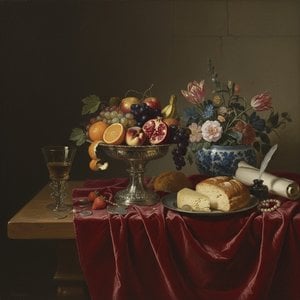
Embark on a sophisticated journey through the history of still life art. From Dutch Golden Age masterpieces to Baroque opulence, explore the profound symbolism and timeless beauty of the world's most exquisite table compositions.
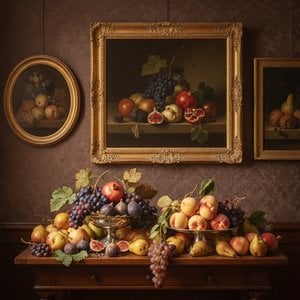
Discover the profound beauty of fruit still life paintings. Explore the rich symbolism, Baroque mastery, and timeless allure of nature's bounty through an art-historical lens, perfect for collectors and enthusiasts of classical fine art.
Embark on a sophisticated journey through art history with our exploration of still life masterpieces. Discover the profound symbolism behind classical paintings of drinks and fruit, curated for the true connoisseur seeking timeless elegance and academic depth.