무료 아트 컨설팅

x

1824 - 1903

주요 정보

  • Art period: 19세기
  • Copyright status: Public domain
  • Movements: hague school
  • Died: 1903
  • Works on APS: 179
  • More…

Jan Weissenbruch: A Master of Dutch Atmospheric Landscapes

Early Life and Artistic Beginnings

  • Born: June 19, 1824, in The Hague, Netherlands.
  • Jan Weissenbruch came from an artistic family; his father, Johannes Weissenbruch, was a painter and art collector.
  • Early exposure to works by artists like Andreas Schelfhout and Bartholomeus van Hove through his father’s collection significantly influenced him.
  • He received drawing lessons from Johannes Low at age sixteen and later attended evening classes taught by Bartholomeus van hove at the Hague Academy of Art in 1843.

Artistic Development and Influences

  • Early Influences: Weissenbruch’s initial work showed a strong resemblance to the Romantic style of Andreas Schelfhout.
  • Ruisdael's Impact: He deeply admired the 17th-century landscape painter Jacob van Ruisdael, whose works he studied at the Mauritshuis in The Hague. This inspired his magnificent and dramatic skies.
  • Evolving Style: Over time, Weissenbruch’s use of color became more restrained, and his application of paint grew broader and looser, resulting in increasingly atmospheric landscapes.

Key Characteristics and Artistic Style

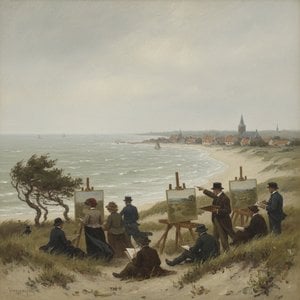
  • Atmospheric Landscapes: Weissenbruch is renowned for his ability to capture the subtle nuances of light and atmosphere in his paintings.
  • Watercolor Mastery: He was particularly noted for his exceptional watercolor skills, creating delicate and evocative scenes.
  • Hague School Representation: His work embodies the characteristics of the Hague School – a focus on realistic depictions of Dutch landscapes and everyday life.

Notable Works and Exhibitions

  • He first exhibited at the Exhibition of Living Masters in 1847, marking his entry into the art world.
  • Founding Member: Weissenbruch was one of the founders of Pulchri Studio, a prestigious artists’ society in The Hague.
  • Early Recognition: In 1849, just two years after his first exhibition, the Teylers Museum in Haarlem acquired one of his panoramic landscapes.
  • Significant Paintings: Some of his most celebrated works include “Shipping Canal at Rijswijk,” “Landscape with Mill near Schiedam,” and “Forest View Near Barbizon.”

Later Life and Legacy

  • Barbizon Influence: In 1900, at the age of seventy, Weissenbruch traveled to Barbizon, France, where he painted his famous “Forest View Near Barbizon.”
  • Working Outdoors: He preferred working outdoors, finding inspiration in the countryside surrounding The Hague.
  • Death and Remembrance: Jan Weissenbruch passed away in 1903, leaving behind a legacy as one of the best representatives of the Hague School. His delicate brushstrokes and restrained color palette continue to captivate art lovers today.

Historical Significance

  • Dutch Landscape Tradition: Weissenbruch played a vital role in continuing the Dutch tradition of landscape painting, building upon the legacy of earlier masters like Ruisdael.
  • Hague School Contribution: His work helped define the aesthetic and philosophical principles of the Hague School, emphasizing realism, atmosphere, and a connection to nature.
  • Lasting Influence: He remains an important figure in Dutch art history, inspiring generations of landscape painters with his sensitive depictions of the natural world.