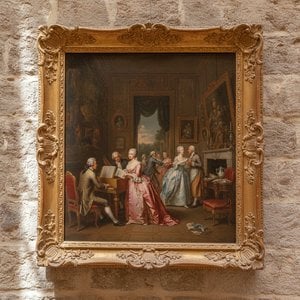
A Chronicler of Antwerp Life: Jan Josef Horemans the Elder
Jan Josef Horemans the Elder, born in Antwerp in 1682 and passing away in the same city in 1759, stands as a fascinating figure within the tapestry of 18th-century Flemish painting. While not achieving the widespread renown of some contemporaries, his meticulous genre scenes offer an invaluable glimpse into the daily existence of bourgeois life in Antwerp during a period of significant social and economic change. He wasn’t merely recording what he saw; Horemans was crafting narratives, small windows into the habits, anxieties, and quiet dramas unfolding within the homes and streets of his native city. His work provides a unique historical record, painted with a precision that borders on photographic realism yet imbued with a distinctly Baroque sensibility.Early Life and Artistic Formation
Horemans’s artistic journey began in 1694 when he was registered as an apprentice at the Antwerp Guild of Saint Luke, initially under the tutelage of the sculptor Michiel van der Voort the Elder. This early exposure to sculpture likely instilled a keen understanding of form and three-dimensionality that would later manifest in his carefully constructed compositions. He subsequently moved into the studio of Jan van Pee, where he honed his skills as a painter. In 1706, Horemans achieved master status within the Guild, marking a pivotal moment in his career. A year later, he solidified both his personal and professional life through marriage to Maria Francisca van der Voort, the daughter of his first mentor. This familial connection would prove significant, as his son, Jan Josef Horemans the Younger, also followed in his artistic footsteps, creating a legacy that spanned generations. The elder Horemans’s commitment to his craft was further demonstrated by his role as a teacher, guiding both his younger brother Peter Jacob and his son along their own creative paths.The World Within Walls: Themes and Style
Horemans carved out a niche for himself with his genre scenes – intimate depictions of everyday life. Unlike the grand historical or religious paintings that dominated much of the artistic landscape, Horemans focused on the domestic sphere. Interiors teeming with activity—families sharing meals, merchants conducting business, children at play—became his signature subject matter. He also ventured into portraiture and allegorical works, but it was in these smaller, anecdotal scenes that his talent truly shone. His style is characterized by a remarkable attention to detail; objects are rendered with painstaking accuracy, fabrics shimmer with texture, and faces convey subtle emotions. However, Horemans’s palette tended towards darker tones—a characteristic that earned him the nicknames “le brun” (the dark one) and “le sombre” (the shadowy one), distinguishing his work from that of his son, who favored a lighter approach. Despite this somewhat somber coloration, his paintings are far from bleak; they possess a lively energy, capturing the bustle and vibrancy of Antwerp life.Influences and Legacy
While Horemans developed a distinctly personal style, he was undoubtedly influenced by the 17th-century Flemish genre painters who preceded him—artists like Pieter Bruegel the Younger and David Teniers the Younger. He inherited their penchant for detailed observation and narrative storytelling but infused his work with a more refined elegance and a greater emphasis on contemporary subject matter. His paintings reflect a shift in artistic focus, moving away from purely moralistic or allegorical themes towards a more straightforward depiction of everyday reality. The sheer volume of small paintings he produced—often executed as part of larger series—suggests a thriving market for his work among the burgeoning bourgeois class. Horemans’s legacy extends beyond his individual artworks; he is remembered as a leading chronicler of 18th-century Antwerp, providing an invaluable visual record of a society undergoing transformation. His son, Jan Josef Horemans the Younger, continued this tradition, further solidifying the family's place in Flemish artistic history.Historical Significance and Modern Appreciation
Today, Jan Josef Horemans the Elder is increasingly recognized for his unique contribution to Flemish painting. While he may not be a household name, his work offers a compelling window into a specific time and place—a world of bustling commerce, domestic intimacy, and subtle social dynamics. His paintings are prized by collectors and scholars alike for their meticulous detail, narrative richness, and historical significance. The fact that over 300 artworks attributed to him have appeared at auction speaks to the enduring appeal of his vision. Horemans’s scenes aren't merely decorative; they are social documents, offering insights into the material culture, customs, and values of 18th-century Antwerp. He stands as a testament to the power of genre painting—a reminder that even the most seemingly mundane subjects can reveal profound truths about the human condition. His ability to capture the essence of everyday life with such precision and sensitivity ensures his continued relevance in the world of art history.질의응답
Jan Josef Horemans The Elder 작가의 출신 국가는 어디인가요?
Jan Josef Horemans The Elder은(는) Belgium에서 태어났습니다.
Jan Josef Horemans The Elder의 작품 세계는 시간이 흐름에 따라 어떻게 변화했나요?
Jan Josef Horemans The Elder의 작품 세계를 시간순으로 정리한 기록은 아티스트 연대기 페이지에서 확인하실 수 있으며, 이곳에서는 각 시기별로 분류된 챕터를 따라 작품들을 제작 순서대로 만나보실 수 있습니다.
Jan Josef Horemans The Elder 작품의 연도별 타임라인이 있나요?
Jan Josef Horemans The Elder의 작품 연표를 확인해 보세요: 작품 연대기 페이지에서 작품들을 제작 날짜순으로 보실 수 있습니다.
Jan Josef Horemans The Elder의 출생지와 출생 연도는 언제인가요?
Jan Josef Horemans The Elder은(는) 1682년 Antwerp에서 태어났습니다.
Jan Josef Horemans The Elder의 작품 전체 목록을 볼 수 있는 곳이 있나요?
본 웹사이트에 등록된 Jan Josef Horemans The Elder의 모든 작품은 작가의 모든 작품 보기 페이지에서 확인하실 수 있습니다.
Jan Josef Horemans The Elder의 출생 도시와 국가는 어디인가요?
Jan Josef Horemans The Elder은(는) Belgium의 Antwerp에서 태어났습니다.
Jan Josef Horemans The Elder의 작품 중 몇 점을 둘러보실 수 있나요?
모든 작품 보기 페이지에서 Jan Josef Horemans The Elder의 작품 작품 40점점을 만나보실 수 있습니다.