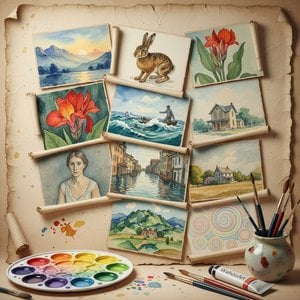
The Quiet Elegance of James Isaiah Lewis
James Isaiah Lewis (1861-1934) emerged as a prominent watercolorist during the Victorian era, establishing himself as a masterful interpreter of Surrey’s picturesque countryside. Born in Middlesbrough, Yorkshire, he possessed an innate fascination with botany and geology—interests that profoundly shaped his artistic vision and informed his meticulous observation of natural forms. His dedication to capturing subtle nuances of light and color cemented his reputation as one of the foremost landscape painters of his time, a creator who found profound beauty in the understated rhythms of the English landscape.
Lewis's artistic journey began modestly, honing his skills through self-taught experimentation before enrolling at the prestigious Slade School of Fine Art in London. There, he studied under the legendary Frederic Leighton, absorbing the Beaux Arts aesthetic championed by the Royal Academy—a style characterized by idealized beauty and formal composition. However, Lewis swiftly transcended mere imitation, developing a distinctive approach rooted in direct plein air painting and an unwavering commitment to realism. He eschewed theatrical grandeur for quiet contemplation, preferring to depict scenes of rural Surrey with remarkable sensitivity and detail.
A Mastery of Light and Landscape
The essence of Lewis’s work lies in his ability to transform a simple river scene or a woodland path into a moment of eternal stillness. His canvases frequently portray iconic locations such as Kew Gardens and Richmond Hill—subjects that captivated Victorian artists and intellectuals alike. Through his meticulous brushwork, he captured the ethereal glow of dawn over the Thames meadows or the stately grandeur of Richmond Castle perched atop its hilltop. He skillfully rendered foliage, water reflections, and architectural elements with astonishing accuracy, conveying not just visual information but also a palpable sense of atmosphere.
His technical prowess allowed him to bridge the gap between scientific observation and romantic emotion. Influenced by masters such as Claude Lorrain and John Constable, Lewis embraced the Romantic tradition's emphasis on emotion and sublime beauty while maintaining an unwavering adherence to the geological and botanical truths of his subjects. This duality is perhaps most evident in his notable works:
- Kew Bridge: A stunning representation of a river scene from 1900, showcasing a lively waterway filled with boats and the delicate textures of oil on canvas.
- The Triangle, Sheen Lane, East Sheen: A serene 19th-century depiction of rural Surrey life that exemplifies his evocative landscape style.
- Syon House Seen across the Thames: A masterful study of light and reflection along the Kew riverbank.
- Isleworth Riverside: A contemplative piece looking towards a distant church, highlighting his ability to find sanctity in the everyday.
Legacy of the Surrey Landscape
The historical significance of James Isaiah Lewis resides in his role as a chronicler of a vanishing era. As the industrial landscape began to shift the face of England, Lewis’s dedication to the plein air tradition preserved the pastoral innocence of the Surrey countryside for future generations. His work serves as both a botanical record and an emotional window into the Victorian soul, capturing a period defined by a deep reverence for the natural world.
Today, his paintings remain cherished in collections such as the Hounslow Local Studies Library, where they continue to invite viewers into a peaceful, meticulously rendered world. Through his ability to marry the precision of a scientist with the heart of a poet, Lewis ensured that the quiet elegance of the English landscape would never truly fade from the annals of art history.
질의응답
James Isaiah Lewis의 모든 작품은 어디에서 볼 수 있나요?
본 웹사이트에 등록된 James Isaiah Lewis의 모든 작품은 작가의 모든 작품 보기 페이지에서 확인하실 수 있습니다.
키워드별로 분류된 James Isaiah Lewis의 작품은 어디에서 볼 수 있나요?
특정 주제의 James Isaiah Lewis 작품을 찾으려면 키워드별로 작품이 분류된 작가의 키워드별로 페이지를 이용해 보세요.
James Isaiah Lewis 작가의 작품을 연도별로 어떻게 확인할 수 있나요?
James Isaiah Lewis의 작품을 연도별로 정리하여 보여주는 작품 연대기 페이지입니다.