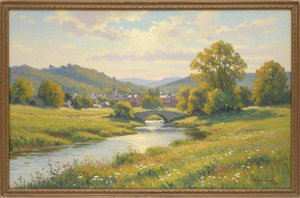
Henri van Assche: The Painter of Waterfalls
Born in Brussels in 1774, Henri van Assche’s life and artistic journey were deeply intertwined with the landscapes of Belgium and beyond. His father, Joseph François Van Assche, a respected brewer and Dean of the Corporation of Brewers, instilled in him not only an appreciation for craftsmanship but also a foundation in design and perspective – skills that would prove crucial to his burgeoning talent. While family tradition steered him towards brewing, Henri’s innate artistic inclination led him to formal training under Jean-Baptiste de Roy, followed by invaluable study trips through the picturesque regions of Switzerland and Italy. These formative experiences ignited a profound love for capturing the beauty of nature, particularly the dramatic power and serenity of waterfalls and the industrious charm of water mills – motifs that would define his career and earn him the enduring moniker “The Painter of Waterfalls.”
Van Assche’s early artistic development was significantly influenced by the Neoclassical style prevalent in Brussels at the time, yet he quickly developed a distinctive approach. He wasn't merely replicating scenes; he sought to convey a sense of atmosphere and emotion through his brushwork. His compositions often featured dynamic diagonals created by cascading water, reflecting a keen understanding of light and shadow. The inclusion of animals – frequently rendered with the assistance of Balthasar Paul Ommeganck, a skilled animal painter – added layers of narrative and realism to his landscapes, grounding them in the natural world.
- Early Exhibitions & Membership: Van Assche’s artistic reputation began to blossom when he exhibited at the Ghent Salon in 1803. He quickly gained recognition within the Belgian art community, becoming a member of prestigious organizations such as the Société de peinture, sculpture et architecture de Bruxelles, the Royal Academy of Fine Arts (Antwerp), and the Royal Academy of Visual Arts in Amsterdam – testaments to his growing influence and skill.
- Swiss-Italian Influence: His travels through Switzerland and Italy were transformative. He absorbed the techniques of landscape painting from masters like Canaletto and sought inspiration in the dramatic mountainscapes and vibrant colors of the Italian countryside.
- Notable Collaborations: The collaboration with Balthasar Paul Ommeganck on animal subjects is a fascinating aspect of Van Assche’s work, demonstrating a willingness to integrate diverse artistic talents into his compositions.
The Art of Waterfalls and Mills
Van Assche's oeuvre is overwhelmingly dominated by depictions of waterfalls and water mills – images that resonate with both the raw power of nature and the industrious spirit of human endeavor. He wasn’t simply documenting these subjects; he was elevating them to a level of artistic significance, imbuing them with a sense of drama, beauty, and even spirituality. His paintings of waterfalls, such as “River in the Ardennes at Sunset,” are characterized by their dynamic compositions, masterful use of light and shadow, and an almost palpable sense of movement. The cascading water seems to leap off the canvas, captivating the viewer’s attention.
Similarly, his depictions of water mills – often set against stunning natural backdrops – capture a sense of rustic charm and timelessness. These scenes are not merely industrial; they are imbued with a quiet dignity, reflecting the vital role that these structures played in the lives of rural communities. The careful attention to detail—the texture of the millstones, the reflections on the water’s surface—demonstrates Van Assche's meticulous approach to his craft.
Key Characteristics of His Style:- Dynamic Compositions
- Masterful Use of Light and Shadow
- Evocative Atmospheric Effects
- Detailed Observation of Natural Elements
A Family Legacy in Art
Van Assche’s artistic lineage extended beyond his immediate family. His father, Joseph François Van Assche, was not only a respected brewer but also an amateur artist who provided Henri with his initial training. Furthermore, two of his nieces – Amélie van Assche and Isabelle Catherine van Assche – followed in the family tradition, pursuing careers as artists. Amélie, a portrait miniaturist, achieved considerable renown, eventually becoming a court painter to Queen Louise of Orléans, while Isabelle was one of Van Assche’s students, demonstrating a clear transmission of artistic knowledge and techniques within the family.
His brother-in-law, Pierre-Joseph de Marneffe, further contributed to the family's artistic circle as an art dealer. This network of artists and patrons provided Van Assche with valuable support and opportunities throughout his career. The interconnectedness of these artistic figures highlights the vibrant cultural landscape of Brussels during the late 18th and early 19th centuries.
Legacy and Recognition
Henri van Assche’s work is now recognized as a significant contribution to Belgian landscape painting. His paintings are held in public and private collections across Belgium, Ghent, Lille, and Haarlem, testament to their enduring appeal. His distinctive style—characterized by its dramatic compositions, masterful use of light and shadow, and evocative depictions of waterfalls and water mills—continues to captivate viewers today. The legacy of “The Painter of Waterfalls” endures as a reminder of the beauty and power of the natural world, skillfully rendered through the talent and vision of one of Belgium’s most celebrated artists.
Further Resources: