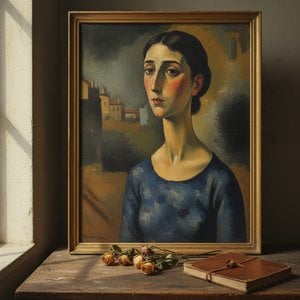
The Quiet Observer of the Slovak Landscape
Gejza Salay lived a life shaped by the textures of the land and the discipline of the classroom. Born in Žilina, his hands were trained early in the ways of form and surface. He studied at the Gymnasium in Žilina before moving on to the High School of Applied Arts, where he focused on sculpture. This early grounding in three-dimensional shape often seems to linger in his later paintings, where the weight of a subject is felt through the way light settles on a surface.
His work often turned toward the simple, unadorned moments of rural life. In pieces like Bača or Matka, there is a focus on the presence of the figure within its environment. He did not seek to dramatize these subjects, but rather to record them. Whether working in oil on canvas or on more humble materials like cardboard and board, his attention remained on the essential character of the scene, from a woman's head to the quietude of a forest.
A Life of Teaching and Making
Beyond the studio, Salay was a pedagogue. His life was split between the act of creation and the act of instruction, serving as a teacher and a sculptor. This dual existence suggests a man deeply rooted in the mechanics of his craft. He understood how to build a form from nothing, a skill that translated into his paintings, where the composition of a landscape or a figure felt deliberate and measured.
His subjects often reflected the natural world and the people who inhabit it. He captured scenes such as Praní na potoce and Stretnutie v prírode, works that suggest a deep familiarity with the rhythms of the outdoors. There is a sense of stillness in these depictions, a feeling of a moment caught in the middle of a task or a quiet encounter. His palette and his choice of surfaces, including oil on cardboard, speak to a practical, working relationship with his materials.
The Physicality of the Work
The marks left by Salay are often found in the specific details of his compositions. In works like Veternô or Z poľa, the texture of the paint and the choice of the substrate contribute to the overall weight of the image. He was a man of many mediums, moving between the permanence of sculpture and the immediacy of oil on canvas. This versatility allowed him to explore the same themes through different tactile experiences.
His legacy is found in these quiet records of a specific time and place. He passed away in Bratislava, leaving behind a body of work that remains grounded in the tangible. His paintings do not reach for the abstract; they stay close to the earth, the wood, and the skin, capturing the world as it was seen from a steady, observant eye.