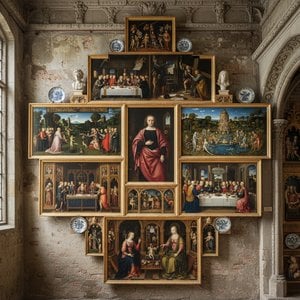
Frans van der Mijn: A Dutch Portraitist Shaped by Influence and Observation
Frans van der Mijn (Frank Vandermine), born in Düsseldorf, Germany around 1719, stands as a relatively obscure figure within the vibrant tapestry of 18th-century Dutch art history. Yet, his contribution to portraiture—particularly his meticulous depictions of individuals and domestic interiors—holds considerable interest for scholars examining the artistic landscape of Amsterdam and Haarlem during the Golden Age. While overshadowed by contemporaries like Rembrandt and Vermeer, Van der Mijn’s work reveals a distinctive style characterized by careful attention to detail and an understated elegance that aligns with the prevailing aesthetic sensibilities of his time.
- Early Life & Family Background: Born into a family of artists—his father, Herman van der Mijn, was himself a painter who relocated to Düsseldorf to pursue artistic endeavors alongside Johann Wilhelm, elector palatine—Frans’s upbringing instilled in him an appreciation for visual arts from a young age. His siblings, Robert, George, Andreas and Cornelia, were equally gifted painters, fostering a familial tradition of artistic excellence.
- Amsterdam Years (1742-1748): Van der Mijn established his presence in Amsterdam during the mid-1740s, immersing himself in the bustling art scene of the city. This period witnessed collaborations with fellow artists like James Latham, whose influence is evident in Van der Mijn’s stylistic choices and compositional techniques.
- Haague Period & London Engagement: Moving to The Hague before returning to England, Van der Mijn continued his artistic practice, focusing on portrait commissions and diligently submitting paintings annually to the London Society of Artists between 1761 and 1772.
Style and Technique: Observation and Precision
Van der Mijn’s artistic approach distinguished itself through a commitment to realism combined with subtle expressive qualities. Unlike some artists of his era who prioritized dramatic gestures or idealized forms, Van der Mijn favored a more restrained style—one that captured the essence of his subjects with remarkable accuracy. Detailed renderings of facial features, clothing textures, and architectural settings demonstrate an unwavering dedication to observation and meticulous craftsmanship. His canvases often convey a sense of quiet contemplation, reflecting the psychological depth he achieved through careful portrayal.
- Notable Works: Among his most celebrated paintings are “Portrait of Jan Pranger and an Enslaved Servant,” “Family Group in an Interior,” and “Portrait of Machteld Muilman.” These pieces exemplify Van der Mijn’s mastery of portraiture, showcasing his ability to convey both physical likeness and inner character.
- Influence of James Latham: Contemporary accounts suggest a significant artistic connection between Van der Mijn and James Latham, whose stylistic innovations undoubtedly impacted Van der Mijn's oeuvre. Latham’s emphasis on naturalistic representation and psychological nuance aligns seamlessly with Van der Mijn’s artistic sensibilities.
Legacy & Historical Context
Edward Edwards penned a poignant portrait of Van der Mijn in 1808, highlighting his unassuming demeanor and unwavering passion for painting—a characteristic that contrasted sharply with the social expectations of his time. Despite his modest lifestyle and somewhat eccentric habits (including a fondness for smoking and drinking), Van der Mijn’s dedication to his craft cemented his reputation as a skilled artist. His work contributes to our understanding of Dutch portraiture during the Enlightenment, reflecting the artistic trends prevalent in Amsterdam and Haarlem.
Further Exploration
For deeper insights into Frans van der Mijn's life and art, consider visiting Museo d’Arte Moderna Ca’ Pesaro in Venice and Frans Hals Museum in Haarlem—institutions that showcase exemplary collections of Baroque and Golden Age paintings respectively. These museums offer invaluable resources for appreciating the artistic heritage of Europe during this transformative period.