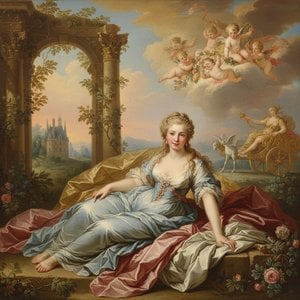
François-Edme Ricois: A Master of Detail and Napoleonic Portraiture
François-Edme Ricois (1795 – 1881), born in Courtallain, France, stands as a testament to the enduring legacy of Mannerist painting within the broader context of French art history. His artistic journey unfolded amidst the turbulent era of Napoleon Bonaparte and witnessed him establishing himself as a respected portrait artist, particularly celebrated for his depictions of members of the imperial family.
Born into a family steeped in artistic tradition – his father, Jacques Edme Ricois, was also a painter – François-Edme’s formative years instilled within him an appreciation for meticulous observation and technical precision. This dedication would become the hallmark of his oeuvre, shaping his distinctive style characterized by clarity and unwavering attention to detail. He married Marie Louise Dubois, cementing his life in France and fostering a family that continued the artistic lineage.
Ricois's artistic development can be traced back to influences rooted in the traditions of Flemish and Italian Mannerism. Artists like Peter Paul Rubens and Caravaggio championed dramatic lighting and expressive gestures, techniques Ricois skillfully adopted to imbue his canvases with palpable emotion and realism. Unlike many contemporaries who favored looser brushstrokes and idealized forms, Ricois prioritized accuracy—capturing subtle nuances of expression and capturing the textures of fabrics and landscapes with remarkable fidelity.
His artistic output spanned a prolific career, producing numerous portraits that solidified his reputation as one of Napoleon’s official artists. These commissions demanded an exacting level of skill, requiring Ricois to meticulously render the likenesses of emperors, princes, and princesses with breathtaking accuracy. Beyond portraiture, he also excelled in landscape painting, demonstrating a keen understanding of atmospheric perspective and capturing the grandeur of French countryside. Notably, “Study of the Roots of a Fallen Tree” exemplifies his masterful technique—a composition imbued with symbolic depth and executed with painstaking detail. This artwork showcases Ricois’s ability to transform observation into artistic expression, reflecting the Mannerist preoccupation with conveying psychological states through visual representation.
Ricois's contribution to French art extends beyond individual masterpieces; he represents a crucial link in the chain of stylistic evolution from Rubens to Rembrandt. His unwavering commitment to realism and his masterful handling of light and shadow ensured that his paintings would endure as timeless representations of both human character and natural beauty, securing his place within the annals of European artistic history.