The Parisian Prelude and Early Foundations
Born in 1886 amidst the rich, cultural tapestry of Istanbul, Feyhaman Duran emerged as a pivotal figure whose life would mirror the profound transformations of his nation. His artistic journey began within the prestigious halls of the Galatasaray High School, where his early talent was nurtured by masters such as Şevket Dağ and Viçen Arslanyan. However, it was a serendipitous encounter with the grace of a portrait that opened the gates to Europe. Supported by the patronage of Prince Abbas Halim Pasha, Duran traveled to Paris, a move that would forever alter the trajectory of Turkish painting. In the legendary studios of the Académie Julian, under the watchful eyes of Jean-Paul Laurens and Paul Albert Laurens, he immersed himself in the rigorous academic traditions of France. This period of intense study at the École des Beaux-Arts allowed him to absorb the nuances of light, shadow, and form, preparing him to bring a sophisticated European sensibility back to his homeland.A Synthesis of East and West
When the shadows of the First World War prompted his return to Istanbul in 1914, Duran did not merely bring back techniques; he brought a new way of seeing. As a prominent member of the so-called 1914 Generation, he became a bridge between the classical Ottoman heritage and the burgeoning modern identity of the Turkish Republic. His work is a masterful dialogue between two worlds. While his training was deeply rooted in Western Impressionism and academic realism, his soul remained tethered to the delicate precision of calligraphy, a discipline in which he had achieved great distinction. This duality allowed him to capture the faces of a new era with unparalleled dignity. His portraits of iconic figures, such as Mustafa Kemal Atatürk and İsmet İnönü, are more than mere likenesses; they are historical monuments rendered in oil, capturing the gravity and the hope of a nation in transition.The Quiet Mastery of Light and Form
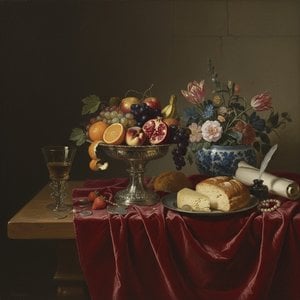
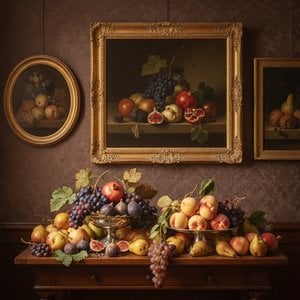
Beyond the monumental scale of his political portraiture, Duran possessed an exquisite sensitivity for the intimate and the ephemeral. He found profound beauty in the mundane, elevating simple subjects to the realm of high art through his masterful still lifes and landscapes. His compositions, such as those featuring cyclamens or the rustic simplicity of a melon, demonstrate a breathtaking command over texture and luminosity. In these works, one can sense the lingering influence of Impressionism—the way light dances across a petal or settles upon fruit—blended with a structural permanence derived from his academic roots. Even within the sacred and historical confines of the Topkapı Palace, where he was granted rare access to paint its interiors, Duran’s brush captured the enduring spirit of the Ottoman past. Through his lifelong devotion to both the pen and the brush, Feyhaman Duran left an indelible mark on the history of art, ensuring that the transition from empire to republic was recorded with both elegance and truth.질의응답
Feyhaman Duran의 작품을 색상별로 모아둔 곳은 어디인가요?
색상별 인덱스 페이지에서는 Feyhaman Duran의 작품들을 색상별로 모아 보실 수 있습니다.
키워드별로 분류된 Feyhaman Duran의 작품은 어디에서 볼 수 있나요?
Feyhaman Duran의 키워드별로 페이지에서는 작가의 작품들을 키워드별로 모아볼 수 있습니다.
Feyhaman Duran가 그린 모든 주제를 한눈에 볼 수 있는 개요가 있나요?
Feyhaman Duran의 주제별 아틀라스는 작가의 작품들을 주제별로 분류하여 보여주는 페이지입니다.