A Breton Brush: The Life and Art of Ferdinand Birotheau
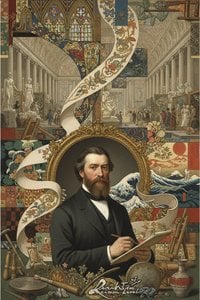
Ferdinand Birotheau, born in 1819 and passing in 1892, was a French portrait painter whose name, though perhaps not as widely celebrated as some of his contemporaries, resonates with a quiet dignity within the annals of 19th-century art. His life unfolded against the backdrop of a France undergoing significant social and political change, a period that subtly informed his artistic vision. While comprehensive biographical details remain elusive—a common fate for artists operating outside the most prominent Parisian circles—Birotheau’s surviving works reveal a dedicated craftsman deeply attuned to capturing the essence of Breton society and its clergy. He wasn't an innovator shattering conventions; rather, he was a skilled interpreter, meticulously rendering his subjects with a classical sensibility that prioritized likeness and character above all else.
Early Life and Artistic Formation
Details surrounding Birotheau’s early training are scarce. It is known that he developed a strong connection to Brittany, the northwestern region of France steeped in Celtic tradition and distinct cultural identity. This geographical and cultural affinity would become a defining characteristic of his oeuvre. Unlike artists who flocked to Paris for formal education at the École des Beaux-Arts, Birotheau appears to have honed his skills through independent study and direct observation. His early works suggest an absorption of academic principles—a focus on anatomical accuracy, balanced composition, and refined brushwork—but tempered with a uniquely regional sensibility. He wasn’t striving for grand historical narratives or allegorical statements; instead, he turned his attention to the people around him, particularly those within the Breton community. This choice speaks to a deliberate artistic direction, one rooted in portraying the everyday lives and faces of his surroundings.
The Portraiture of Breton Society
Birotheau’s reputation rests primarily on his portraits, which offer a fascinating glimpse into the social fabric of 19th-century Brittany. He became particularly sought after by members of the clergy and prominent figures within the region's administrative structures. His paintings are characterized by their meticulous detail—the precise rendering of fabrics, the subtle play of light across faces, and the careful attention to individual features. Portrait de Jules Jan, Directeur du Musée de Rennes, exemplifies this approach; it’s a compelling depiction of dignity and authority, capturing not merely the physical appearance of Jan but also his intellectual presence. Similarly, Portrait du Chanoine Duver showcases Birotheau's ability to convey the solemnity and gravitas associated with religious office. These are not flamboyant displays of wealth or power; they are intimate studies of character, revealing the inner lives of his sitters through subtle nuances of expression and posture.
Beyond Clergy: Exploring Diverse Subjects
While known for his clerical portraits, Birotheau’s artistic scope wasn't limited to religious figures. Works like La Marguerite, a Rococo-inspired portrait of a lady in elegant pink and gold, demonstrate his versatility and mastery of different stylistic approaches. This painting reveals a lighter, more decorative side to his talent, showcasing his ability to capture the grace and refinement of aristocratic society. He also produced self-portraits, offering valuable insights into his own appearance and artistic self-perception. These introspective works provide a rare glimpse behind the artist’s professional facade, revealing a thoughtful individual deeply engaged with his craft. The existence of nude studies, though less common in his overall body of work, further suggests a commitment to exploring fundamental principles of form and anatomy.
Legacy and Historical Significance
Ferdinand Birotheau's place within art history is not one of revolutionary change but rather of consistent quality and dedicated craftsmanship. He wasn’t seeking to redefine the boundaries of painting; he was focused on perfecting his technique and capturing the essence of his subjects with unwavering precision. His work serves as a valuable historical document, offering a nuanced portrait of Breton society during a period of significant transformation. His paintings are not merely representations of individuals but windows into a specific time and place, revealing the values, customs, and social hierarchies that shaped 19th-century Brittany. While his name may not be instantly recognizable to all, Birotheau’s legacy endures through the quiet dignity and enduring beauty of his portraits—a testament to the power of skilled observation and dedicated artistic practice.