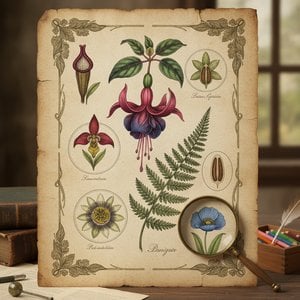
Top 3 works: Page from Principal Poisonous Plants of Canada; False Hellebore (leaf, flowers roots); Death Camas, Seed-vessels of Death Camas.
Art period: Modern
Works on APS: 1
Museums on APS: Canada Agriculture and Food Museum
Faith Fyles: Pioneer Botanist and Artistic Illustrator
Faith Fyles (1875–1961) stands as a singular figure in Canadian art history—a woman who simultaneously championed scientific rigor and artistic beauty, forging an unprecedented path for women in STEM fields during the early 20th century. Born September 30, 1875, in Cowansville, Québec, Fyles’s upbringing instilled within her a deep appreciation for both botany and visual arts—influences that would profoundly shape her lifelong dedication to documenting the natural world through meticulous illustration. Her journey began with a Bachelor of Arts degree from McGill University in 1900, earned under the mentorship of Professor Carrie Derick, another trailblazing botanist who recognized Fyles’s potential for scientific exploration and artistic expression.
Early Career & Education: Following graduation, Fyles pursued further studies focusing on Québec's flora and honed her artistic skills at the Québec Studio Club under Robert J. Wickenden. This formative period cemented her commitment to blending scientific observation with artistic interpretation—a combination that would define her distinctive style.
Service at the Experimental Farm: In 1909, Fyles joined the Department of Agriculture’s Seed Division, marking the commencement of a career dedicated to advancing agricultural knowledge and promoting botanical understanding. Her subsequent appointment as Assistant Botanist at the Central Experimental Farm in 1911 represented a pivotal moment—a rare opportunity for women to occupy positions traditionally held by men within scientific institutions.
Botanical Illustration: A Legacy of Detail and Accuracy
Fyles’s contribution to Canadian botany extended far beyond her administrative duties; she became renowned for her extraordinary botanical illustrations—a testament to her artistic talent and unwavering commitment to scientific precision. Recognizing the importance of visual representation in communicating complex scientific concepts, Fyles embarked on a mission to capture the essence of plant specimens with unparalleled accuracy and aesthetic appeal. Her watercolors, executed with painstaking detail, served as invaluable tools for researchers and educators alike, aiding in species identification and fostering a deeper appreciation for Canada’s diverse flora. Notably, she spearheaded the creation of “Principal Poisonous Plants of Canada,” a publication that cemented her reputation as a leading authority on plant toxicity—a project which showcased not only her scientific expertise but also her artistic prowess.
Notable Projects: Among Fyles's most significant achievements were her expeditions to western Canada and Shediac, New Brunswick, where she diligently collected specimens of weeds and indigenous plant species for the Botany Division. Her meticulous documentation of these plants—combined with her artistic renderings—contributed significantly to advancing botanical research and disseminating knowledge about Canadian ecosystems.
Recognition & Influence: Fyles’s work garnered considerable acclaim within the scientific community, demonstrating the transformative potential of combining artistic vision with scientific inquiry. Her illustrations appeared in publications such as “Cultivation of the Apple in Canada,” “Black or Stem-Rust of Wheat,” and “Beans,” furthering her impact on agricultural education and promoting a deeper understanding of plant pathology.
Faith Fyles’s influence transcended the realm of artistic illustration; she played an instrumental role in bolstering Canada's herbarium—a repository of plant specimens vital for taxonomic research and conservation efforts. Her dedication to preserving botanical heritage fueled her advocacy for expanding herbarium collections, recognizing their importance as resources for scientific discovery and safeguarding biodiversity. Furthermore, Fyles’s groundbreaking identification of a new fungal species—documented in the Wild Rice bulletin of 1920—underscored her commitment to advancing mycological knowledge and furthering our understanding of ecological interactions.
A Singular Achievement: The First Botanical Artist Employed by the Federal Government
Faith Fyles’s career represents a remarkable accomplishment—she was Canada's first botanical artist employed by the federal government, shattering gender barriers within STEM fields during her time. Her unwavering determination to pursue both scientific exploration and artistic expression served as an inspiration for aspiring women artists and scientists alike. Today, her legacy continues to resonate through the Beechwood Cemetery where she rests peacefully, a testament to a life dedicated to fostering botanical knowledge and celebrating the beauty of the natural world—a singular contribution to Canadian art history that deserves enduring recognition.
WahooArt.com 편집팀 작성
예술 상식 퀴즈
각 질문의 정답은 하나뿐입니다.
질문 1:
What was Faith Fyles’s primary role at the Canadian Federal Government, Department of Agriculture?
질문 2:
Where did Faith Fyles earn her Bachelor of Arts degree?
질문 3:
What publication is Faith Fyles particularly known for illustrating?
질문 4:
During her time at the Experimental Farm, what was Faith Fyles’s role regarding plant specimens?
질문 5:
What distinguished Faith Fyles’s artistic style compared to other artists of her era?
Discover the exquisite intersection of science and fine art. Explore the history of scientific illustration, from botanical watercolor masters to nature's intricate geometry, through an expert lens of art history and technical precision.
Discover the exquisite world of Victorian botanical art. Explore the intersection of scientific precision and luxury aesthetics through masterfully curated floral illustrations and hand-painted oil reproductions for discerning collectors and fine interiors.
Explore the exquisite intersection of science and art in botanical illustration. Discover the history, technical mastery, and timeless beauty of scientific floral studies from Renaissance masters to modern collectors.