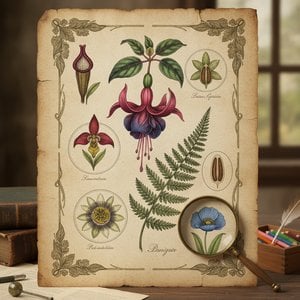
Elizabeth Colwell: A Victorian Vision of Floral Still Life
The world of 19th-century British art is often associated with grand landscapes and historical portraits, yet within this established canon resided a quietly remarkable talent – Elizabeth Colwell. Born in Bronson, Michigan, in 1881, she emerged as a master of the floral still life, capturing the delicate beauty of roses, primroses, and fruit with an exquisite attention to detail and a distinctly Victorian sensibility. Her work isn’t merely decorative; it's imbued with a profound appreciation for nature’s fleeting grace and a subtle exploration of color and texture that continues to resonate today.
Colwell’s artistic journey began in Chicago, where she studied at the School of the Art Institute. Crucially, her training extended beyond traditional painting techniques; she became deeply involved with Japanese woodblock printing under Bror Julius Olsson Nordfeldt, a technique that profoundly influenced her approach to composition and color harmony. This exposure to *ukiyo-e* aesthetics – characterized by bold outlines, flat planes of color, and a focus on capturing the essence of a subject – is evident in her later works, particularly in the careful arrangement of elements within her still lifes.
Her career unfolded during a period of significant change for women artists. While opportunities were limited, Colwell persevered, establishing herself as a respected printmaker and illustrator. She worked for publications like *The Blue Sky*, contributing illustrations and poetry, showcasing her versatility and artistic vision. Later in life, she found work with American Type Founders, designing the iconic Colwell Handletter typeface – a testament to her skill in typography and her understanding of visual communication. This design achievement solidified her place as one of the few female type designers recognized during that era.
The Language of Flowers
Colwell’s still lifes are not simply representations of flowers; they're carefully constructed narratives. Each arrangement is a deliberate meditation on beauty, fragility, and the passage of time. She meticulously observed the subtle variations in color, texture, and form – the velvety blush of a rose petal, the delicate veins of a leaf, the glistening surface of a fruit. Her brushstrokes are remarkably fine, creating an illusion of three-dimensionality that draws the viewer into the scene.
The choice of flowers themselves is significant. Roses, frequently depicted in her work, held symbolic weight within Victorian culture – representing love, beauty, and passion. Primroses, with their cheerful yellow hue, symbolized hope and new beginnings. Fruit, particularly apples and pears, often alluded to abundance, prosperity, and the cycle of life. Colwell’s ability to imbue these commonplace subjects with such profound meaning speaks to her deep understanding of both artistic technique and cultural context.
Her use of color is equally masterful. She favored a palette of muted tones – soft pinks, pale blues, and earthy greens – creating a sense of tranquility and intimacy. She skillfully employed *sfumato*—a subtle blending of colors to create atmospheric effects—to soften edges and suggest the play of light on surfaces. This technique contributes significantly to the luminous quality of her paintings.
A Legacy in Printmaking and Type Design
Beyond her celebrated floral paintings, Colwell’s contributions extend to the world of printmaking and typography. Her work as a woodblock printer demonstrated an exceptional command of color separation and registration—essential skills for creating intricate multi-colored prints. Her design of the Colwell Handletter typeface remains a significant achievement in American type design, showcasing her artistic sensibility and technical expertise.
Elizabeth Colwell’s life spanned nearly eight decades, witnessing profound social and technological shifts. Despite facing challenges as a woman artist in a male-dominated field, she maintained an unwavering commitment to her craft. Her legacy lies not only in the beauty of her floral paintings but also in her pioneering spirit and her enduring influence on both printmaking and typography. Her work continues to be exhibited and appreciated for its exquisite detail, evocative symbolism, and timeless appeal.
Notable Works
- Mixed Bouquet: /en/art/elizabeth-colwell-mixed-bouquet-AR23A2-en/ A vibrant example of her ability to capture the complexity and beauty of a diverse floral arrangement.
- Three Roses: /en/art/elizabeth-colwell-three-roses-AR239U-en/ Demonstrates her mastery of capturing delicate textures and subtle color variations in a single flower.
- A Bowl of Fruit: /en/art/elizabeth-colwell-a-bowl-of-fruit-AR239N-en/ Highlights her skill in still life composition and her ability to convey the richness and abundance of nature.
Historical Context
Elizabeth Colwell’s artistic career unfolded during the late 19th and early 20th centuries, a period marked by significant social and cultural transformations. The Victorian era, characterized by its emphasis on morality, domesticity, and sentimentality, profoundly influenced her aesthetic sensibilities. The rise of photography challenged traditional painting practices, prompting artists to explore new ways of representing reality. Simultaneously, the influence of Japanese art—particularly *ukiyo-e* prints—introduced novel compositional techniques and color palettes that resonated with many European artists.
Furthermore, Colwell’s journey as a female artist in a predominantly male field reflects broader societal challenges faced by women during this era. Despite limited opportunities and systemic biases, she persevered, demonstrating remarkable resilience and artistic talent. Her achievements serve as an important reminder of the contributions made by women artists throughout history.