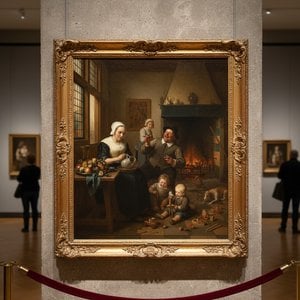
A Glimpse into the World of Dirck Craey
Dirck Craey, a name perhaps less celebrated than some of his Dutch Golden Age contemporaries, nevertheless occupies a fascinating niche in the history of portraiture. While biographical details remain somewhat elusive, the surviving body of work speaks volumes about an artist skilled in capturing not merely likenesses, but also the inner lives and social standing of his sitters. Born in the early 17th century – precise dates are currently unavailable – Craey flourished during a period of unprecedented artistic innovation and prosperity in the Netherlands. His paintings offer a window into the burgeoning middle class and the values they held dear: respectability, piety, and material comfort.
Early Life and Artistic Training
The specifics of Craey’s early life are shrouded in mystery. It is believed he received his artistic training within the established guild system prevalent in Dutch cities like Leiden or Amsterdam, though concrete evidence remains scarce. The influence of Rembrandt van Rijn is often detected in Craey's use of chiaroscuro – the dramatic interplay of light and shadow – suggesting a possible apprenticeship or at least a keen awareness of the master’s techniques. However, Craey developed a distinct style that moved away from Rembrandt’s psychological intensity towards a more refined and elegant portrayal of his subjects. He was clearly adept at rendering textures, particularly fabrics and jewelry, indicating access to quality materials and perhaps patronage from affluent clients early in his career.
Portraiture as Social Commentary
Craey's oeuvre is almost entirely dedicated to portraiture, a genre that thrived during the Golden Age due to the increasing wealth and self-awareness of Dutch society. His subjects are typically depicted in half-length or three-quarter length poses, often set against dark, neutral backgrounds which serve to emphasize their features and clothing. He wasn’t interested in grand historical narratives or mythological scenes; instead, he focused on the individual, meticulously documenting the fashions, hairstyles, and accessories of his time.
Portrait of a Woman, thought to be Catharina Kettingh (1626/27-73), Wife of Bartholomeus Vermuyden, painted in 1650, exemplifies Craey’s skill. The subject's gaze is direct and engaging, conveying a sense of intelligence and composure. The delicate rendering of her lace collar and the subtle sheen of her satin gown demonstrate his technical prowess. Beyond mere representation, these portraits served as statements of social status and marital fidelity – visual affirmations of the sitter’s position within the community.
Style and Influences
While acknowledging Rembrandt's impact on his early development, Craey carved out a unique artistic identity characterized by a more polished aesthetic. He favored a restrained palette, employing rich browns, blacks, and creams to create a sense of depth and realism. His brushwork is generally smooth and controlled, lacking the impasto textures often associated with Rembrandt or Frans Hals.
- Chiaroscuro: The use of dramatic light and shadow, inherited from Rembrandt, but employed in a more subtle manner.
- Refined Detail: A meticulous attention to detail, particularly in the rendering of fabrics, jewelry, and hairstyles.
- Compositional Simplicity: Portraits are typically set against dark backgrounds, focusing attention on the sitter.
Historical Significance and Legacy
Dirck Craey’s historical significance lies in his contribution to the tradition of Dutch portraiture. He wasn't a revolutionary innovator like Rembrandt or Vermeer, but he was a highly competent and sought-after artist who captured the spirit of his age with sensitivity and skill. His paintings provide valuable insights into the material culture, social customs, and psychological attitudes of 17th-century Netherlands. Though not as widely recognized today as some of his peers, Craey’s work continues to be appreciated for its technical mastery, elegant style, and evocative portrayal of a bygone era. The enduring appeal of his portraits lies in their ability to connect us with the individuals who once sat before him, offering a glimpse into their lives and aspirations across the centuries.